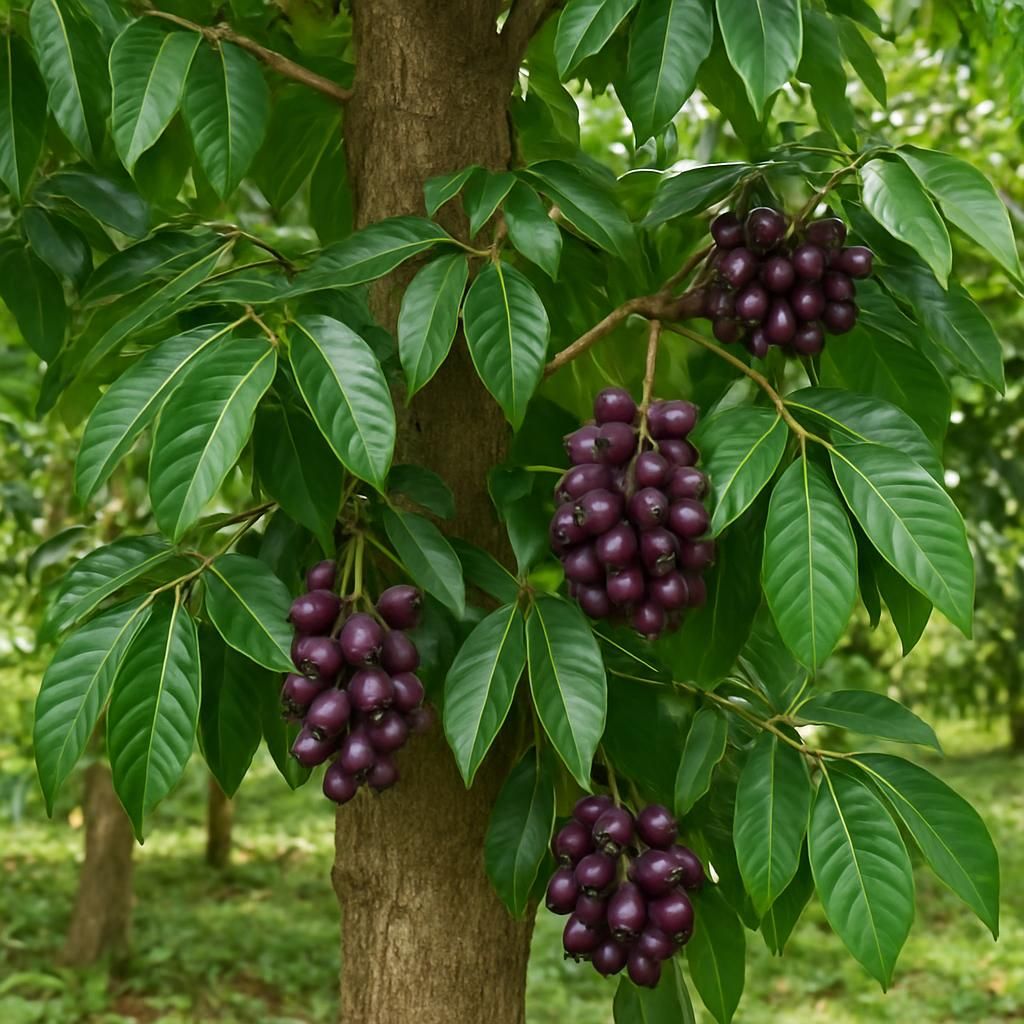
Introduction to Canarium indicum
Canarium indicum is a large, long-lived tropical tree that produces highly nutritious, oil-rich nuts valued across Melanesia and increasingly in international specialty markets. The tree is known locally as galip in Papua New Guinea and kenari in parts of Indonesia and the Solomon Islands. Its kernels are eaten fresh, roasted, or pressed for high-quality culinary oil, while the hard shells and timber provide additional economic value. Because the species is well-adapted to humid lowland environments and requires minimal inputs once established, it offers strong potential for sustainable agroforestry systems.
Botanical Profile of Canarium indicum
Canarium indicum belongs to the Burseraceae family and is characterized by a straight, cylindrical trunk that can reach 30–40 meters in height with a spreading crown. The compound leaves are glossy and dark green, typically arranged in 3–7 pairs of leaflets. Small, creamy-white flowers appear in axillary panicles and are primarily pollinated by insects. The fruit is a drupe with a hard, woody endocarp containing one to three oily kernels. Trees are dioecious, requiring both male and female individuals for reliable nut production.
Soil, pH, and Climate Requirements for Canarium indicum
Successful cultivation depends on well-drained, fertile soils in humid tropical climates. The species performs best at low to mid elevations with consistent rainfall and protection from strong winds.
| Parameter | Ideal Range | Notes |
|---|---|---|
| Soil Type | Deep, well-drained loam or sandy loam | Avoid heavy clay or waterlogged sites |
| Soil pH | 5.5 – 7.0 | Slightly acidic to neutral preferred |
| Annual Rainfall | 1500 – 3500 mm | Evenly distributed; short dry seasons tolerated once established |
| Temperature Range | 22 – 32 °C | Sensitive to frost; optimal growth above 20 °C |
| Elevation | 0 – 600 m | Performs well in coastal lowlands |
| Relative Humidity | 70 – 90 % | High humidity supports flowering and nut fill |
Step-by-Step Planting & Propagation
Propagation is most reliable from fresh seed collected from high-yielding mother trees. Seeds should be soaked in water for 24 hours, then sown in well-drained nursery media at 2–3 cm depth. Germination occurs in 3–8 weeks under 50 % shade. Seedlings are transplanted to the field at 6–12 months when they reach 50–80 cm. Grafting onto seedling rootstocks using side-wedge or approach grafts can be used to propagate superior female clones. Recommended spacing is 10–12 m between trees in monoculture or 8–10 m when intercropped with Coconut or other canopy species.
Care & Maintenance regimes for Canarium indicum
Young trees require regular weeding and mulching for the first three years. Mature trees need little irrigation but benefit from annual nutrient top-ups and selective pruning to maintain an open canopy.
| Practice | Frequency | Details |
|---|---|---|
| Watering | Weekly for first 2 years; then as needed | Deep watering during extended dry periods improves early survival |
| Fertilizer | Year 1–3: 200 g NPK 15-15-15/tree every 3 months; Year 4+: 1–2 kg/tree annually split into two applications | Use organic compost or well-rotted manure to improve soil biology |
| Pruning | Formative prune at 12–18 months; maintenance prune every 2–3 years | Remove dead wood and crossing branches after harvest to improve light penetration |
Pests, Diseases & Organic Management
Major pests include fruit flies, scale insects, and termite attack on young stems. Fungal issues such as anthracnose and Phytophthora root rot can occur in poorly drained soils. Integrated management relies on sanitation, sticky traps for fruit flies, neem-based sprays for scale, and improved drainage plus Trichoderma applications for root pathogens. Regular monitoring during flowering and fruit development is essential.
Harvesting, Curing & Optimal Storage
Nuts are harvested when the fruit husk turns dark purple and begins to split, typically 5–7 months after flowering. Whole fruits are collected from the ground or shaken from branches using long poles. After harvest, fruits are fermented 3–5 days to loosen the husk, then depulped and sun-dried for 5–7 days until kernel moisture reaches 8–10 %. Kernels are extracted by cracking the hard shell with a hammer or mechanical cracker. Store kernels in cool, dry conditions (below 15 °C and 60 % RH) in airtight containers for up to 12 months. Vacuum packing extends shelf life and preserves oil quality.
Companion Planting for Canarium indicum
Canarium indicum integrates well into multi-strata agroforestry systems. Compatible understory crops include Ginger, Turmeric, and Cacao which tolerate partial shade. Leguminous cover crops such as Pigeon pea and Gliricidia improve soil nitrogen and provide wind protection. Tall canopy species like Coconut or Banana can be planted at wider spacing to create a beneficial microclimate without excessive competition.