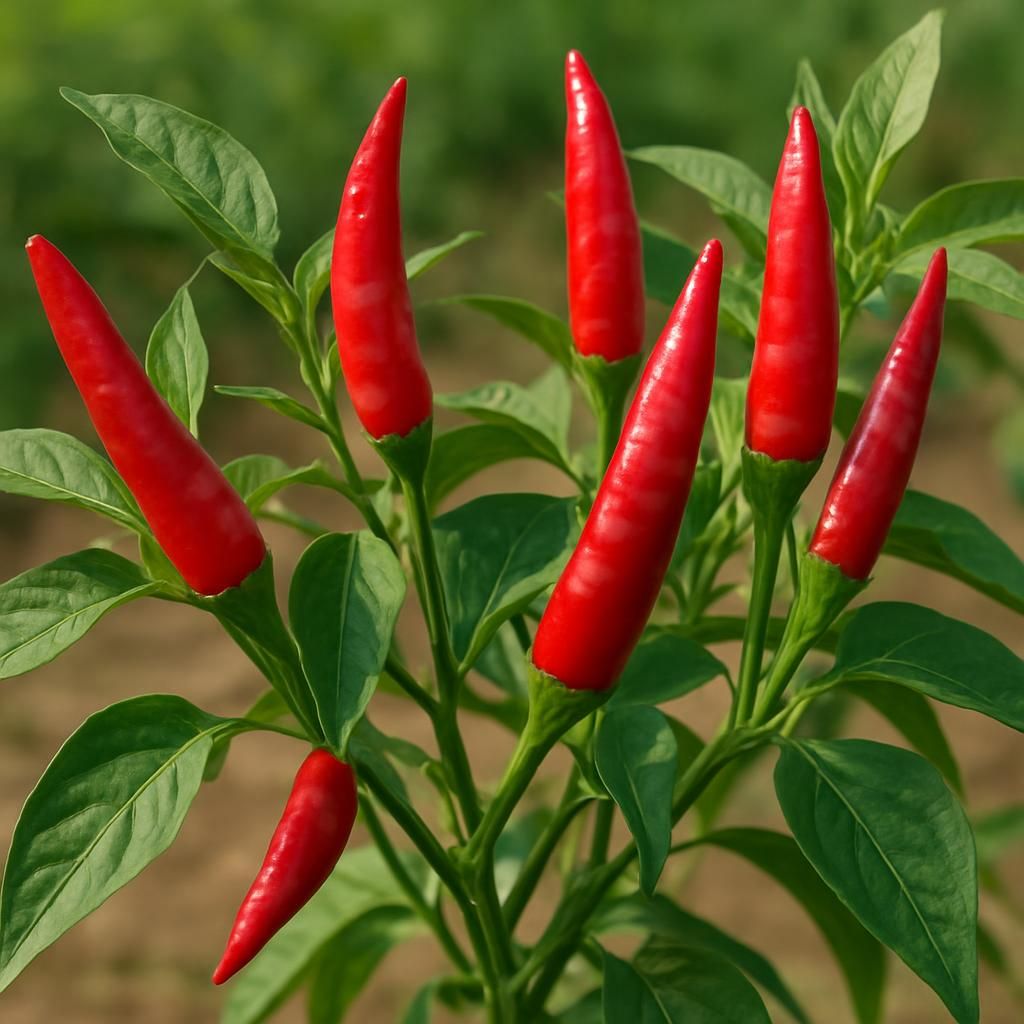
Introduction to Cabe Rawit
Cabe Rawit, also known regionally as bird’s eye chili, is a small-fruited Capsicum species that delivers exceptional pungency in a compact plant. Native to tropical regions, it has become a cornerstone crop for smallholder farmers and commercial growers alike because of its rapid maturation, continuous fruiting habit, and strong market demand for fresh, dried, and processed products. This guide provides detailed, field-tested recommendations for successful cultivation under both open-field and protected environments.
Botanical Profile of Cabe Rawit
Cabe Rawit belongs to the Solanaceae family. Plants are typically 40–80 cm tall with an upright, branching habit. Leaves are lanceolate, dark green, and slightly pubescent. Flowers are small, white to cream-colored with greenish-yellow anthers. Fruits are slender, 2–4 cm long, and ripen from green to bright red or orange-red. The Scoville heat rating commonly ranges from 50,000 to 175,000 SHU, making it significantly hotter than most bell peppers but milder than some super-hot varieties such as Ghost Pepper. Multiple fruiting flushes occur over a 6–9 month productive period when plants are well-managed.
Soil, pH, and Climate Requirements for Cabe Rawit
Cabe Rawit performs best in well-drained, fertile loam or sandy loam soils. Heavy clay soils must be amended with organic matter to improve aeration and drainage. The crop is highly sensitive to waterlogging, which quickly induces root rot.
| Parameter | Ideal Range | Notes |
|---|---|---|
| Soil Type | Sandy loam to loam | Avoid compacted or poorly drained soils |
| Soil pH | 5.8–6.8 | Slightly acidic to neutral; lime if below 5.5 |
| Temperature (Day) | 24–32 °C | Optimal growth and fruit set |
| Temperature (Night) | 18–24 °C | Below 15 °C slows growth and reduces yield |
| Relative Humidity | 60–80 % | High humidity favors disease; ensure airflow |
| Annual Rainfall | 1000–2000 mm | Supplemental irrigation required in dry periods |
| Altitude | 0–1500 m a.s.l. | Performs well across lowland to mid-hill zones |
Step-by-Step Planting & Propagation
- Seed Selection and Treatment: Source certified disease-free seed. Soak seeds in 1 % potassium nitrate for 24 hours to enhance germination.
- Nursery Preparation: Use sterilized seed trays or raised nursery beds with a 1:1:1 mix of cocopeat, compost, and perlite. Sow seeds 0.5 cm deep; maintain 28–30 °C and 80 % humidity. Germination occurs in 7–12 days.
- Seedling Hardening: Reduce water and expose seedlings to full sun 7–10 days before transplanting.
- Field Preparation: Incorporate 15–20 t ha⁻¹ well-rotted compost or farmyard manure. Form raised beds 20–25 cm high and 80–100 cm wide.
- Transplanting: Transplant 25–30-day-old seedlings at 40 × 50 cm spacing (double row) or 30 × 40 cm (single row) for high-density systems. Plant in the late afternoon and water immediately.
- Mulching: Apply 5–7 cm organic mulch (rice straw or coconut husk) to conserve moisture and suppress weeds.
Care & Maintenance regimes for Cabe Rawit
Consistent water and nutrient management, combined with timely pruning, are essential for sustained high yields.
| Growth Stage | Watering Frequency | Fertilizer Application | Pruning Action |
|---|---|---|---|
| Establishment (0–4 wk) | Light daily irrigation to keep soil moist | 10-10-10 NPK at 50 kg ha⁻¹ split into 2 doses | Remove lower leaves touching soil |
| Vegetative (4–8 wk) | 2–3 times weekly, 15–20 mm per event | 15-15-15 NPK 100 kg ha⁻¹; side-dress every 14 days | Pinch terminal shoots at 6–8 nodes to promote branching |
| Flowering & Fruiting (8–20 wk) | Every 3–4 days, avoid overhead wetting | High-K formula (12-6-22) 80 kg ha⁻¹ every 10 days; supplement with calcium nitrate | Remove diseased or shaded inner branches; thin excessive fruit clusters |
| Late Season (>20 wk) | Reduce to maintain 60 % field capacity | Foliar micronutrient mix (Mg, Zn, B) monthly | Light rejuvenation pruning after main flush |
Pests, Diseases & Organic Management
Major insect pests include Aphids, Thrips, Spider mites, and fruit flies. Common diseases are Anthracnose, bacterial spot, and Phytophthora root rot.
Organic control strategies:
- Install yellow sticky traps at 20–25 per 1000 m² for aphids and whiteflies.
- Release predatory mites (Phytoseiulus persimilis) at 2–5 per m² when spider mite populations exceed 5 per leaf.
- Apply neem oil (0.5 %) or spinosad (0.02 %) at 7–10 day intervals for thrips and caterpillars.
- Practice strict sanitation: remove and destroy infected plant debris.
- Use copper-based fungicides and Bacillus subtilis products for bacterial and fungal leaf spots.
- Maintain 30–40 cm plant spacing and good airflow to reduce humidity-driven diseases.
Harvesting, Curing & Optimal Storage
Harvest begins 60–75 days after transplanting when fruits reach full size and color. Pick every 3–5 days to encourage continuous production. For fresh market, harvest at mature green or turning stage. For drying, allow full red color development on the plant.
Post-harvest handling: Sort fruits to remove damaged or diseased pods. Dry in solar dryers or forced-air ovens at 45–50 °C until moisture content reaches 10–12 %. Store dried chilies in airtight containers or vacuum packs at 10–15 °C and <60 % RH. Properly cured product retains pungency and color for 9–12 months.
Companion Planting for Cabe Rawit
Cabe Rawit benefits from strategic companions that improve pest pressure, soil fertility, and microclimate. Recommended pairings include Thai Basil to repel aphids and thrips, Marigold for nematode suppression, and Coriander to attract beneficial insects. Avoid planting near Fennel which may inhibit growth. Intercropping with short-duration legumes such as Mung Bean provides nitrogen and ground cover. Rotate with non-solanaceous crops every two seasons to break disease cycles.
For further reading on resilient small-farm systems, see The Truth About Weather Patterns and Small Farm Resilience.