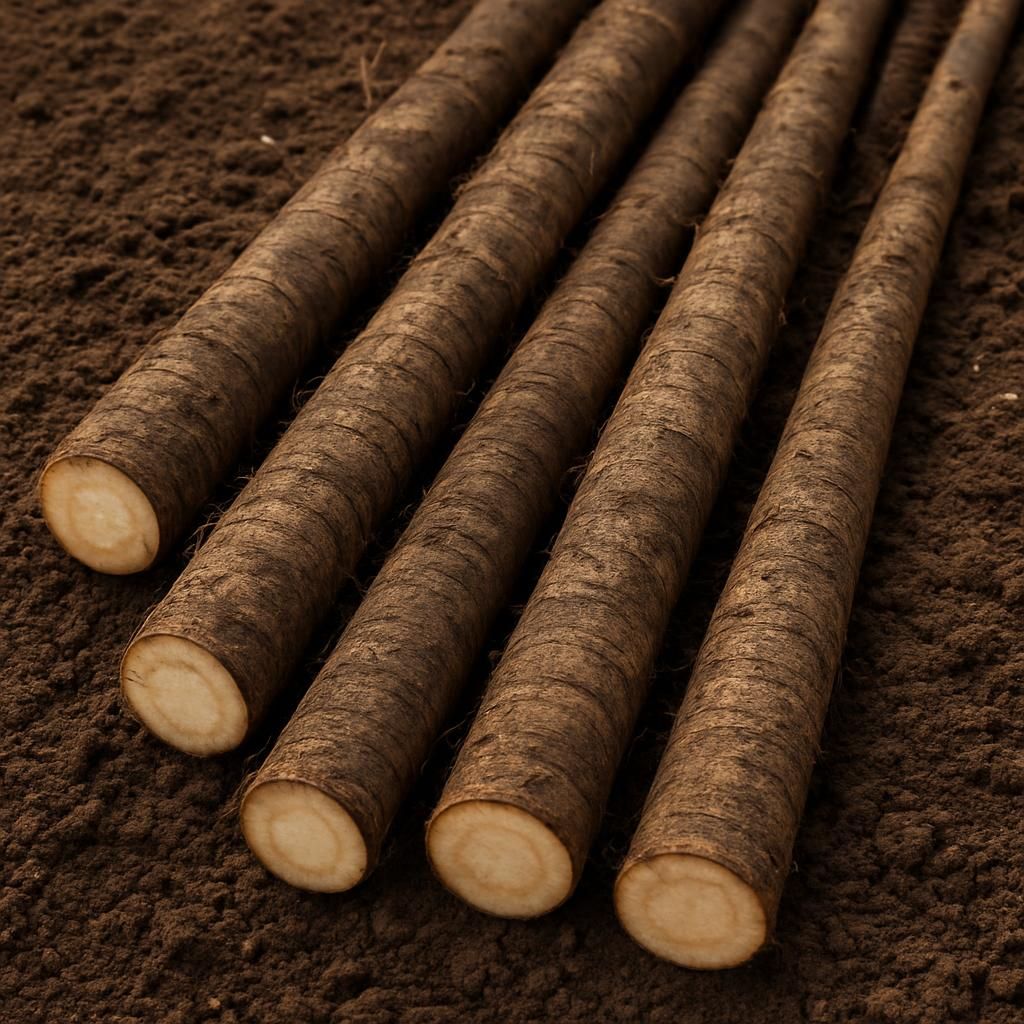
Introduction to Burdock (Gobo - Watanabe Early)
Burdock, known in Japan as gobo, is a biennial herb in the Asteraceae family whose edible taproot has been cultivated for centuries in East Asia. The Watanabe Early cultivar is specifically bred for commercial and home gardeners who need a quicker turnaround without sacrificing root length or quality. Its roots are typically harvested at 60–90 days, reaching 60–90 cm in length and 2–3 cm in diameter while remaining tender and low in fiber. In addition to its culinary value, burdock root is valued in traditional medicine for its inulin content and antioxidant properties. This guide provides professional-grade, field-tested recommendations for growing Watanabe Early burdock at commercial or serious home-garden scale.
Botanical Profile of Burdock (Gobo - Watanabe Early)
Watanabe Early produces a deep, fleshy taproot that stores carbohydrates as inulin rather than starch. The plant forms a basal rosette of large, cordate leaves with wavy margins during the vegetative stage. In its second year it sends up a tall, branched flower stalk bearing purple disc florets that attract pollinators. Because Watanabe Early is harvested for its root in the first season, flowering is rarely observed in production systems. The cultivar exhibits moderate cold tolerance and performs best when daytime temperatures remain between 15–22 °C.
Soil, pH, and Climate Requirements for Burdock (Gobo - Watanabe Early)
Burdock demands deep, friable soil free of stones and compaction to allow straight, unbranched roots. Heavy clay or shallow soils cause forking and reduce marketability.
| Parameter | Ideal Range | Notes |
|---|---|---|
| Soil Type | Sandy loam to loam | Minimum 60 cm depth; avoid compacted layers |
| Soil pH | 6.0–7.0 | Slightly acidic to neutral; liming if below 5.8 |
| Organic Matter | 3–5 % | Incorporate well-rotted compost or aged manure |
| Temperature (Day) | 15–22 °C | Optimal root elongation occurs in this range |
| Temperature (Night) | 8–12 °C | Cool nights improve sweetness |
| Frost Tolerance | Light frost (-2 °C) | Seedlings tolerate light frost; mature roots tolerate -5 °C |
| Rainfall / Irrigation | 25–40 mm per week | Consistent moisture prevents cracking |
Step-by-Step Planting & Propagation
- Site Preparation: Deeply till or double-dig the bed to 60 cm, removing stones and breaking up clods. Incorporate 5–7 cm of well-aged compost.
- Seed Treatment: Soak seeds in water for 12–24 hours to improve germination uniformity.
- Sowing Window: Direct sow in early spring (soil ≥10 °C) or late summer for fall harvest in temperate climates.
- Spacing: Sow seeds 1 cm deep in rows 45–60 cm apart. Thin seedlings to 10–15 cm in-row spacing once they reach 5 cm height.
- Succession Planting: Stagger sowings every 3 weeks to extend the harvest window.
Care & Maintenance regimes for Burdock (Gobo - Watanabe Early)
Consistent moisture and balanced nutrition are critical for straight, tender roots. Avoid high-nitrogen fertilizers after establishment to prevent excessive foliage at the expense of root development.
| Growth Stage | Watering Schedule | Fertilizer Schedule | Pruning / Other Tasks |
|---|---|---|---|
| Germination (0–14 days) | Keep top 5 cm moist daily | None; pre-plant compost supplies nutrients | Thin seedlings at 5 cm height |
| Vegetative (15–45 days) | 25–30 mm/week; drip irrigation preferred | Side-dress 20-10-20 NPK at 4 weeks (30 g/m²) | Weed regularly; mulch with 5 cm straw |
| Root Bulking (46–75 days) | Maintain even moisture; avoid water stress | Apply 10-20-20 at 6 weeks if leaf color pale | Hill soil lightly around crowns if exposed |
| Pre-Harvest (76–90 days) | Reduce water slightly 7 days before harvest | None | Remove any flowering stalks immediately |
Pests, Diseases & Organic Management
Burdock is relatively pest-resistant but can be affected by Aphids, Slugs, and Root-knot nematodes. Fungal issues such as Powdery mildew may appear in humid conditions. Use floating row covers at germination to exclude insects, and apply iron-phosphate slug baits as needed. Crop rotation with Onion or Garlic helps break nematode cycles. Maintain good airflow and avoid overhead irrigation to reduce foliar diseases.
Harvesting, Curing & Optimal Storage
Harvest when roots reach 60–90 cm and skin is still smooth (usually 60–90 days after sowing). Loosen soil with a fork inserted 30 cm from the row and lift carefully to avoid breakage. Trim tops to 2 cm, wash gently, and cure at 10–15 °C and 85–90 % RH for 3–5 days. Store at 0–2 °C and 90–95 % RH for up to 4 months. Vacuum-packed or pickled roots extend usability for culinary applications.
Companion Planting for Burdock (Gobo - Watanabe Early)
Burdock pairs well with deep-rooted companions that do not compete for surface nutrients. Carrot and Daikon radish can be interplanted in alternate rows. Aromatic herbs such as Thyme and Rosemary help deter aphids. Avoid planting near shallow-rooted leafy greens that may shade the developing rosette. For additional organic strategies, see Summer Companion Planting: 10 Organic Pairings to Boost Small Farm Resilience.