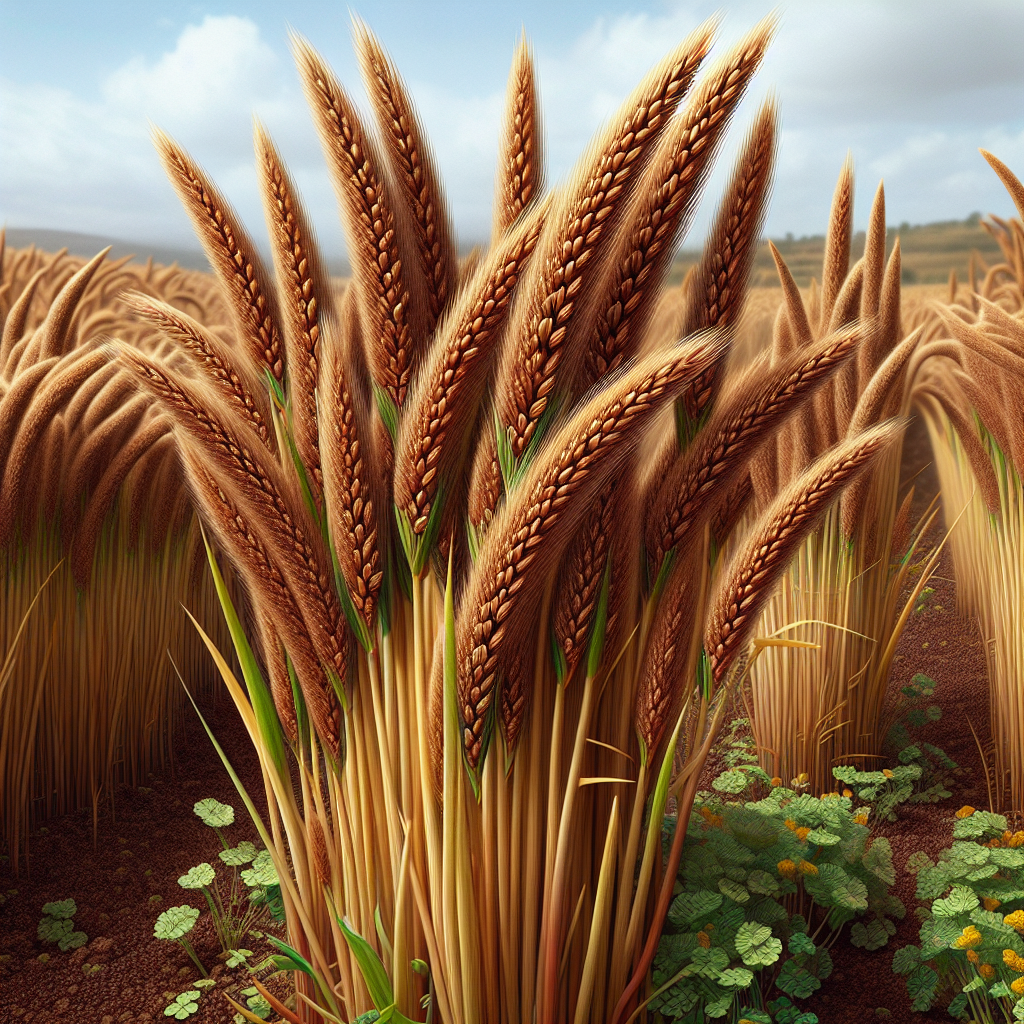
Introduction to Brown Teff
Brown Teff, a distinctive variety of Eragrostis tef, stands out with its deep reddish-brown seeds that offer a richer, earthier flavor profile compared to ivory or white teff types. Originating from the Ethiopian highlands over 5,000 years ago, it has been a dietary staple, forming the base of injera flatbread central to East African cuisine. This guide dives into the specifics of cultivating Brown Teff, highlighting its unique adaptability to poor soils, low water needs, and resilience against environmental stresses, making it a top choice for small-scale farmers seeking sustainable, gluten-free grain production. With global demand rising for superfoods, Brown Teff yields 1,000-2,500 kg/ha under optimal conditions, positioning it as a profitable crop for diverse climates.
Botanical Profile of Brown Teff
Brown Teff belongs to the Poaceae family, classified as Eragrostis tef (Zuccagni) Trotter, with the brown variety distinguished by its pigmented hull and seed coat rich in antioxidants like lutein and phenolic compounds. It is a warm-season annual C4 grass, growing to 30-120 cm tall with slender, tillering culms that produce 4-12 panicles per plant. Each panicle bears 200-400 tiny seeds (0.5-1.0 mm diameter, 1,000 seeds weighing 0.55-0.65g), enabling massive seed set—up to 5 million seeds per square meter. Botanically, it features a fibrous root system penetrating 1-1.5m deep, aiding drought resistance, and self-pollinating florets that ensure pure stands without isolation. Compared to Teff, Brown Teff has higher protein (11-13%) and fiber content, with a bran layer contributing to its nutty taste and darker hue post-harvest. Its short stature and fine leaves (5-8 mm wide) minimize lodging, even in winds up to 40 km/h.
Soil, pH, and Climate Requirements for Brown Teff
Brown Teff excels in well-drained loams or sandy loams with 1-2% organic matter, tolerating clay contents up to 35% but faltering in heavy, waterlogged soils where root rot sets in. Optimal pH ranges 5.5-7.5; below 5.0, aluminum toxicity stunts growth, while above 8.0, iron deficiency yellows leaves—test soil and amend with lime (1-2 t/ha) for acidic sites or sulfur for alkaline. It thrives in semi-arid to sub-humid climates with 400-1,000 mm annual rainfall, peaking at 20-30°C day/15-20°C night temperatures; frost below -2°C kills seedlings, so avoid planting before last frost. Drought tolerance shines with just 300 mm seasonal water, drawing from 1.2m soil depth via extensive roots. For irrigation, maintain 50-60% field capacity (volumetric water content 15-20%); overwatering above 70% causes lodging. In high altitudes (1,800-3,000m), it yields best, mimicking Ethiopian origins. See our Soil Health Mastery for enhancement tips.
Step-by-Step Planting & Propagation
- Seed Selection & Preparation: Source certified Brown Teff seeds (germination >85%) at 15-20 kg/ha for broadcast or 12 kg/ha drilled. Treat with thiram (2g/kg) against Damping-off; no priming needed due to rapid 3-5 day germination at 20-25°C.
- Land Preparation: Plow to 20-25 cm, disk twice for fine tilth (<2 cm clods), level with Cambridge roller to prevent air pockets. Incorporate 40-60 kg N, 20-40 kg P2O5, 20 kg K2O/ha pre-plant.
- Timing: Sow post-monsoon or early spring when soil >12°C; in tropics, June-July; temperate zones, April-May. Days to 50% emergence: 4-7.
- Sowing Methods: Broadcast uniformly, cover 0.5-1 cm deep (shallower in dry soils), roll lightly. For rows, space 20-30 cm apart, depth 1 cm. Inoculate seeds with Azospirillum (10g/kg) for 10-15% yield boost.
- Seeding Rate & Spacing: 15 kg/ha ensures 300-400 plants/m²; thin to 200/m² if overcrowded. Propagation is seed-only; no viable cuttings or division due to annual habit.
- Post-Sowing: Irrigate lightly (5-10 mm) if dry; mulch with straw (1 t/ha) suppresses weeds in first 2 weeks.
Care & Maintenance regimes for Brown Teff
Irrigate to 40-50 mm every 10-14 days pre-tillering, reducing to 20 mm at grain fill; signs of underwatering include rolled leaves and purple stems—target -0.3 to -0.5 bar soil moisture. Fertilize: split N (30 kg at tillering, 30 kg at panicle initiation); monitor with SPAD chlorophyll meter (>35 units). Weed manually or use pendimethalin (1 kg/ha pre-emerge); critical weed-free period is 20-40 DAS. Scout for N deficiency (yellow lower leaves) and apply urea foliar (2%). Maintain plant population by rogueing lodged tillers. Height management: no lodging risk below 90 cm, but dense stands (>500/m²) benefit from ethephon (250 ppm) at boot stage. Rotate with legumes every 2 years to fix N and break pests.
Pests, Diseases & Organic Management
Pests: African armyworm (Spodoptera exempta) defoliates—handpick eggs, spray neem oil (5 ml/L) at 10% infestation threshold. Shoot flies (Atherigona spp.) cause dead hearts—rogue 5-10% affected hills, use trichogramma parasitoids (20,000/ha). Birds target ripening grains—net or decoy. Diseases: Head smut (Ustilago spp.) blackens panicles—use resistant varieties, rotate, seed treatment with carboxin. Leaf rust (Uromyces eragrostidis)—neem + potassium phosphite sprays; remove infected debris. Damping-off (Pythium)—improve drainage, solarize soil 4 weeks pre-sow. Organic: Companion with Clover for N-fixation; trap crops like sorghum divert stem borers. BTK (Bacillus thuringiensis kurstaki) at 1 kg/ha for caterpillars. Maintain >20% ground cover to suppress weeds.
Harvesting, Curing & Optimal Storage
Harvest at 12-15% grain moisture (soft dough, 85-90% panicles golden-brown) using sickle or combine; direct-cut to minimize shattering (up to 20% loss if delayed). Yields peak 45-60 days post-flowering. Thresh gently (rubber beaters <500 rpm) to preserve tiny seeds; clean via air-screen (0.8 mm sieve). Dry to 10-12% MC in thin layers (5 cm) under shade (35-40°C, 3-5 days); solar dryers speed to 2 days. Store in hermetic bags or silos at <13% MC, 15-20°C, <65% RH—viable 2-3 years. Pests like weevils prevented by diatomaceous earth (2 kg/t) or phosphine fumigation.
Companion Planting for Brown Teff
Brown Teff pairs excellently with nitrogen-fixing legumes to enhance soil fertility without competing for light due to its tall, open canopy. Plant Clover as understory (5 kg/ha) for green manure, suppressing weeds and adding 40-60 kg N/ha. Intercrop with Chickpeas at 20x20 cm spacing, boosting total yield 15-20% via phosphorus mobilization. Lentils in 1:2 ratio provide ground cover, reducing evaporation by 25% in dry spells. Avoid tall cereals like Sorghum which shade and compete. Benefits include improved biodiversity, pest diversion, and sequential harvesting—clover post-teff grazing.