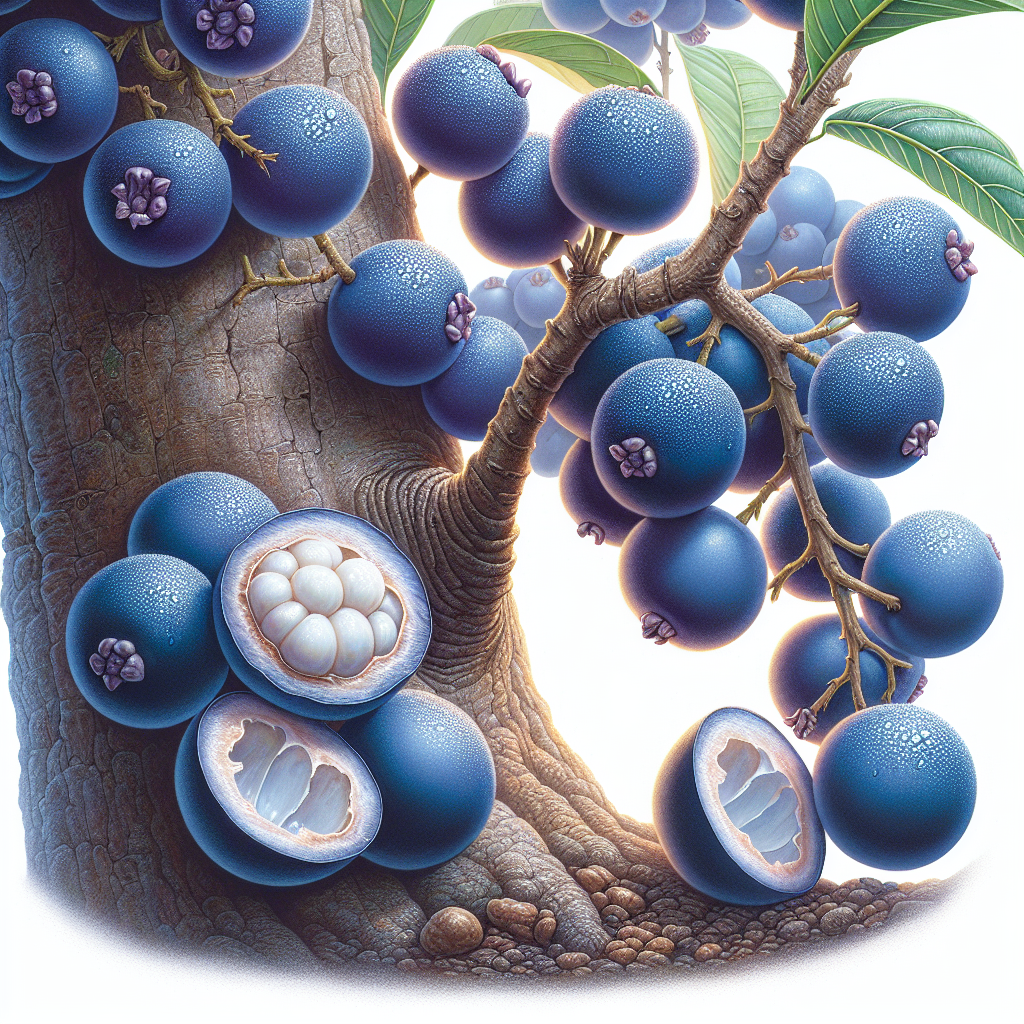
Introduction to Blue Jaboticaba (Myrciaria vexator)
Blue Jaboticaba, scientifically known as Myrciaria vexator, stands out among tropical fruit trees for its mesmerizing blue-hued fruits that emerge dramatically from the bark in dense clusters, creating a spectacle often called the 'tree grape.' Unlike its more common relative, the standard Jaboticaba (Myrciaria cauliflora), which bears dark purple-black fruits, Blue Jaboticaba offers a rarer, powdery blue-purple skin that encases juicy, white pulp with a grape-like snap and balanced sweet-tart profile. Originating from the Atlantic Forest regions of southeastern Brazil, this species has gained niche popularity among specialty fruit growers, permaculturists, and gourmet home gardeners seeking exotic, high-value crops.
The tree's cauliflorous habit—fruits sprouting directly from the trunk and older branches—makes it a conversation piece in any landscape while maximizing harvest accessibility without ladders. Fruits mature in 2-3 months after flowering, yielding 10-30 kg per mature tree annually under ideal conditions. Nutritionally, Blue Jaboticaba berries are packed with anthocyanins, vitamin C, and ellagic acid, positioning them as a superfruit for health-conscious markets. For small-scale farmers, its rarity commands premium prices at farmers' markets or for value-added products like jellies, liqueurs, and fresh exports. Successful cultivation requires mimicking its humid, subtropical native habitat, with protection from frost and wind. This guide equips growers with evidence-based strategies drawn from botanical research and field trials to achieve vigorous growth and prolific fruiting. Why Companion Planting Feels Like Guesswork for Small Farms - And How AI Makes It Foolproof
Botanical Profile of Blue Jaboticaba (Myrciaria vexator)
Myrciaria vexator belongs to the Myrtaceae family, closely related to guavas, eucalyptus, and common Jaboticaba. It is an evergreen tree reaching 4-8 meters in height at maturity, with a compact, rounded canopy supported by a sturdy trunk up to 30 cm in diameter. Leaves are opposite, lanceolate, 4-8 cm long, glossy dark green above and slightly pubescent beneath, providing year-round shade and aesthetic appeal.
Flowering occurs multiple times yearly in flushes, producing small, white, four-petaled blooms with numerous stamens clustered on lignified branches. Pollination is primarily entomophilous, relying on bees and native flies, though hand-pollination boosts set in low-pollinator areas. Fruits are berries 1.5-2.5 cm in diameter, with thin, waxy blue-purple skin that shifts from green to intense azure upon ripening. The translucent white pulp surrounds 1-4 small, hard seeds, delivering a flavor blending grape, blueberry, and lychee notes—sweet (12-16° Brix) with mild acidity.
Growth is slow initially (30-50 cm/year), accelerating to 60-90 cm/year post-establishment. Root systems are fibrous and shallow, extending widely for moisture uptake, making mulch essential. Compared to Myrciaria cauliflora, Blue Jaboticaba is slightly more cold-tolerant (down to 28°F/-2°C briefly) but demands higher humidity. Seed viability drops rapidly post-harvest, necessitating fresh propagation. In cultivation, grafted trees fruit in 3-5 years versus 8-10 for seedlings, inheriting scion traits like fruit size and color intensity.
Soil, pH, and Climate Requirements for Blue Jaboticaba (Myrciaria vexator)
Blue Jaboticaba flourishes in fertile, well-draining soils rich in organic matter, ideally sandy loam or clay loam with 5-10% organic content. Heavy clays lead to root rot, while pure sands demand frequent irrigation. Optimal pH is 5.5-6.8—mildly acidic to neutral—where iron and micronutrients remain available. Test soil annually; amend with pine bark, composted leaves, or peat to lower pH if above 7.0, or add dolomitic lime cautiously for alkalinity below 5.0.
Climate-wise, USDA zones 9b-11 are ideal, with average temperatures 18-28°C (65-82°F). It requires 1200-2000 annual chill hours below 20°C for flower induction but abhors frost; protect young trees with frost cloth during dips below 30°F/-1°C. High humidity (60-85%) is non-negotiable—arid regions need misting or micro-sprinklers. Annual rainfall of 1200-1800 mm, evenly distributed, suits it best; supplement with drip irrigation during dry spells, targeting 40-60 mm/week. Full sun (6-8 hours) promotes fruiting, though light shade tempers extreme heat. Windbreaks are crucial, as desiccating gusts cause leaf scorch and reduced set. In marginal climates, container culture in 50-100L pots with heated greenhouses extends viability.
Step-by-Step Planting & Propagation
Propagation
Seeds: Extract from ripe fruit, wash, sow immediately in 1:1:1 peat-perlite-vermiculite at 25-30°C. Germination in 20-40 days; success 70-90%. Pot up at 10 cm height.
Grafting: Cleft or veneer on Myrciaria cauliflora rootstock for vigor; 80% take in humid conditions.
Air-layering: Optimal on 2-3 year branches; roots in 8-12 weeks.
Planting
- Site prep: Dig 60x60x60 cm hole, fill with 40% compost, 30% topsoil, 30% sand. Mulch base.
- Timing: Early spring post-frost or rainy season.
- Spacing: 4-6 m apart for trees, 3 m for hedges.
- Planting: Position graft union 10 cm above soil. Water deeply.
- Staking: Support for 1-2 years against wind. Initial fertilizer: 10-10-10 NPK at 50g/tree, monthly first year.
Care & Maintenance regimes for Blue Jaboticaba (Myrciaria vexator)
Water: Deep soak weekly first 2 years, then biweekly; avoid waterlogging. Mulch 10 cm thick with organic matter to retain moisture.
Fertilization: Balanced 8-3-9 in growing season (Sep-Apr), 200g/tree mature. Foliar micronutrients (Fe, Zn, Mn) quarterly. Reduce N post-fruit set.
Pruning: Annual winter removal of deadwood, watersprouts; thin canopy for light penetration. Cauliflory benefits from trunk scarring lightly to stimulate flowering.
Weed control: Mulch suppresses; hand-pull competitors. Pest scouting: Weekly inspections. For heat stress, shade cloth during peaks >35°C. Read Soil Health Mastery: 5 Proven Strategies for Small Farms to Build Fertile Ground Without Breaking the Bank.
Pests, Diseases & Organic Management
Pests: Scale insects cluster on branches—neem oil 2% weekly. Mealybugs on new growth; alcohol sprays or ladybugs. Aphids; insecticidal soap. Fruit flies target ripe berries; kaolin clay barriers. Birds love fruits—netting essential.
Diseases: Phytophthora root rot from overwatering; improve drainage, use biofungicides like Trichoderma. Anthracnose causes fruit mummification; copper sprays pre-flower. Powdery mildew; sulfur-based organics. Avoid overhead watering. Rotate with guava companions. Cultural: Sanitize tools, remove debris.
Integrated: Beneficials like predatory mites, Bacillus thuringiensis for caterpillars. Threshold: Treat at 5% infestation.
Harvesting, Curing & Optimal Storage
Harvest when fruits fully blue, detach easily with gentle twist; 2-3 picks per flush. Yield peaks years 5-15. Handle delicately to prevent bruising.
Curing: Ripen off-tree 3-5 days at 20-25°C for peak flavor.
Storage: Fresh: 7-10 days at 10°C, 90% RH. Frozen pulp: 12 months at -18°C. Processed: Jams (pectin + sugar), wines (ferment pulp/skins). Dry skins for tea. Market unwashed clusters for shelf appeal.
Companion Planting for Blue Jaboticaba (Myrciaria vexator)
Pair with Thai Basil for pest repulsion, nitrogen-fixers like pigeon pea for soil enrichment. Underplant with pineapple for ground cover, suppressing weeds. Avoid water-hogging avocado nearby. Marigold deters nematodes. Benefits: Enhanced pollination, microclimate moderation, biodiversity boosting resilience.