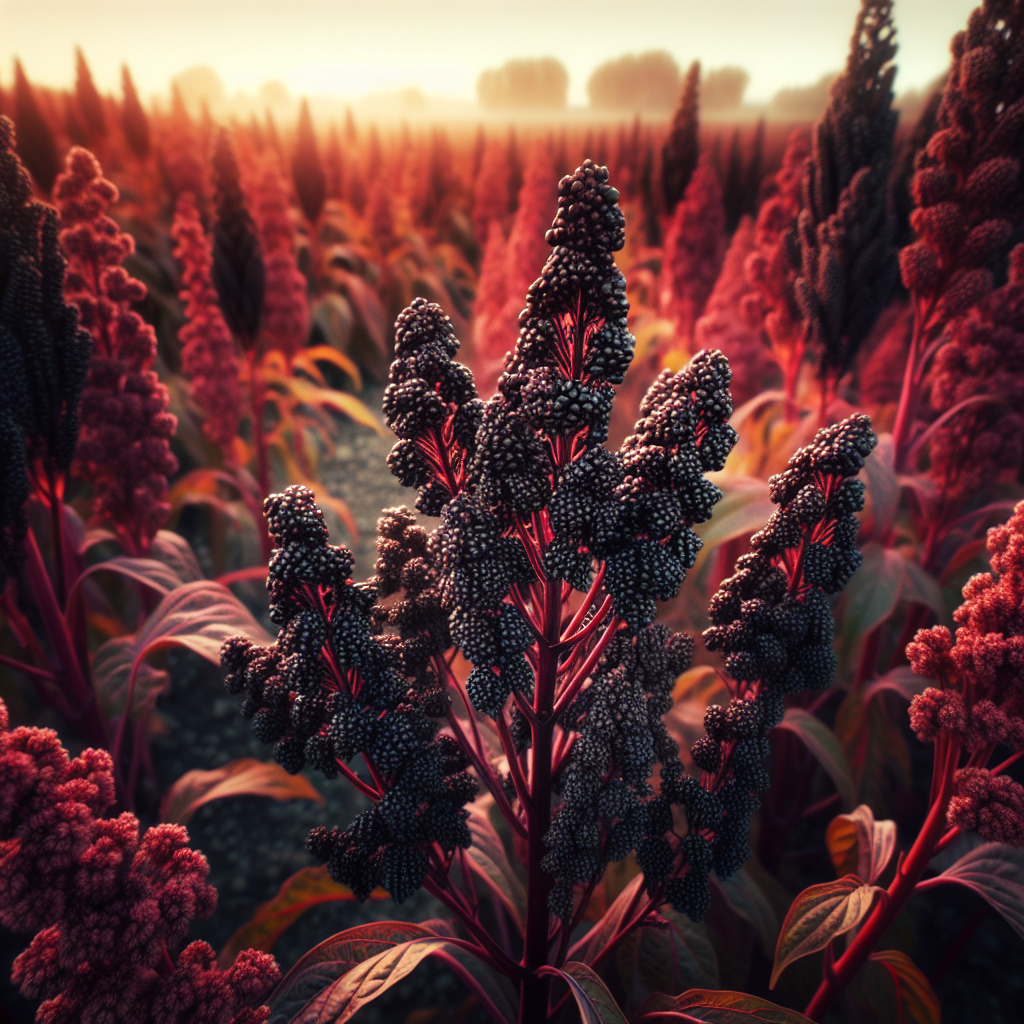
Introduction to Black Quinoa
Black quinoa is one of the colored seed types of Chenopodium quinoa, an ancient Andean crop domesticated thousands of years ago in the highlands of present-day Peru and Bolivia. Compared with white types, black-seeded quinoa usually has a slightly stronger, earthier taste, a firmer cooked texture, and often somewhat greater field resilience under marginal conditions. It is not a true cereal grass like wheat, but a broadleaf pseudo-cereal in the amaranth family, grown for its highly nutritious seed.
From a grower’s perspective, black quinoa is attractive because it tolerates poor soils better than many grain crops, handles light drought once established, and can fit into diversified small-farm systems. However, it is not a “plant it and forget it” crop. Its tiny seed, sensitivity to crusted soils during emergence, vulnerability to early weed competition, and susceptibility to lodging under excessive nitrogen mean that professional management matters. In warm, humid regions, disease pressure and uneven maturity can also become major constraints.
Black quinoa is especially well suited to temperate and semi-arid climates with cool nights, moderate daytime temperatures, and a relatively dry finishing period. The crop can perform from lowland farms to higher elevations, but its best grain quality generally comes from sites where flowering and seed fill occur without prolonged heat above 32 C (90 F). If you want a specialty grain with strong market appeal and manageable acreage requirements, black quinoa deserves serious consideration.
For broader soil-building principles before planting, see soil health strategies.
Botanical Profile of Black Quinoa
This crop belongs to the family Amaranthaceae and is closely related to beets, spinach, and lambsquarters. The species is extremely variable, which is one reason quinoa has adapted across wide geographies. Black quinoa is not a separate species; it is a seed-color class within Chenopodium quinoa, and cultivars marketed as black quinoa may differ in plant height, maturity, branching habit, and saponin level.
Plants typically range from 0.9 to 1.8 meters tall depending on genetics, fertility, and spacing. Stems are ribbed and can show green, red, or purple pigmentation. Leaves are broad and somewhat farinose when young, often triangular to lance-shaped, with varying degrees of serration. The inflorescence is a terminal panicle, though some cultivars also produce significant lateral panicles if spaced widely or if apical growth is disrupted.
Seed color in black quinoa is usually dark brown to nearly black rather than jet black. The pericarp may contain pigments that persist after harvest, giving the grain its market identity. Black types often mature a little more slowly than white quinoa and can hold texture better in cooking, which is desirable for grain bowls and pilaf-style uses.
Quinoa is predominantly self-pollinating, but some outcrossing occurs via wind and insects, so isolation matters if you are saving seed for varietal purity. The crop has a C3 photosynthetic pathway and performs best under cool to mild conditions. Germination is epigeal, and the seedling stage is delicate: a short period of surface drying can be tolerated, but crust formation, saturation, or heavy rain immediately after sowing may sharply reduce stand establishment.
One agronomic nuance is the crop’s similarity in juvenile stages to wild Chenopodium species such as lambsquarters. That resemblance can complicate roguing and seed purity. Seed producers should inspect leaf shape, stem color, growth uniformity, and eventual panicle form through the season to remove off-types before flowering if possible.
Soil, pH, and Climate Requirements for Black Quinoa
Black quinoa performs best in well-drained loam or sandy loam soils with moderate water-holding capacity and low compaction. It can grow in lighter or poorer soils better than many small grains, but yield and stand uniformity suffer in heavy clay that seals over after rain. A friable seedbed is essential because the seed is small and should not be buried deeply.
Ideal soil pH is about 6.0 to 7.5. The crop tolerates slightly alkaline soils better than many vegetables and often performs acceptably up to about pH 8.0 if drainage is good and micronutrient availability remains adequate. Below pH 5.8, watch for reduced vigor and possible nutrient imbalances, especially calcium and magnesium limitations or manganese toxicity in strongly acidic soils.
Black quinoa prefers cool-season establishment. Optimal germination usually occurs when soil temperatures are roughly 7 to 20 C (45 to 68 F), though emergence is fastest and most uniform closer to 10 to 18 C (50 to 64 F). Once established, vegetative growth proceeds well under daytime temperatures of 15 to 25 C (59 to 77 F). Repeated temperatures above 32 C during flowering can reduce pollen viability, seed set, and grain fill, especially if paired with hot, dry wind.
Rainfall needs are moderate. A total seasonal water supply of roughly 250 to 500 mm can be enough under field conditions, depending on soil type and evaporative demand. The most important moisture windows are germination, seedling establishment, stem elongation, flowering, and early grain fill. After physiological maturity approaches, drier weather is an advantage because it reduces sprouting risk, lodging, and harvest delays.
Despite quinoa’s reputation for drought tolerance, that trait is often misunderstood. Established plants can survive dry periods by reducing growth and shedding lower leaves, but drought during flowering and seed set still cuts yield significantly. On the other hand, chronically wet soil is usually more damaging than moderate drought. If the root zone stays saturated for more than 48 hours in warm conditions, expect yellowing, slowed growth, and possible root decline. Overwatered plants often show dull, pale leaves, lower leaf drop, and a soft, lush canopy that later lodges.
Wind exposure matters. Tall, heavily fertilized stands are prone to leaning or stem breakage, especially on fertile ground. Choose a site with good air movement but not extreme funneling winds. Full sun is essential; shaded stands elongate, branch unevenly, and yield poorly.
Step-by-Step Planting & Propagation
Propagation is by seed. Transplanting is technically possible in small-scale research or garden settings, but it is rarely efficient for grain production because quinoa develops best from direct sowing.
Select clean, adapted seed. Use seed from a reliable source with known days to maturity suitable for your frost-free window. Black quinoa lines vary widely; in cooler areas, prioritize earlier-maturing strains.
Prepare a fine, firm seedbed. The top 2 to 3 cm of soil should be crumbly, level, and free of large clods. A boot heel should leave a shallow imprint without sinking deeply. If the surface powders excessively, a light pre-irrigation followed by shallow finishing can improve seed-soil contact.
Control weeds before sowing. Because seedlings are not highly competitive in the first 3 to 5 weeks, stale seedbed techniques are useful. Encourage a flush of weeds with irrigation or light rain, then terminate them shallowly before planting.
Time sowing carefully. Sow in early spring once severe frost risk has passed and soil is workable, but while temperatures are still cool. In mild winter climates, late winter to early spring sowing can be effective. Avoid planting so late that flowering lands in midsummer heat.
Set seeding depth shallow. Plant 0.6 to 1.3 cm deep. In heavier soils, stay closer to 0.6 cm; in sandy soils, up to 1.5 cm may work if moisture is adequate. Deeper sowing often causes weak or failed emergence.
Use appropriate spacing. For drilled grain production, rows 20 to 30 cm apart are common, aiming for a final stand of roughly 80 to 150 plants per square meter depending on cultivar vigor and expected rainfall. In wider-row systems for mechanical cultivation, use 45 to 75 cm rows and thin within-row spacing to 10 to 20 cm. Dense stands suppress weeds better, while wider spacing improves airflow and individual plant branching.
Irrigate lightly after sowing if needed. The goal is to moisten the top 2 to 4 cm of soil without causing crusting. If using overhead irrigation, apply enough to settle the seedbed but not enough to puddle the surface.
Monitor emergence closely. Seedlings usually appear in 4 to 10 days in favorable temperatures. A successful stand should emerge uniformly with stout hypocotyls and upright cotyledons. Patchy emergence often points to crusting, planting too deep, seed rot, or drying of the topsoil.
Thin if necessary. In garden or small-block production, thin overcrowded seedlings once they reach 5 to 8 cm tall. Crowded plants become spindly and more disease-prone.
Rogue off-types early if saving seed. Remove plants that are unusually tall, late, heavily pigmented in the wrong pattern, or obviously different in leaf or panicle form.
Care & Maintenance regimes for Black Quinoa
Successful black quinoa production depends on disciplined early management and restrained fertility. The crop does not reward excessive feeding the way corn or brassicas might. Too much nitrogen produces lush growth, delayed maturity, and lodging rather than grain.
Water management: Keep the seed zone consistently moist until emergence. After establishment, aim for even but not excessive soil moisture in the upper 15 to 30 cm of root zone. In practical terms, the soil should feel slightly cool and cohesive when squeezed, not sticky or waterlogged. During vegetative growth, allow the top few centimeters to dry somewhat between irrigations to encourage rooting, but do not let plants wilt repeatedly. During flowering and early seed fill, avoid moisture stress; even short droughts at this stage can reduce panicle seed density. Reduce irrigation as seed hardens and foliage begins to senesce. By late maturity, watering should stop unless severe drought is causing premature stem death before seed finishes.
Signs of underwatering: dull gray-green leaves, midday wilting that persists into evening, rapid lower leaf senescence, shortened plants, and sparse seed set. Signs of overwatering: yellow lower leaves, soft lush stems, slow growth despite wet soil, root-zone odor, lodging, and in some cases reddish or purplish stress coloration unrelated to cool weather.
Fertility: Quinoa often does well on moderate fertility. As a general field target, total available nitrogen in the range of 40 to 90 kg/ha is often sufficient, with the lower end favored on fertile soils or in dryland systems. If soil organic matter is high or a legume crop preceded quinoa, reduce supplemental nitrogen further. Excess nitrogen causes tall plants with weak stems and delayed panicle dry-down. Phosphorus and potassium should be corrected according to soil tests; quinoa needs adequate phosphorus for early rooting and potassium for stem strength and stress tolerance. Sulfur and boron may matter on deficient soils, but apply only according to test results.
Weed control: This is the single most important maintenance task early on. The first month after emergence is the critical weed-free period. Tiny seedlings compete poorly with fast annual weeds, especially pigweed, lambsquarters relatives, mustard species, and grasses. Use shallow mechanical cultivation in wider rows, hand hoeing in small plots, or dense stand establishment in drilled fields. Never cultivate deeply near established plants, as quinoa roots are relatively shallow in the upper profile.
Hilling and support: In windy areas or fertile soils, a light hilling pass can brace stems in wider-row systems. This is most useful when plants are 15 to 25 cm tall. Heavy support systems are usually impractical for field grain but may help in demonstration plots.
Temperature protection: Young plants tolerate light frost better than flowering plants tolerate heat. A mild frost may only scorch leaf tips, while heat during anthesis can sharply cut yield. If your region has erratic spring weather, early sowing is generally safer than late sowing so long as the soil is not cold and saturated.
Crop rotation: Rotate away from closely related species such as beets and spinach when disease pressure is known, and avoid planting after heavily manured crops that leave excessive residual nitrogen.
Pests, Diseases & Organic Management
Black quinoa is often less pest-ridden than many vegetable crops, but it is far from immune. Pressure varies strongly by region, surrounding vegetation, and seasonal humidity.
Birds: In many areas, Birds are the most economically significant “pest,” especially as seed matures and panicles dry. Flocks can strip exposed heads quickly. Use reflective tape, netting for small plantings, auditory deterrents, and synchronized harvest timing. Border trap plantings of sunflower may distract some bird species, though this is not foolproof.
Aphids: These may colonize stems and panicles during lush vegetative growth, especially under high nitrogen. They rarely destroy the crop directly but can distort growth and encourage sooty residues. Encourage predators such as lacewings and lady beetles, avoid overfertilization, and use insecticidal soap only when populations are building on young panicles.
Leaf miners and Flea beetles: Usually cosmetic in low numbers, but severe seedling feeding can reduce stand density. Row covers can protect small plantings during establishment. Once plants are larger, they usually outgrow moderate damage.
Cutworms and Seedling pests: These are sporadic but serious where previous vegetation was not well managed. Scout at dusk if seedlings are being clipped. Collars, baiting, or habitat disruption before sowing can reduce losses in small-scale systems.
Downy mildew: One of the most important diseases of quinoa, especially in cool, humid weather. Symptoms include pale angular lesions on upper leaf surfaces and grayish-purple sporulation beneath. Severe infections reduce photosynthesis and seed fill. Prevention is more effective than treatment: use airflow-promoting spacing, avoid overhead irrigation late in the day, rotate fields, destroy volunteer plants and related weeds, and select tolerant seed where available.
Damping-off and Root rots: Poor drainage and cold wet soils favor seedling collapse. Avoid overwatering, sow into warm-enough soils, and use only high-quality seed. Raised beds or ridges can help in marginally drained sites.
Powdery mildew and Leaf spots: More common late in the season when canopies are dense and airflow is poor. Moderate infection near maturity is often tolerable, but early severe outbreaks reduce yield. Manage with spacing, nutrition balance, and sanitation.
Stem lodging and physiological disorders: Not a pathogen, but often confused with disease. Lodging usually results from high nitrogen, dense shade-like growth, strong wind, or late irrigation. Correcting fertility and water timing is more effective than any treatment.
Organic management depends on prevention: clean seed, crop rotation, weed control, moderate fertility, and canopy dryness. Remove nearby volunteer chenopods and lambsquarters when practical because they can harbor pests and diseases and complicate field sanitation.
Harvesting, Curing & Optimal Storage
Harvest timing is critical because black quinoa often ripens unevenly across the panicle and among branches. Wait until the majority of seeds are hard and cannot be dented easily with a fingernail. Leaves should be mostly dropped, stems beginning to dry, and panicles shifting from pliable to more brittle. Seed moisture at direct combine harvest is often targeted around 12 to 15%, though slightly higher moisture may be acceptable if you have prompt drying capacity.
In small-scale production, one practical indicator is to rub a panicle between the hands: mature seed threshes relatively easily, while immature seed remains soft or smears. Another clue is color stability; black seed should be fully dark and firm, not greenish or translucent.
Harvest methods:
- For hand harvest, cut plants or panicles when 70 to 90% of seed is mature, then bundle and dry under cover.
- For mechanized harvest, swathing can improve uniform dry-down where maturity is uneven, though it increases weather risk if rain follows.
- Direct combining works best in dry climates with uniform stands and even maturity.
Curing and drying: After cutting, dry material in a well-ventilated, shaded, low-humidity area. Do not pile deeply while stems are still green, as heating can discolor seed and encourage mold. Spread panicles thinly on screens or hang small bundles upside down with airflow. Target seed moisture below 10% for medium-term storage and closer to 8 to 9% for long-term storage.
Threshing and cleaning: Thresh once stems are crisp and seed separates readily. Small batches can be rubbed, flailed gently, or processed with a small thresher. Winnow carefully because quinoa seed is small and can blow away with excessive airflow. Final cleaning with screens helps remove chaff, immature seed, and weed seed contamination.
Saponin note: Many quinoa types contain saponins on the seed coat, though levels vary. Black quinoa may require rinsing or abrasion before food use depending on cultivar. This is a post-harvest processing issue rather than a storage issue, but growers selling direct should know whether their strain is sweet or bitter.
Storage conditions: Store fully dried seed in airtight containers or grain-safe bags in a cool, dark, dry environment. Ideal storage temperature is below 15 C (59 F), with low relative humidity. If seed is intended for planting, protect it from temperature swings and condensation. Insects are less of a problem in very dry seed, but periodic inspection is still wise. Properly dried grain can remain sound for a year or more; seed intended for sowing is best used within one to two seasons depending on storage quality.
Companion Planting for Black Quinoa
In diversified systems, black quinoa benefits most from companions that support pollinators and beneficial insects, reduce wind stress, or occupy adjacent zones without overwhelming young seedlings. Because quinoa is not highly competitive early, companions should not be allowed to shade or crowd it during establishment.
clover is useful as a managed living mulch in pathways or between wider rows, especially when mowed low. It helps protect soil, supports beneficial insects, and contributes nitrogen over time, but it must be controlled so it does not compete for moisture while quinoa is young. Low-growing clover works better in lower-rainfall systems than vigorous upright legumes.
thyme and yarrow are especially valuable along borders rather than inside dense production rows. Their flowers attract parasitoid wasps, hoverflies, and predatory insects that help moderate aphid populations. They also fit well in market garden layouts where quinoa is grown in blocks rather than broadacre fields.
sunflower can serve as a wind filter or visual barrier on the edge of a planting, but place it so it does not cast significant shade over the crop. In some systems it may also concentrate bird activity away from quinoa panicles, though in other settings it can attract more Birds overall. Observe local behavior before relying on it.
Avoid aggressive companions that spread quickly, climb, or require frequent irrigation. Quinoa prefers a relatively dry canopy and open airflow, so lush intercrops can increase disease risk. The best companion strategy is usually border planting and managed adjacent strips rather than true intercropping inside the stand.