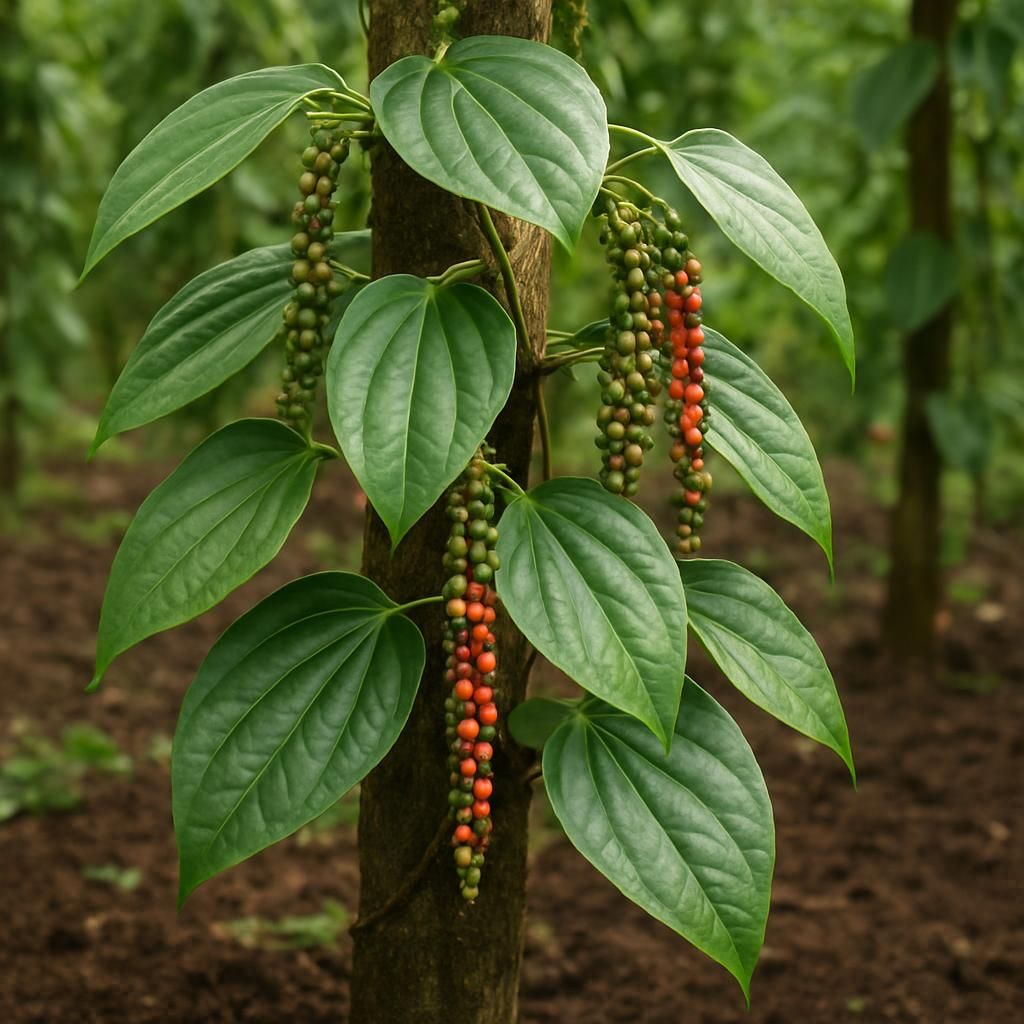
Introduction to Black Pepper (Lampong)
Lampong black pepper is a globally recognized variety of Black Pepper originating from Indonesia’s Lampung province. It is celebrated for its high piperine content (typically 5–7%), intense pungency, and robust aroma, making it a favorite among spice traders and gourmet kitchens. Commercial growers value Lampong pepper for its consistent berry size, dark color after curing, and strong market demand in both whole and ground forms. Successful cultivation demands tropical climates, well-drained soils, and long-term vine management on living or dead supports.
Botanical Profile of Black Pepper (Lampong)
Piper nigrum is a woody, perennial climbing vine belonging to the Piperaceae family. Lampong selections typically exhibit vigorous growth, reaching 4–6 meters when trained on supports, with heart-shaped, alternate leaves 8–12 cm long. The plant produces pendulous spikes (catkins) 7–12 cm long bearing 50–150 tiny flowers that develop into single-seeded drupes. These drupes mature from green to red and are harvested at different stages to produce green, black, or white pepper. The root system is shallow and fibrous, making the crop sensitive to both drought and waterlogging.
Soil, pH, and Climate Requirements for Black Pepper (Lampong)
Lampong black pepper thrives in deep, fertile, well-drained loamy soils rich in organic matter. The crop performs best on slopes or raised beds to prevent water stagnation around the shallow roots.
| Parameter | Ideal Range | Notes |
|---|---|---|
| Soil Type | Sandy loam to clay loam | High organic matter (3–5%) preferred |
| Soil pH | 5.5 – 6.5 | Slightly acidic; avoid saline or alkaline soils |
| Temperature | 20–34 °C (day); 18–24 °C (night) | Sensitive to frost and prolonged >38 °C |
| Annual Rainfall | 2000–3000 mm | Even distribution; supplemental irrigation in dry periods |
| Relative Humidity | 70–90% | Critical during flowering and fruit set |
| Altitude | 0–1200 m | Lower elevations produce higher yields |
| Sunlight | Partial shade (30–50%) | Shade nets or intercrops provide protection |
Step-by-Step Planting & Propagation
Lampong black pepper is almost exclusively propagated vegetatively using 3–5 node cuttings taken from healthy, high-yielding mother vines. Select semi-hardwood cuttings 30–40 cm long from the basal portion of 2–3 year-old vines during the monsoon season. Treat cuttings with a rooting hormone (IBA 1000 ppm) and plant in polybags filled with a 1:1:1 mix of topsoil, sand, and well-rotted FYM. Maintain 70–80% humidity under shade until roots develop in 6–8 weeks. Field planting occurs at the start of the rainy season. Dig pits 60 × 60 × 60 cm, fill with topsoil mixed with 10 kg FYM and 500 g neem cake. Plant one rooted cutting per pit at the base of a living standard (Gliricidia or Erythrina) or a 3 m concrete/wooden post. Initial spacing is 2 m × 2 m for high-density systems or 3 m × 3 m for traditional gardens. Mulch immediately with 10–15 cm of organic material and provide temporary shade for the first 4–6 weeks.
Care & Maintenance regimes for Black Pepper (Lampong)
Young vines require regular training to the support, removal of unwanted shoots, and protection from direct sun. Mature vines need annual pruning after harvest to encourage lateral branching and maintain an open canopy. Fertilizer application follows a split schedule aligned with rainfall and growth flushes.
| Operation | Schedule | Details |
|---|---|---|
| Irrigation | Every 7–10 days in dry season | 20–30 L per vine; drip irrigation preferred to avoid foliar wetting |
| Fertilizer (NPK) | 3 splits: May, August, November | Year 1: 50 g N, 30 g P₂O₅, 60 g K₂O per vine; increase annually to 200:100:200 g by year 5 |
| Organic Manure | Twice yearly (pre-monsoon & post-monsoon) | 10–15 kg well-rotted FYM + 1 kg neem cake per vine |
| Micronutrients | Foliar every 60 days | ZnSO₄ 0.5% + Borax 0.2% + MgSO₄ 1% during flowering |
| Pruning | After each harvest (Dec–Jan) | Remove dead wood, water shoots, and thin dense laterals to 8–10 productive branches |
| Mulching | Renew twice yearly | 10 cm layer of coconut husk, leaf litter, or wood chips to conserve moisture |
| Weed Control | Manual or glyphosate spot treatment | Maintain 1 m weed-free circle around each vine; intercrop with Clover or Thyme for living mulch |
Pests, Diseases & Organic Management
Lampong pepper is susceptible to several insect pests and soil-borne pathogens. The most damaging include scale insects, mealybugs, and root-knot nematodes. Fungal issues such as Phytophthora foot rot, Fusarium wilt, and anthracnose can cause significant losses if drainage is poor.
Organic Management Strategies:
- Use disease-free planting material and resistant rootstocks where available.
- Apply 2–3 kg Trichoderma viride + Pseudomonas fluorescens per vine annually mixed with FYM.
- Install yellow sticky traps and release Cryptolaemus montrouzieri for mealybug control.
- Practice crop rotation with non-hosts and solarize soil before replanting.
- Maintain strict sanitation by removing infected plant debris and pruning affected branches.
- Apply neem oil (3%) or garlic-chili extract sprays every 15 days during high pest pressure.
Harvesting, Curing & Optimal Storage
Lampong vines begin bearing from the third year, reaching full production by year 7–8. Harvest occurs when 1–2 berries on each spike turn red-orange, typically December to March in Indonesia. Hand-pick entire spikes to avoid damage. For black pepper, sun-dry whole spikes 4–6 days until moisture drops to 10–12%, followed by threshing and further drying to 8–10%. White pepper is produced by soaking ripe berries 4–6 days to remove the pericarp, then drying the seeds. Store cured peppercorns in clean, food-grade jute or multi-wall paper bags with 8–10% moisture at 10–15 °C and 60% RH. Properly stored Lampong pepper retains quality for 18–24 months. Avoid plastic bags that promote condensation and mold.
Companion Planting for Black Pepper (Lampong)
Strategic companion planting improves microclimate, soil health, and pest regulation. Gliricidia and Sesame are widely used as living standards and nutrient cyclers. Interplanting with Marigold or Nasturtium repels nematodes and aphids while providing ground cover. Leguminous cover crops such as Pigeon pea or Clover fix nitrogen and reduce soil erosion on slopes. Avoid heavy feeders like Corn or Banana that compete for light and water. Maintain a 1 m buffer between pepper vines and tall companions to prevent shading during critical flowering periods.