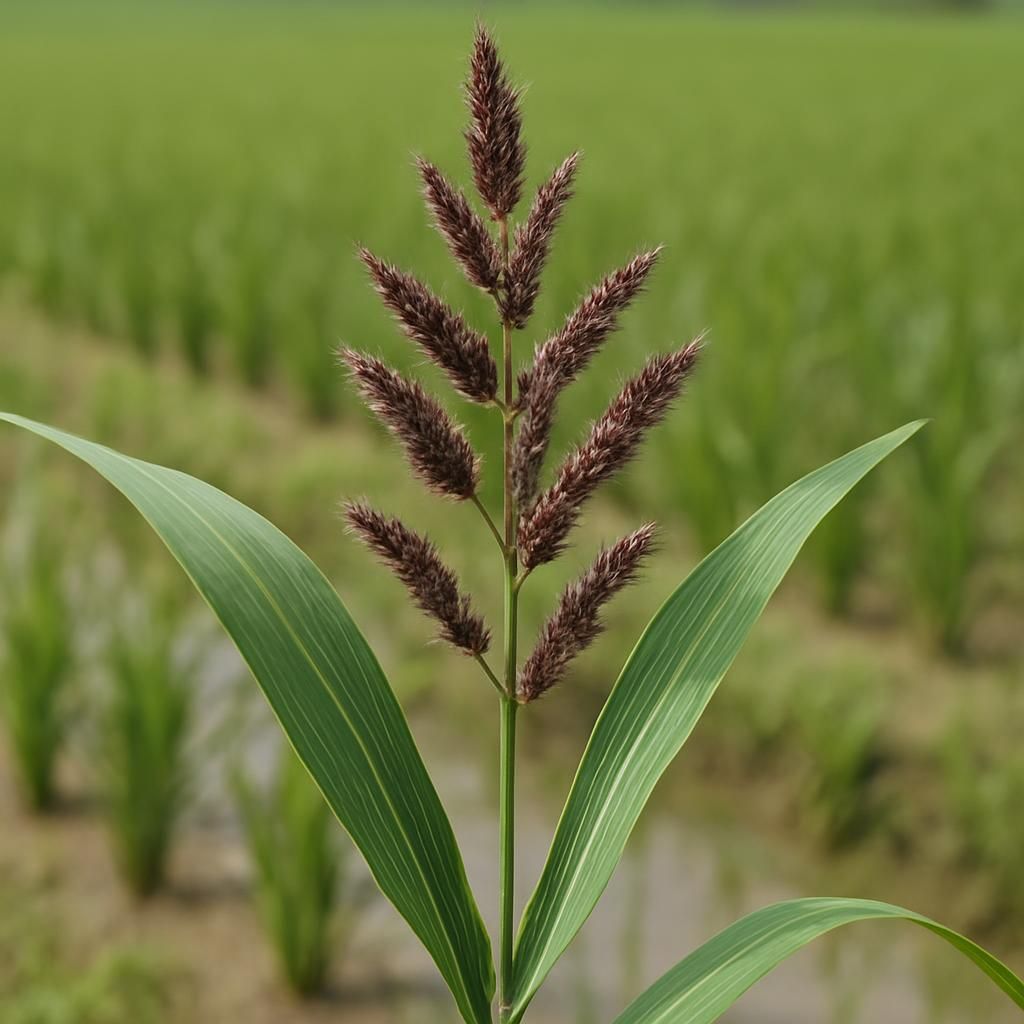
Introduction to barnyard grass
Barnyard grass (Echinochloa crus-galli) is a warm-season annual grass weed belonging to the Poaceae family. It is one of the most widespread and competitive weeds in global agriculture, particularly problematic in Rice paddies, Corn, and vegetable production systems. This C4 photosynthetic species exhibits rapid growth, high seed output, and remarkable tolerance to flooding and drought, allowing it to thrive across diverse agroecosystems. Its ability to mimic crop seedlings in early growth stages often delays detection and control.
Originating from temperate and tropical regions, barnyard grass has spread globally through contaminated seed lots and irrigation water. It competes intensely for light, water, and nutrients, often causing yield losses of 30-80% in heavily infested fields. The weed's fibrous root system and tillering capacity enable it to form dense stands that suppress crop growth. Effective management requires integrated approaches combining cultural, mechanical, and chemical strategies tailored to specific cropping systems.
Identifying Symptoms & Damage
Barnyard grass seedlings emerge with narrow, linear leaves that closely resemble young rice or corn plants, making early identification challenging. Mature plants reach heights of 30-150 cm with smooth, hairless stems and broad, flat leaves up to 2 cm wide. The inflorescence consists of dense, bristly panicles with purplish awns that produce thousands of seeds per plant.
Damage manifests primarily through resource competition, leading to stunted crop growth, reduced tillering in cereals, and lower grain fill. In Rice fields, barnyard grass can reduce yields by shading the crop canopy and depleting soil nitrogen. Its allelopathic compounds may further inhibit crop germination and root development. Severe infestations create harvest difficulties and increase drying costs due to green weed biomass.
Lifecycle and Progression of barnyard grass (MUST INCLUDE A MARKDOWN TABLE OF LIFECYCLE STAGES)
Barnyard grass completes its lifecycle in 60-120 days depending on temperature and moisture. Germination occurs in flushes throughout the growing season, with seeds remaining viable in soil for 5-10 years. The weed's ability to produce multiple generations per year in warm climates accelerates population buildup.
| Lifecycle Stage | Duration | Key Characteristics | Management Implications |
|---|---|---|---|
| Seed Germination | 3-14 days | Requires soil temperatures above 15°C and adequate moisture; multiple flushes possible | Pre-emergence herbicides or stale seedbed technique most effective |
| Vegetative Growth | 20-45 days | Rapid tillering and height increase; C4 photosynthesis enables fast biomass accumulation | Early post-emergence control critical before canopy closure |
| Flowering | 10-20 days | Panicle emergence with wind-pollinated flowers; self-fertile | Prevent seed set through timely mowing or herbicide application |
| Seed Production | 15-30 days | Each plant produces 2,000-40,000 seeds; high dormancy potential | Sanitation and harvest weed seed control essential |
| Seed Dispersal & Dormancy | Ongoing | Seeds spread by water, machinery, and animals; remain viable for years | Crop rotation and sanitation reduce long-term seedbank |
Environmental Triggers & Risk Factors
Barnyard grass germination is triggered by soil temperatures between 15-35°C with optimal emergence at 25-30°C. Flooded conditions favor its establishment in Rice systems, while it also thrives in upland dryland crops. High light intensity and nitrogen-rich soils accelerate growth rates.
Risk factors include poor field drainage, continuous monoculture of susceptible crops, and inadequate sanitation of equipment and irrigation water. Compacted soils and reduced tillage systems can increase seedbank persistence. Climate change with warmer temperatures may extend the weed's range into higher latitudes.
Organic Control & Treatment Plans (MUST INCLUDE A MARKDOWN TABLE OF TREATMENT OPTIONS AND FREQUENCIES)
Organic management emphasizes prevention, cultural practices, and mechanical interventions. Stale seedbed preparation combined with shallow cultivation disrupts early flushes. Mulching with organic materials suppresses emergence while improving soil health. Hand weeding and hoeing remain viable for small-scale operations.
| Treatment Option | Application Method | Frequency/Timing | Efficacy Notes |
|---|---|---|---|
| Stale Seedbed Technique | Shallow tillage 2-3 weeks before planting | Once per season pre-planting | Reduces initial emergence by 60-80% |
| Mulching (Straw/Plastic) | 5-10 cm layer or black plastic mulch | At planting and maintained throughout season | Prevents 70-90% of emergence in row crops |
| Hand Weeding/Hoeing | Manual removal before flowering | Every 7-14 days during vegetative stage | Essential for seedbank reduction; labor intensive |
| Cover Cropping (Rye, Sorghum-Sudangrass) | Drill or broadcast before main crop | Annual winter or summer cover | Smothers seedlings and improves soil structure |
| Flame Weeding | Directed flame at 2-3 leaf stage | 1-2 applications early season | Effective on small seedlings; fuel cost consideration |
| Crop Rotation with Competitive Crops | Alternate with Wheat or dense legumes | Every 2-3 years | Breaks lifecycle and reduces seedbank over time |
Preventing barnyard grass in the Future
Long-term prevention relies on integrated weed management focusing on seedbank depletion. Implementing diverse crop rotations with competitive canopies, maintaining clean equipment, and using certified seed reduce new introductions. Proper irrigation management and drainage minimize favorable conditions for germination.
Sanitation practices such as harvesting weed-free seed and cleaning machinery between fields are critical. Establishing buffer strips and managing irrigation canals prevent seed movement. Regular scouting and early intervention limit population expansion before seed production occurs.
Crops Most Affected by barnyard grass
Barnyard grass severely impacts Rice production worldwide, with significant yield reductions reported in both transplanted and direct-seeded systems. It also competes aggressively in Corn, Wheat, Soybeans, and vegetable crops including Tomato and Onion. The weed's rapid growth often outpaces slower-establishing crops.
High-value horticultural crops suffer from both competition and harvest contamination. Root crops like Potato and Sweet Potato experience reduced tuber quality when barnyard grass invades. Its presence in Cotton and Sugarcane fields complicates mechanical harvesting and increases processing costs.