Introduction to Bacopa monnieri
Bacopa monnieri, commonly known as water hyssop or Brahmi, is a low-growing, succulent perennial herb native to wetlands across India, Australia, Europe, Africa, Asia, and North and South America. For centuries it has been prized in Ayurvedic medicine for its cognitive-enhancing and adaptogenic properties. Modern commercial cultivation focuses on both dried leaf biomass for supplements and live plants for aquascaping and pond edges. Because it grows rapidly in saturated conditions, it also serves as an effective groundcover in constructed wetlands and rice paddies.
Successful large-scale production requires precise control of soil moisture, temperature, and fertility. Unlike many leafy herbs, Bacopa monnieri tolerates periodic flooding yet demands consistent nutrition to maintain high bacoside content—the active compounds responsible for its nootropic reputation. Growers targeting certified organic markets must integrate strict sanitation, beneficial insect releases, and soil health practices from the outset.
Botanical Profile of Bacopa monnieri
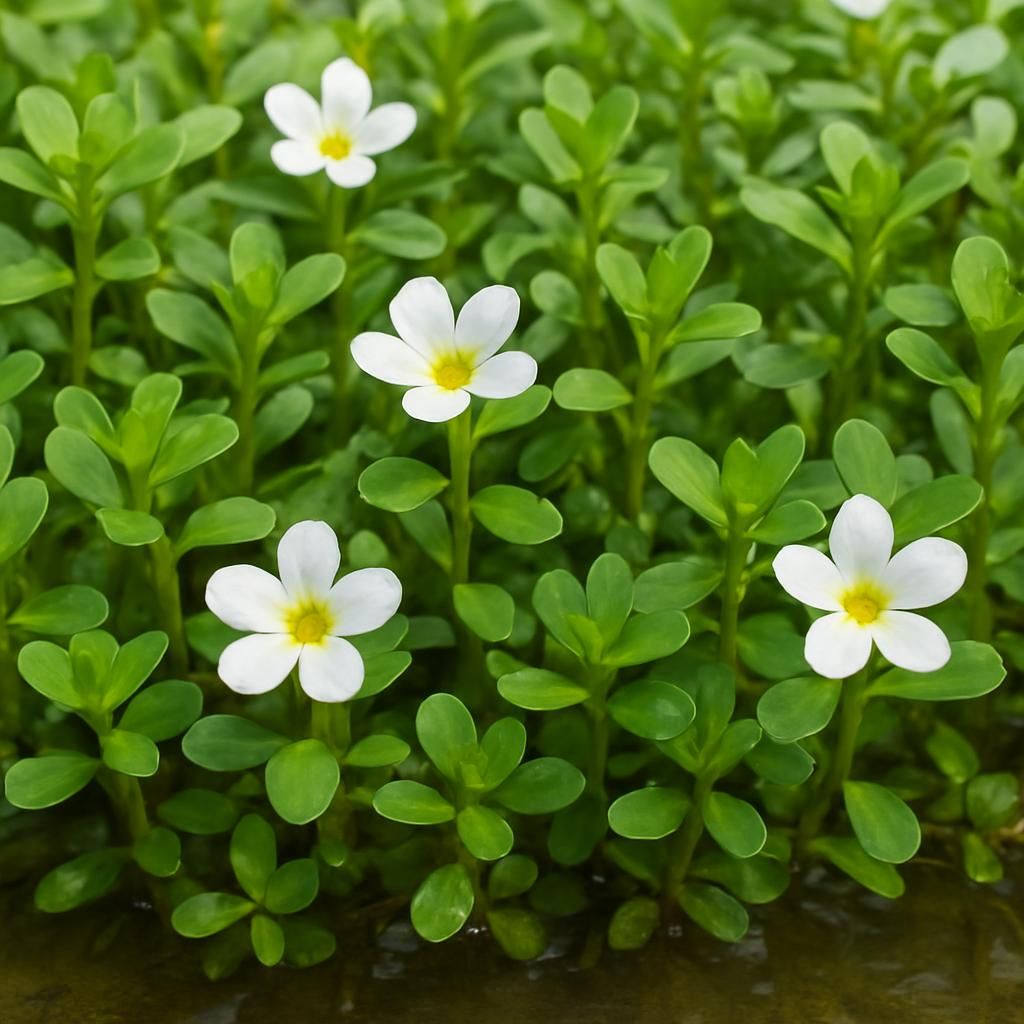
Bacopa monnieri belongs to the Plantaginaceae family. It produces creeping stems 10–30 cm long that root at the nodes, forming dense mats. Leaves are small, opposite, obovate, and succulent with entire margins. Solitary, five-petaled white or pale blue flowers appear year-round in tropical climates, each measuring 8–10 mm across. The plant’s ability to switch between terrestrial and aquatic growth forms makes it highly adaptable but also means cultural practices must account for both regimes.
Soil, pH, and Climate Requirements for Bacopa monnieri
Bacopa monnieri performs best in fertile, loamy soils that remain saturated yet well-aerated. It tolerates salinity up to 4 dS/m but suffers under prolonged drought. The following table summarizes optimal environmental parameters for commercial production.
| Parameter | Ideal Range | Notes |
|---|---|---|
| Soil Type | Loam to sandy loam with 2–4 % organic matter | Heavy clay requires raised beds or drainage tiles |
| Soil pH | 5.5–7.5 | Slightly acidic to neutral maximizes nutrient uptake |
| Temperature (day) | 22–32 °C | Growth slows below 18 °C; frost kills foliage |
| Temperature (night) | 15–22 °C | Maintain minimum 10 °C to avoid chilling injury |
| Relative Humidity | 70–90 % | High humidity reduces transpiration stress |
| Light | Full sun to partial shade (4–6 h direct) | Excessive shade reduces bacoside concentration |
| Water Table / EC | 0–5 cm standing water; EC < 2.0 dS/m | Periodic flooding tolerated; stagnant water invites root rot |
Step-by-Step Planting & Propagation
- Site Preparation: Clear weeds, incorporate 5–8 cm of well-rotted compost, and install drip or micro-sprinkler irrigation. Level beds to a 1 % slope to prevent waterlogging.
- Propagation Material: Use 8–10 cm stem cuttings with at least three nodes. Rooting hormone is optional; 90 % success occurs in moist sand or cocopeat within 10–14 days.
- Planting Density: Space rooted cuttings 15 cm apart in rows 20 cm apart for biomass production. For ornamental ponds, plant 25 cm apart along the waterline.
- Transplant Timing: In tropical and subtropical regions, plant year-round. In temperate zones, transplant after last frost when soil temperature exceeds 18 °C.
- Initial Irrigation: Keep the top 5 cm continuously moist for the first three weeks; thereafter maintain a shallow water layer or drip irrigation at 4–6 L m⁻² day⁻¹.
Care & Maintenance regimes for Bacopa monnieri
Consistent moisture and moderate fertility are the keys to high-quality leaf production. Over-fertilization increases nitrate accumulation and reduces bacoside levels. The table below outlines a practical weekly schedule for a 1 000 m² commercial plot.
| Week | Water Management | Fertilizer (NPK or Organic Equivalent) | Pruning / Canopy Management |
|---|---|---|---|
| 1–2 (Establishment) | Keep soil saturated; mist 3× daily if humidity <60 % | 5 g m⁻² 10-10-10 or 2 L m⁻² fish emulsion (1:10) | None; allow rooting |
| 3–6 (Vegetative) | Maintain 1–2 cm standing water or drip 5 L m⁻² day⁻¹ | 8 g m⁻² 20-10-20 every 14 days or 3 L m⁻² vermicompost tea | Tip prune at 10 cm height to encourage branching |
| 7–12 (Peak Growth) | Alternate 2 cm flood / drain cycle every 3 days | 6 g m⁻² 15-5-20 + 1 g m⁻² Epsom salt monthly | Harvest 30 % top growth every 21 days |
| Ongoing Maintenance | Monitor EC; flush monthly if >2.5 dS/m | Reduce N by 25 % after first harvest to maintain quality | Remove yellow leaves and spent flowers weekly |
Pests, Diseases & Organic Management
Common pests include aphids, spider mites, and whiteflies. Root-knot nematodes can become problematic in sandy soils. Major diseases are Pythium root rot, Phytophthora crown rot, and Alternaria leaf spot. Integrated management begins with certified disease-free cuttings, strict sanitation of tools, and avoidance of overhead irrigation. Beneficial releases of lady beetles, lacewings, and predatory mites provide season-long control. Neem oil (0.5 % emulsion) or Bacillus thuringiensis sprays manage caterpillars without residue concerns.
Harvesting, Curing & Optimal Storage
Harvest when stems reach 15–20 cm and bacoside content peaks (typically 60–90 days after planting). Cut above the second node with sanitized shears, leaving 5 cm stubble for regrowth. Rinse in chilled chlorinated water (50 ppm) within 30 minutes to remove field heat. For dried herb, spread in single layers at 35–40 °C with 15 % RH until moisture drops to 8–10 %. Vacuum-seal in light-proof foil pouches with oxygen absorbers; store at 4 °C for up to 18 months. Fresh biomass for the supplement industry is flash-frozen at −40 °C within 4 hours of harvest.
Companion Planting for Bacopa monnieri
Bacopa monnieri pairs well with rice in paddy systems, where it suppresses weeds and improves water quality. In wetland margins, interplant with Thai basil or parsley to diversify insect habitats. Avoid planting near tomato or potato because shared susceptibility to Phytophthora can lead to cross-infection. Marigold borders deter nematodes and enhance biodiversity without competing for light.