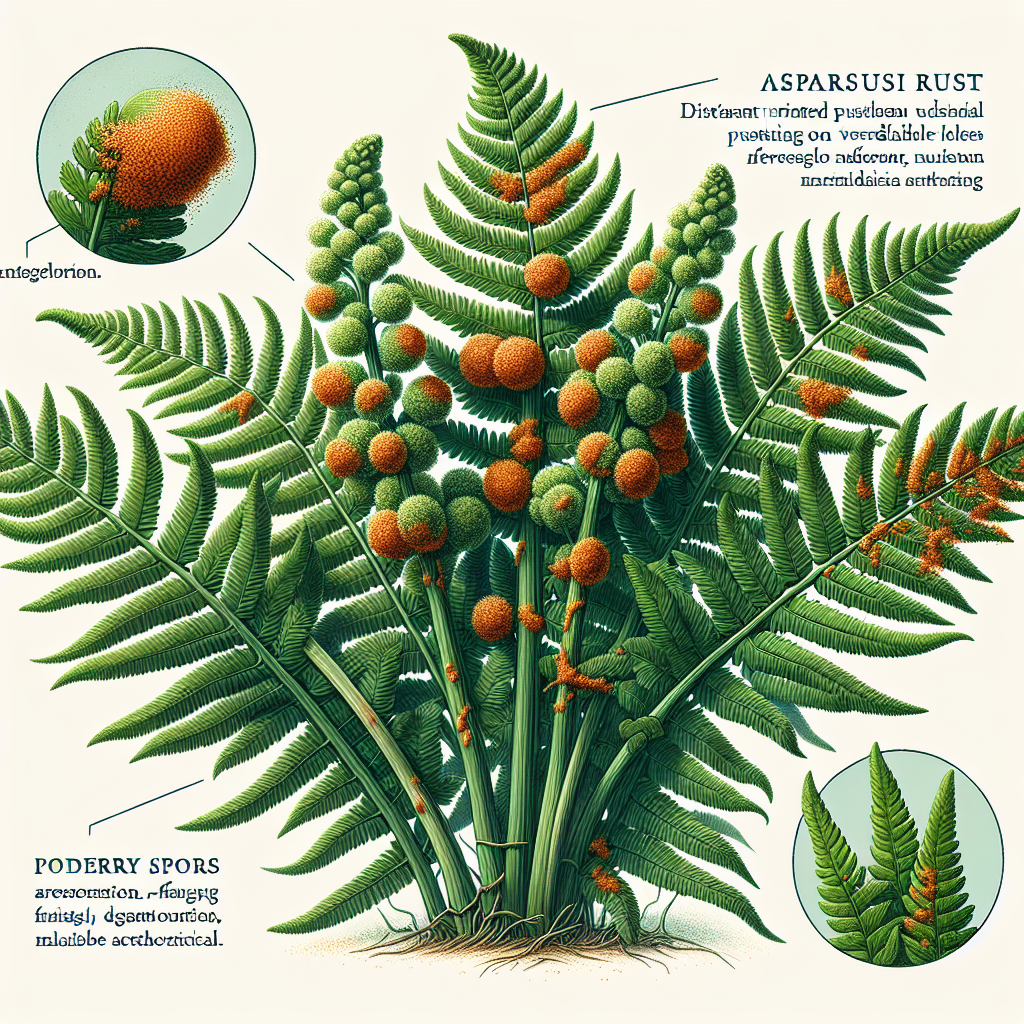
Introduction to Asparagus rust
Asparagus rust is one of the most serious fungal diseases affecting asparagus (Asparagus officinalis) crops worldwide, caused by the obligate parasitic fungus Puccinia asparagi. First identified in the early 19th century, this pathogen thrives in temperate climates and can devastate perennial asparagus plantings by reducing fern vigor, spear yield, and stand longevity. In severe outbreaks, yield losses can exceed 50%, making timely diagnosis and management essential for commercial growers and home gardeners alike.
The disease is particularly problematic because asparagus is a long-lived perennial crop, often maintained for 10-20 years. Infected ferns produce fewer carbohydrates, weakening crowns and reducing future spear production. Symptoms typically appear mid-season on ferns, with orange urediniospores signaling active infection. Understanding asparagus rust is critical for sustainable production, especially in regions with high humidity. For detailed asparagus cultivation tips, see the Asparagus (crop) page.
This guide covers identification, lifecycle, risk factors, organic treatments, prevention, and affected crops, empowering growers to implement integrated strategies that minimize losses while promoting plant health.
Identifying Symptoms & Damage
Accurate identification of asparagus rust is key to preventing spread. The disease manifests in distinct stages, each with characteristic signs:
Early Symptoms (Uredinial Stage): Small, circular, chlorotic (yellow) spots appear on needles and branches in late spring or early summer. These spots enlarge to 1-3 mm and develop raised, orange-yellow pustules filled with urediniospores. Pustules rupture, releasing powdery orange spores that coat foliage and can blow long distances.
Telial Stage: Later in the season, pustules turn dark brown or black, producing teliospores that overwinter on plant debris. Affected ferns yellow prematurely, wilt, and defoliate by fall.
Damage Assessment: Severe infections cause 20-100% defoliation, reducing photosynthesis and carbohydrate storage in crowns. Weakened plants produce thin, spindly spears the following spring. Secondary infections by common asparagus beetle or spotted asparagus beetle often follow, exacerbating damage.
To diagnose, use a hand lens to confirm bicellular urediniospores (18-25 μm). Differentiate from Fusarium crown and root rot, which affects crowns below ground, or purple spot, showing violet lesions without spores. Scouting weekly from fern emergence is recommended; threshold is 1% incidence for action.
Lifecycle and Progression of Asparagus rust
Puccinia asparagi has a complex, heteroecious lifecycle alternating between asparagus (primary host) and an alternate host, Matteuccia struthiopteris (ostrich fern), though in many regions, it completes cycles on asparagus alone via urediniospores.
Overwintering: Teliospores on infected debris germinate in spring, producing basidiospores that infect ostrich fern if present.
Aecial Stage: On alternate host, aecia produce aeciospores, but this is rare in commercial areas.
Uredinial Stage: Primary cycle on asparagus—urediniospores (summer spores) infect ferns under moist conditions (dew >8 hours, 65-75°F). Each cycle takes 10-14 days, leading to 5-8 generations per season.
Telial Stage: Late summer, telia form for overwintering.
Progression accelerates in warm, humid weather; spores spread by wind up to 300 miles. Infected ferns die back early, entering dormancy stressed. Crowns decline over 2-3 years without intervention.
Environmental Triggers & Risk Factors
Asparagus rust favors moderate temperatures (60-75°F) and leaf wetness >6-12 hours, common in coastal or irrigated fields. High humidity (>85% RH) and dense fern canopies trap moisture, promoting infection.
Key Risk Factors:
- Planting Density: Crowded rows (>5 ft between) limit airflow.
- Cultivar Susceptibility: Older varieties like Mary Washington Asparagus are highly susceptible; resistant hybrids (e.g., Jersey series) perform better.
- Site History: Fields with prior rust (>5% incidence) harbor inoculum.
- Irrigation: Overhead watering splashes spores.
- Alternate Host: Nearby ostrich ferns amplify epidemics.
Monitor weather data; infection risk peaks when >10 hours leaf wetness at 68°F. Poor fertility stresses plants, increasing vulnerability.
Organic Control & Treatment Plans
Organic management integrates cultural, biological, and approved fungicides. For more on organic practices, check this Organic Farming for Hobby Farms blog post.
Immediate Response (Active Infection):
- Remove Infected Ferns: Mow or burn ferns at first sign of pustules to reduce spore load (before telia form).
- Foliar Sprays:
- Potassium Bicarbonate (e.g., MilStop): 2-5 lb/100 gal, weekly; OMRI-listed.
- Copper Octanoate (e.g., Cueva): 0.5-2 gal/100 gal, 7-day intervals.
- Bacillus subtilis (e.g., Serenade): Biocontrol, suppresses spore germination.
- Neem Oil: 1-2% solution with insecticidal soap.
- Timing: Begin at 1% incidence, continue until ferns senesce.
Biological Controls: Apply Coniothyrium minitans or Trichoderma spp. to debris for teliospore degradation.
Integrated Plan: Scout weekly, spray preventively in high-risk weather. Rotate with non-hosts if replanting.
Preventing Asparagus rust in the Future
Prevention focuses on inoculum reduction and resistance:
- Resistant Varieties: Plant Asparagus (Jersey Knight) or Purple Passion Asparagus.
- Cultural Practices:
- Space rows 6-8 ft apart; orient north-south for airflow.
- Avoid overhead irrigation; use drip.
- Fertilize balanced (N-P-K 1-2-2) to avoid lush growth.
- Destroy ferns annually post-harvest; till lightly.
- Sanitation: Remove wild asparagus; control ostrich fern.
- Crop Rotation: 3-5 years if rust persists.
- Monitoring: Use weather-based models for spray timing.
Long-term, healthy crowns resist infection better. Yields recover in 1-2 seasons post-control.
Crops Most Affected by Asparagus rust
Asparagus rust is highly host-specific to Asparagus officinalis and related species:
- Primary Host: Garden asparagus cultivars like Mary Washington Asparagus, Jersey Knight, and UC157.
- Wild/Related: Wild asparagus (A. officinalis subsp. prostratus), ornamental asparagus ferns.
- Alternate Host: Ostrich fern (Matteuccia struthiopteris)—rarely symptomatic but sources aeciospores.
No other commercial crops affected, unlike rusts impacting wheat or bean rust. Focus protection on asparagus plantings.