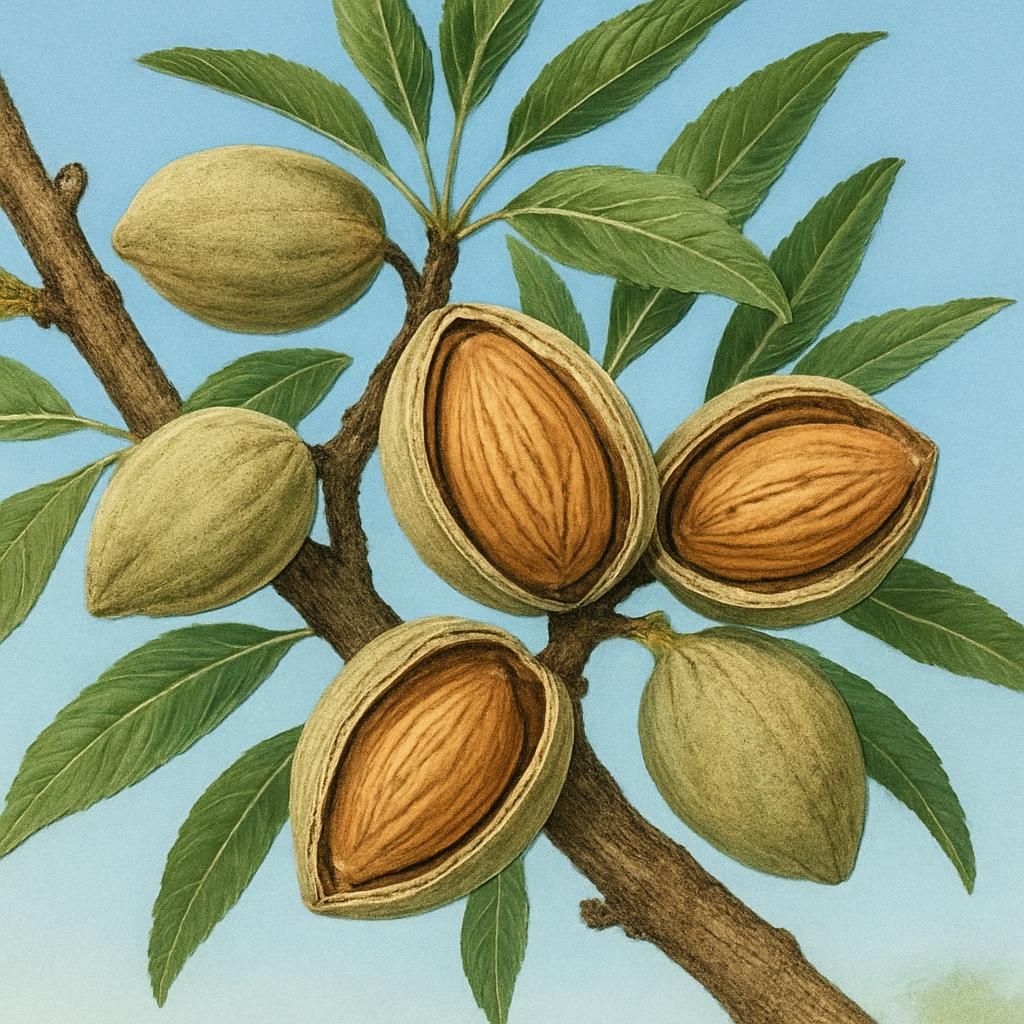
Introduction to Almond (Butte)
Almond (Butte) is a vigorous, late-blooming cultivar of Almond developed for California’s Central Valley. It produces large, uniform kernels with excellent blanching qualities and is widely planted for both domestic and export markets. Growers favor Butte for its reliable set, moderate vigor, and strong performance under mechanical shaking.
Botanical Profile of Almond (Butte)
The tree is deciduous and reaches 15–25 ft at maturity. It bears showy white-to-pale-pink flowers in late February to early March. Nuts form in a dry, dehiscent hull that splits at maturity, exposing the shell. Kernels average 1.2–1.4 g with 60–65 % edible yield.
Soil, pH, and Climate Requirements for Almond (Butte)
| Parameter | Ideal Range | Notes |
|---|---|---|
| Soil Texture | Sandy loam to loam | Excellent drainage critical |
| Soil pH | 6.0–7.5 | Avoid saline or sodic conditions |
| Organic Matter | 1.5–3.0 % | Maintain with compost or cover crops |
| USDA Zones | 7–9 | Requires 400–500 chill hours |
| Summer Temperature | 85–105 °F day / 55–65 °F night | Heat units drive kernel fill |
| Annual Rainfall | 8–20 inches | Supplemental irrigation mandatory |
Step-by-Step Planting & Propagation
- Select certified, virus-indexed Butte scions grafted on vigorous rootstocks such as Nemaguard or Hansen 536.
- Plant bare-root or potted trees in late fall or early winter while dormant.
- Dig holes twice the width of the root ball and set trees so the graft union sits 2–3 inches above grade.
- Backfill with native soil amended with 10 % well-aged compost.
- Irrigate immediately after planting and stake young trees against wind.
- Space trees 18–22 ft apart in rows 22–26 ft wide for high-density hedgerow systems.
Care & Maintenance regimes for Almond (Butte)
| Season | Water (gal/tree/week) | Fertilizer (N-P-K lbs/tree/year) | Pruning Action |
|---|---|---|---|
| Dormant | 0–5 | 0.8 lb N, 0.4 lb P₂O₅, 1.2 lb K₂O | Remove dead wood; shape scaffold branches |
| Bloom | 8–12 | 0.2 lb N at pink bud | Minimal; avoid heavy cuts |
| Nut Fill | 15–20 | 0.5 lb N split in May & June | Tip prune water sprouts |
| Post-Harvest | 10–15 | 0.3 lb N + micronutrients | Light hedging to maintain light penetration |
Pests, Diseases & Organic Management
Monitor weekly for Navel orangeworm using degree-day models and deploy mating disruption. Spider mites flare in dusty conditions; release predatory mites and maintain dust-free orchard floors. Peach twig borer is controlled with dormant oil plus spinosad timed to biofix. Hull rot is minimized by reducing late-season nitrogen and ensuring rapid drying after irrigation cutoff. Phytophthora root rot is prevented by planting on berms and using resistant rootstocks.
Harvesting, Curing & Optimal Storage
Butte nuts reach 85 % hull-split in late August to early September. Shake trees when 95 % of hulls have split and sweep windrows within 24 hours. Field-dry to 6–8 % kernel moisture, then move to forced-air dryers at 95–105 °F. Store in sealed bins at 35–40 °F and <65 % RH for up to 18 months with <1 % quality loss.
Companion Planting for Almond (Butte)
Inter-row cover crops such as Clover and Hairy vetch supply 60–90 lb N/acre and improve soil structure. Marigold borders attract beneficial insects that suppress aphids. Avoid planting Tomato or Potato nearby to reduce shared disease pressure from Verticillium wilt.