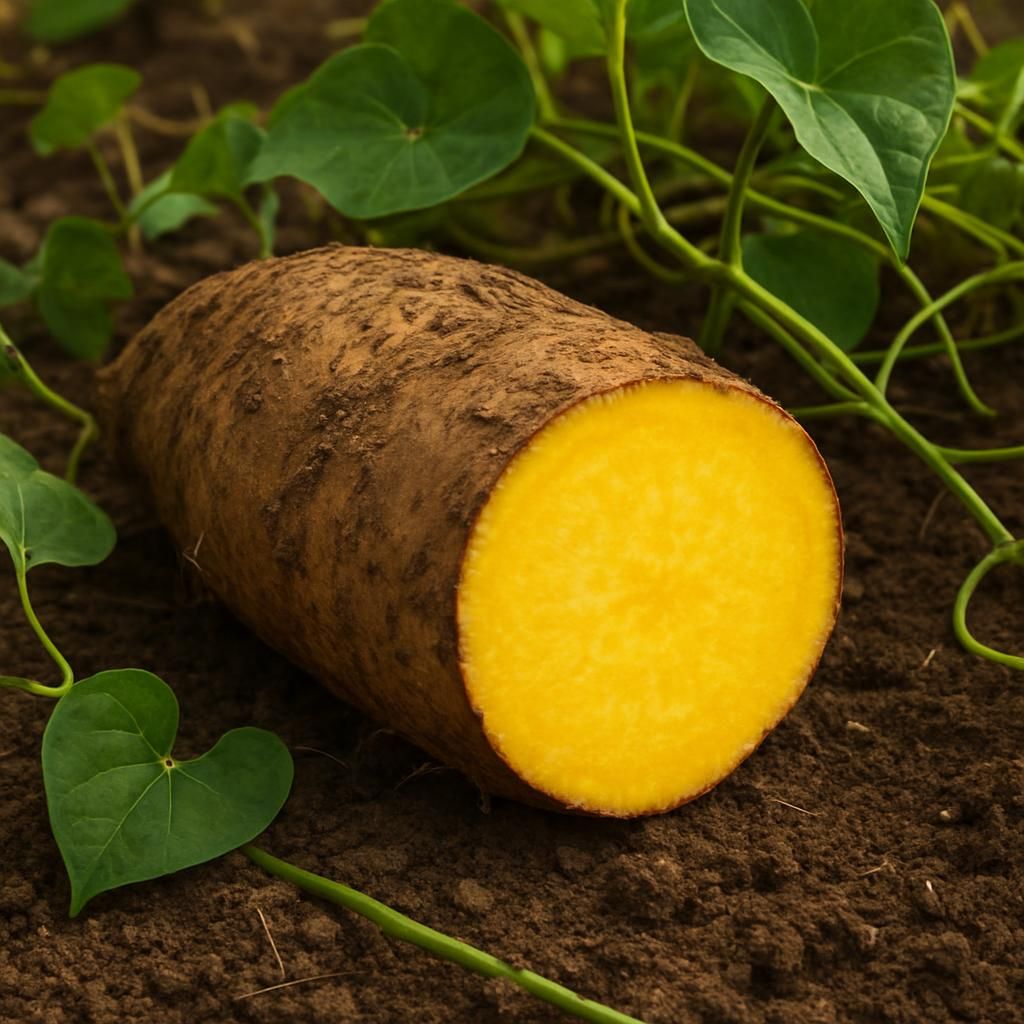
Introduction to Yam (Dioscorea cayennensis - Yellow Guinea)
Yellow Guinea yam (Dioscorea cayennensis) is a vigorous climbing vine native to West Africa and widely cultivated across tropical regions for its large, yellow-fleshed tubers. This crop serves as a critical food security staple, providing carbohydrates, vitamins, and minerals to millions of smallholder farmers. Unlike water yam or white yam, Yellow Guinea yam offers superior drought tolerance and stores exceptionally well after harvest. Its robust growth habit and high market demand make it an excellent choice for both subsistence and commercial production. Growers value its adaptability to marginal soils and its resistance to many common storage rots.
Botanical Profile of Yam (Dioscorea cayennensis - Yellow Guinea)
Dioscorea cayennensis belongs to the Dioscoreaceae family and produces annual vines that can reach 4–6 meters in length. The plant develops heart-shaped leaves and produces small, inconspicuous flowers. Underground, it forms elongated, cylindrical tubers with rough, corky skin and bright yellow flesh. Tubers typically weigh 2–5 kg at maturity and contain high levels of starch and dietary fiber. The crop is propagated vegetatively from setts or whole tubers rather than true seeds. Vines climb by twining counterclockwise around stakes or living supports.
Soil, pH, and Climate Requirements for Yam (Dioscorea cayennensis - Yellow Guinea)
Yellow Guinea yam thrives in well-drained, sandy loam to clay loam soils rich in organic matter. It performs best on slightly acidic to neutral soils with good aeration to prevent tuber rot. Consistent warmth and adequate rainfall during the growing season are essential for optimal tuber bulking.
| Parameter | Ideal Range | Notes |
|---|---|---|
| Soil Type | Sandy loam to clay loam | Excellent drainage prevents waterlogging |
| Soil pH | 5.5 – 7.0 | Avoid strongly acidic or alkaline conditions |
| Temperature | 25 – 32 °C daytime | Minimum 18 °C; frost will kill vines |
| Annual Rainfall | 1200 – 2000 mm | Even distribution; supplemental irrigation in dry spells |
| Altitude | 0 – 1500 m | Lower elevations preferred for faster growth |
| Sunlight | Full sun to light shade | At least 6 hours direct sun daily |
Step-by-Step Planting & Propagation
- Select healthy, disease-free tubers weighing 200–400 g. Cut into setts of 50–100 g each with at least two buds.
- Dust cut surfaces with wood ash or a fungicide to prevent infection.
- Prepare mounds or ridges 30–40 cm high and 1 m apart to improve drainage.
- Plant setts 10–15 cm deep with the bud facing upward during the early rainy season.
- Space plants 1 m × 1 m for optimal light interception and tuber expansion.
- Immediately install 2–3 m stakes or trellises; train vines to climb.
- Apply a 5–10 cm layer of mulch to conserve moisture and suppress weeds.
Care & Maintenance regimes for Yam (Dioscorea cayennensis - Yellow Guinea)
Regular weeding, balanced nutrition, and timely irrigation are critical during the first four months when vines establish and tubers begin to form. Mulching reduces soil temperature fluctuations and conserves water. Avoid over-fertilization with nitrogen, which promotes excessive foliage at the expense of tubers.
| Growth Stage | Watering Schedule | Fertilizer Application | Pruning / Training |
|---|---|---|---|
| Weeks 1–8 | 25–30 mm/week; keep soil moist | 200 kg/ha NPK 15-15-15 at planting | Train vines weekly; remove basal suckers |
| Weeks 9–16 | 20–25 mm/week; reduce if raining | Side-dress 100 kg/ha urea at 10 weeks | Continue training; pinch tips if over 4 m |
| Weeks 17–24 | 15–20 mm/week; allow slight drying | 150 kg/ha potassium sulfate at tuber bulking | Remove diseased leaves; maintain support |
| Weeks 25–harvest | Withhold water 2 weeks before harvest | None; focus on weed control | Cut back vines 10 cm above ground at harvest |
Pests, Diseases & Organic Management
Common pests include Aphids, Mealybugs, and Scale insects that weaken vines and transmit viruses. Root-knot nematodes cause galls on tubers, reducing marketability. Major diseases are Anthracnose, Yam mosaic virus, and Bacterial soft rots. Implement crop rotation with Cassava or Maize every 3–4 years. Use neem oil sprays and introduce predatory insects for aphid control. Rogue and destroy infected plants promptly. Apply well-composted manure to improve soil biology and suppress nematodes.
Harvesting, Curing & Optimal Storage
Harvest 8–10 months after planting when leaves begin to yellow and vines dry back. Carefully dig tubers to avoid bruising. Cure harvested yams in a shaded, well-ventilated area at 28–32 °C and 70–80 % RH for 4–7 days to heal wounds. Store cured tubers in ventilated barns or on raised racks at 15–18 °C and 60–70 % RH. Inspect monthly and remove any showing soft rot. Properly cured Yellow Guinea yam can store 4–6 months with minimal weight loss.
Companion Planting for Yam (Dioscorea cayennensis - Yellow Guinea)
Interplant with Maize or Sorghum for living stakes and wind protection. Legumes such as Cowpea or Pigeon pea fix nitrogen and improve soil fertility. Marigold borders deter nematodes and attract beneficial insects. Avoid planting near Sweet Potato to reduce shared pest pressure. Use Gliricidia as a living trellis and green manure source.