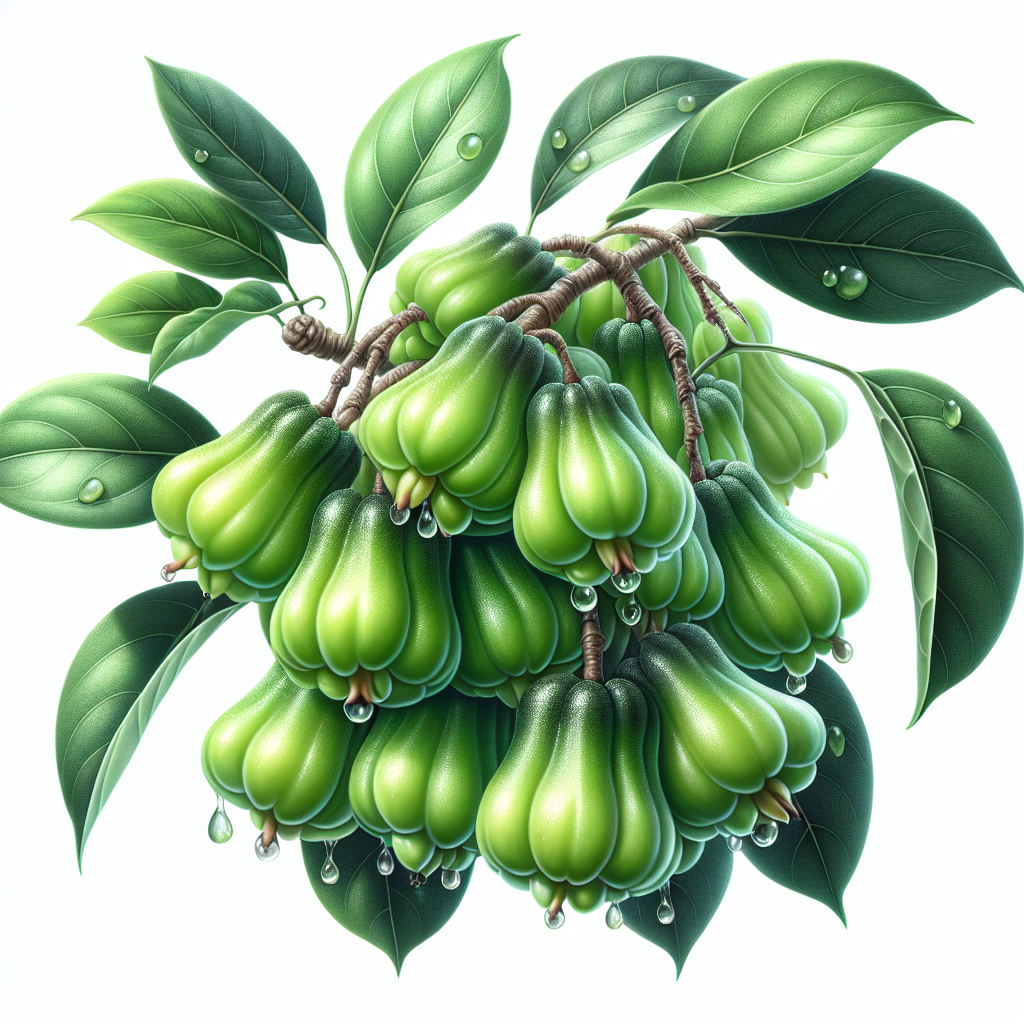
Introduction to Wax Jambu (Green Pearl)
Wax Jambu, commonly known as Green Pearl, is an exquisite tropical fruit tree that has captured the hearts of gardeners and fruit enthusiasts worldwide. Scientifically classified as Syzygium samarangense 'Green Pearl', this variety stands out for its striking green fruits that stay vibrantly emerald even when fully ripe, unlike the pink or red varieties. Native to Southeast Asia, particularly Malaysia and Indonesia, Wax Jambu has spread to subtropical regions globally, including Florida, Hawaii, and parts of Australia, where it flourishes in backyard orchards and commercial groves.
The allure of Green Pearl lies in its bell-shaped, waxy-skinned fruits, which measure 3-5 cm in diameter and weigh up to 50 grams each. These fruits boast a crisp, juicy texture reminiscent of a green apple, with a balanced sweet-tart flavor accented by floral undertones. Beyond its culinary appeal—perfect for fresh eating, salads, juices, or garnishes—Wax Jambu trees serve as stunning ornamentals with glossy, lance-shaped leaves and attractive reddish new growth. They can reach 10-15 meters in height if unpruned, but dwarfing rootstocks keep them manageable at 4-6 meters for home gardens.
This comprehensive guide dives deep into every aspect of cultivating Wax Jambu (Green Pearl), from site selection to harvest. Whether you're a novice gardener or seasoned farmer, mastering this crop unlocks prolific yields—up to 50-100 kg per mature tree annually—with relatively low input. Its resilience to heat and humidity, coupled with self-fertile flowers, makes it a standout for sustainable tropical agriculture. Discover proven techniques to achieve bumper crops while navigating common challenges like aphids and root rot. Why Companion Planting Feels Like Guesswork for Small Farms - And How AI Makes It Foolproof
Botanical Profile of Wax Jambu (Green Pearl)
Wax Jambu (Green Pearl) belongs to the Myrtaceae family, closely related to guava and clove. It's an evergreen perennial tree with a dense, pyramidal canopy formed by opposite, elliptical leaves reaching 10-20 cm long and 5-8 cm wide. The leaves are leathery, dark green above, and slightly paler beneath, providing year-round shade and aesthetic appeal.
Flowering occurs in clusters of 4-petaled white blooms, each 1-2 cm across, from spring through fall in tropical climates. These hermaphroditic flowers are self-pollinating, though cross-pollination with other jambu varieties boosts yields. Fruits develop rapidly, maturing in 30-45 days, and cluster profusely on branch tips. The 'Green Pearl' cultivar is selected for its uniform green skin, high sugar content (12-15° Brix), and low seed count—often seedless or with tiny, abortive seeds.
Root systems are shallow and wide-spreading, extending 2-3 times the canopy radius, making mulching essential for moisture retention. Trees exhibit strong apical dominance but respond well to pruning for shape and productivity. Nutritionally, the fruits are low-calorie (25-30 kcal/100g), rich in vitamin C (20-30 mg/100g), fiber, and antioxidants, positioning Green Pearl as a superfood in fresh markets.
In cultivation, Wax Jambu demonstrates vigorous growth, gaining 1-2 meters annually in youth. Mature specimens yield continuously in frost-free zones, with peak seasons in summer. It's wind-pollinated but benefits from bees, and its wood is lightweight, suitable for crafts.
Soil, pH, and Climate Requirements for Wax Jambu (Green Pearl)
Wax Jambu (Green Pearl) demands well-draining, fertile soils to prevent phytophthora issues common in waterlogged conditions. Sandy loam or loamy soils with 20-30% organic matter are ideal, amended with compost or aged manure at planting. Avoid heavy clays; raised beds (30-50 cm high) mitigate poor drainage in marginal sites.
Optimal pH ranges from 5.5-7.0, slightly acidic to neutral. Test soil annually; if below 5.5, apply dolomitic lime at 2-4 kg per tree; above 7.5, use elemental sulfur. Incorporate micronutrients like iron, zinc, and manganese via chelated fertilizers, as deficiencies manifest as chlorosis in high-pH soils.
Climatically, Green Pearl thrives in USDA zones 10-11, tolerating brief dips to 28°F (-2°C) but suffering damage below 25°F (-4°C). Ideal temperatures are 70-95°F (21-35°C) daytime, with humidity above 60%. Full sun (6-8 hours daily) promotes fruiting; partial shade reduces yields by 30-50%. Annual rainfall of 1000-2000 mm suits it, supplemented by irrigation during dry spells—drip systems delivering 20-40 liters per tree weekly. In cooler subtropics, protect with frost cloth and microclimates near south-facing walls. Windbreaks are crucial, as gales scar fruits and dry foliage.
Mulch 10-15 cm deep with organic materials (e.g., wood chips, coconut coir) to conserve moisture, suppress weeds, and regulate soil temperature. Monitor EC levels below 1.5 dS/m to avoid salinity stress.
Step-by-Step Planting & Propagation
Propagation
Air-layering yields 90-95% success: Select 2-3 year-old branches (1-2 cm diameter), girdle 2 cm wide, apply rooting hormone (IBA 5000 ppm), wrap in moist sphagnum moss and plastic for 6-8 weeks until roots form. Sever and pot in 20 cm containers with 1:1:1 sand:perlite:compost mix. Seed propagation is viable but variable; stratify fresh seeds 2-4 weeks at 4°C, germinate in 70% shade at 25-30°C in 10-20 days. Seedlings fruit in 4-6 years versus 2-3 for air-layers.
Cuttings root poorly (30% success); use semi-hardwood with mist propagation.
Planting
Plant in early spring or post-monsoon. Dig holes 60x60x60 cm, enrich with 10-20 kg compost, 500g superphosphate, 200g potash. Space trees 6-8 m apart (4-5 m for dwarfs). Position graft union 10 cm above soil. Water deeply post-planting, stake if windy. Initial fertilizer: NPK 10-10-10 at 100g/tree, monthly for first year.
For container growing, use 50-100L pots with excellent drainage; repot every 2 years.
Care & Maintenance regimes for Wax Jambu (Green Pearl)
Young trees need weekly watering (30-50L), maturing to bi-weekly. Fertigate with balanced NPK (e.g., 12-6-18) at 1-2 kg/tree/year, split into 4 applications. Foliar sprays of micronutrients (Fe, Zn, Mn) monthly during growth flushes.
Prune lightly post-harvest: Remove deadwood, water sprouts, and thin canopy for light penetration. Tip prune to encourage bushiness. Thin fruits to 10-15 cm spacing for larger sizes.
Weed circle 1-2 m radius; mulch annually. Monitor for nutrient imbalances—yellow leaves indicate nitrogen lack; apply urea.
In high-rain areas, elevate trunks to avoid rot. Support heavy fruit loads with props.
Pests, Diseases & Organic Management
Common pests include mealybugs, scale insects, and fruit flies. Manage with neem oil (2-3 ml/L) weekly, introduce ladybugs, or horticultural oil sprays. For fruit flies, use protein baits or kaolin clay barriers.
Diseases: Anthracnose causes fruit rot—apply copper fungicide pre-monsoon. Powdery mildew treated with potassium bicarbonate. Prevent root rot via drainage and Trichoderma drenches. Why 90% of Small Farms Fail at Pest Management - And 8 Organic Fixes That Actually Work
Cultural IPM: Prune for airflow, remove debris, companion with marigolds.
Harvesting, Curing & Optimal Storage
Harvest when fruits plump, waxy, and separate easily (30-45 days post-bloom). Twist or clip clusters; yield peaks every 2-3 days. Handle gently to avoid bruising.
No curing needed; store at 10-13°C, 85-90% RH for 3-4 weeks. Ripen at room temp. Market fresh or process into jams.
Companion Planting for Wax Jambu (Green Pearl)
Pair with guava for pest deterrence, Thai basil for nematodes, marigold against soil pests. Avoid water-hungry crops like watermelon. Legumes (peas) fix nitrogen; lemongrass repels insects. Benefits: Enhanced pollination, biodiversity, reduced aphids.