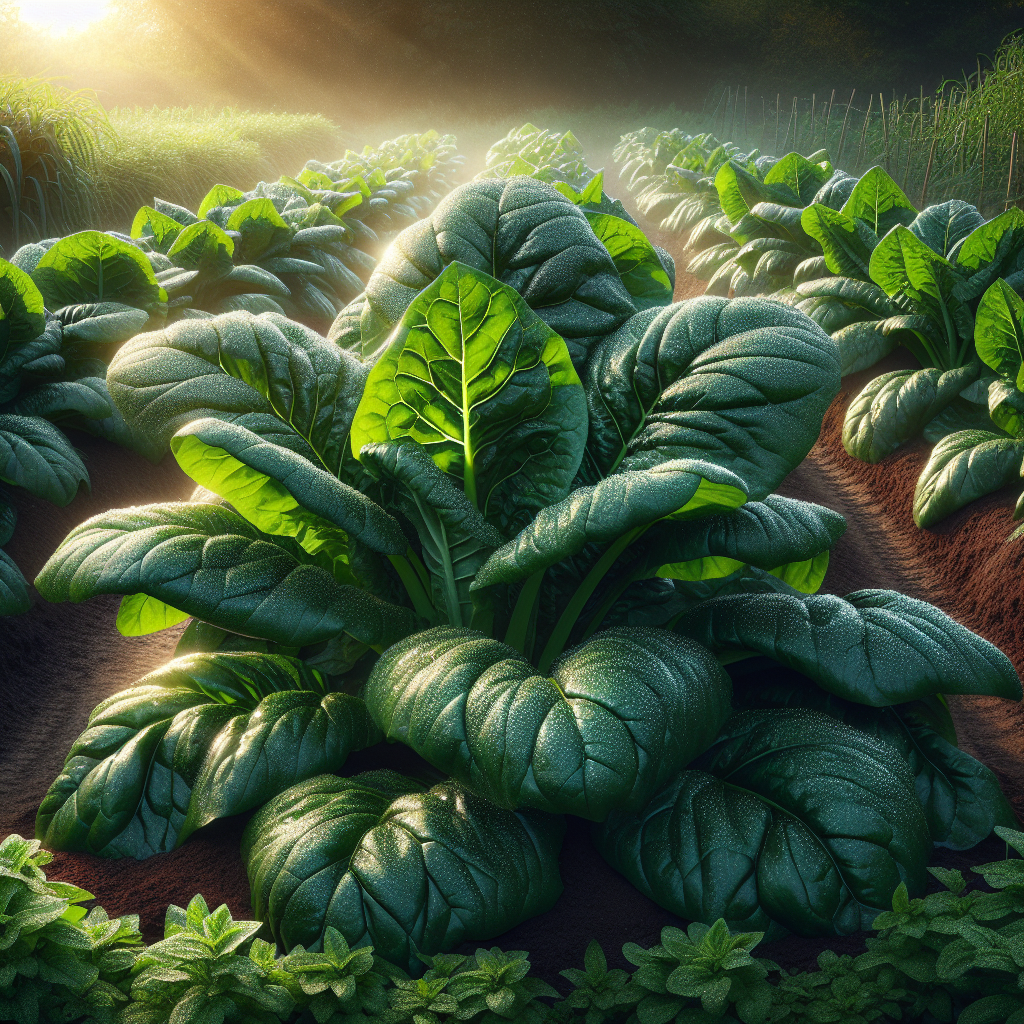
Introduction to Viroflay Spinach
Viroflay Spinach, named after the French commune of Viroflay near Paris, emerged in the 19th century as a premium heirloom variety prized by European market gardeners. First documented around 1866, it gained fame for producing enormous, tender leaves up to 12 inches long, far surpassing standard spinach types in size and uniformity. This savoy-free, smooth-leaf cultivar delivers mild, nutty flavor without bitterness, even as plants mature. Botanically optimized for cool weather, Viroflay resists bolting longer than many competitors, enabling extended harvests from fall to spring. Its vigorous growth suits both small gardens and commercial fields, yielding up to 20% more biomass than modern hybrids under optimal conditions. Nutritionally dense, it's packed with iron, vitamins A and C, and folate, supporting its status as a superfood green. For home growers, Viroflay offers reliability; for farmers, scalability—check the general Spinach profile for species context.
Botanical Profile of Viroflay Spinach
Viroflay belongs to Spinacia oleracea, an annual in the Amaranthaceae family, tracing origins to ancient Persia where wild progenitors like Spinacia tetrandra still grow. This cultivar features thick, lanceolate leaves with entire margins, deep emerald green hue (chlorophyll content ~2.5 mg/g fresh weight), and minimal petiole savoying, distinguishing it from crinkled types like Bloomsdale. Plants reach 10-12 inches tall and 18 inches wide, with a rosette growth habit that funnels dew to roots, enhancing drought tolerance. Stems are semi-succulent, aiding cold hardiness down to 20°F (-6°C). Flowers are inconspicuous monoecious spikes; however, Viroflay's bolt resistance stems from photoperiod insensitivity, delaying inflorescence until 14+ hours daylight. Seed viability lasts 4-5 years at 40°F (4°C) storage, with 85-95% germination rates. Genetically stable as an open-pollinated heirloom, it preserves traits like oversized lamina (leaf blade area ~200 cm² per leaf) across generations. Root systems are fibrous with mycorrhizal associations boosting phosphorus uptake by 30%.
Soil, pH, and Climate Requirements for Viroflay Spinach
Viroflay demands loose, fertile loam with 2-4% organic matter; heavy clays compact petioles, reducing expansion by 25%. Optimal pH is 6.5-7.0—below 6.0, molybdenum deficiency causes whiptail (narrowed leaves); above 7.5, iron chlorosis yellows margins. Test soil annually; amend with 2-4 lbs/100 sq ft dolomitic lime for acidity correction. Climate-wise, it's cool-season supreme: germinates at 40-75°F (4-24°C), ideal 50-65°F (10-18°C) growth. Day lengths under 12 hours suppress bolting; summers above 75°F (24°C) trigger flowering in 10-14 days. Winter hardiness allows overwintering under mulch in USDA zones 4-9. Full sun (6-8 hours) maximizes yields, but light shade (4-6 hours) prevents scald in hot climates. Moisture retention is key—aim for 60-70% field capacity (volumetric water content 0.20-0.25 m³/m³). For soil prep insights, see Soil Health Mastery.
Step-by-Step Planting & Propagation
Start with high-quality pelleted seeds (1,000-1,500 seeds/oz) for uniform spacing. Step 1: Timing—sow direct 4-6 weeks before last frost (spring) or 6-8 weeks before first frost (fall); soil temp 40°F+ (4°C+). Step 2: Prep—till 6-8 inches deep, incorporate 2-3 lbs/100 sq ft 10-10-10 fertilizer or composted manure (N-P-K ratio 1:1:1). Step 3: Sowing—broadcast or drill ½ inch deep, 1-2 inches apart in rows 12 inches apart (population density 20-30 plants/sq ft). Cover lightly; firm soil. Step 4: Germination—water gently to 1 inch/week; emerge in 7-14 days at 55°F (13°C). Thin to 4-6 inches at 2-leaf stage. For propagation, save seeds from non-bolted plants: isolate 50 ft from other spinach, harvest dry spikes, thresh, dry 2 weeks at 40% RH. Transplant option: start indoors in 72-cell trays at 45°F (7°C), harden off 7 days, plant 6 inches apart. Succession sow every 10-14 days for continuous yield.
Care & Maintenance regimes for Viroflay Spinach
Irrigate to maintain 1-1.5 inches/week, equivalent to 60-70% soil moisture (probe to 6 inches; water if <50%). Overwatering signs: yellowing lower leaves, root rot (Pythium; mushy roots, foul odor). Underwatering: cupped leaves, purpling stems (anthocyanin stress). Fertilize at planting (1 lb N/100 sq ft via blood meal), side-dress 0.5 lb N/100 sq ft at 3 weeks. Mulch with 2 inches straw post-emergence to retain moisture, suppress weeds, moderate soil temp (reduces bolting 20%). Thin aggressively—crowding halves yields. Scout weekly for nutrient flags: N deficiency (pale yellow older leaves), K shortage (brown leaf edges). Rotate every 3 years post-harvest. For overwintering, hill 4-6 inches loose straw over rows after hard freeze; yields resume 4 weeks pre-last frost.
Pests, Diseases & Organic Management
Leaf miners (Liriomyza spp.) tunnel white trails—handpick adults, use row covers (90% exclusion), neem oil (0.5% weekly). Aphids cluster undersides—blast with water, introduce ladybugs (1:100 Aphids), insecticidal soap (1 tbsp/gal). Downy mildew (Peronospora farinosa) shows yellow upper/gray lower lesions—improve air flow (18-inch rows), copper fungicide (pre-emptive every 10 days), resistant spacing. Fusarium wilt (yellowing, droop at base)—solarize soil 6 weeks pre-plant, biofumigants like mustard cover crop. Slugs chew holes—beer traps (1/ sq 100 ft), diatomaceous earth barriers. Organic IPM: monitor with sticky traps, diversify rotations with onion family. Cultural controls cut disease 40-60%.
Harvesting, Curing & Optimal Storage
Harvest outer leaves at 4-6 inches (25-35 days spring, 40-50 fall), promoting rosette regrowth (5-7 cuts/plant). Cut-and-come-again: snip 1 inch above base at 3-4 leaf stage. Full plant harvest pre-bolt (bolts show central spike, tough texture). Use sharp shears mornings when turgid. Yield: 2-4 lbs/sq 10 ft. Curing unnecessary; rinse cool water, spin dry. Store unwashed in perforated bags at 32-36°F (0-2°C), 95% RH—lasts 10-21 days (vs. 7 for bolted). Frozen: blanch 1-2 min, ice bath, vacuum seal (-0°F/-18°C, 12 months). Dried: dehydrate 95°F (35°C) 8-12 hrs, store airtight cool/dark (6-12 months).
Companion Planting for Viroflay Spinach
Viroflay pairs excellently with cool-season allies to deter pests and optimize space. Plant Sugar Snap Peas nearby—their vertical growth shades spinach, nitrogen-fixing boosts soil N by 50-100 lbs/acre. Radish (e.g., Cherry Belle) loosens soil, repels leaf miners via glucosinolates. Onion family thwarts Aphids with sulfur volatiles. Avoid potatoes (nitrate competition, blight risk). Interplant in beds: spinach base layer, peas climb trellis, radish/onion edges. This guild increases yields 15-25%, enhances biodiversity.