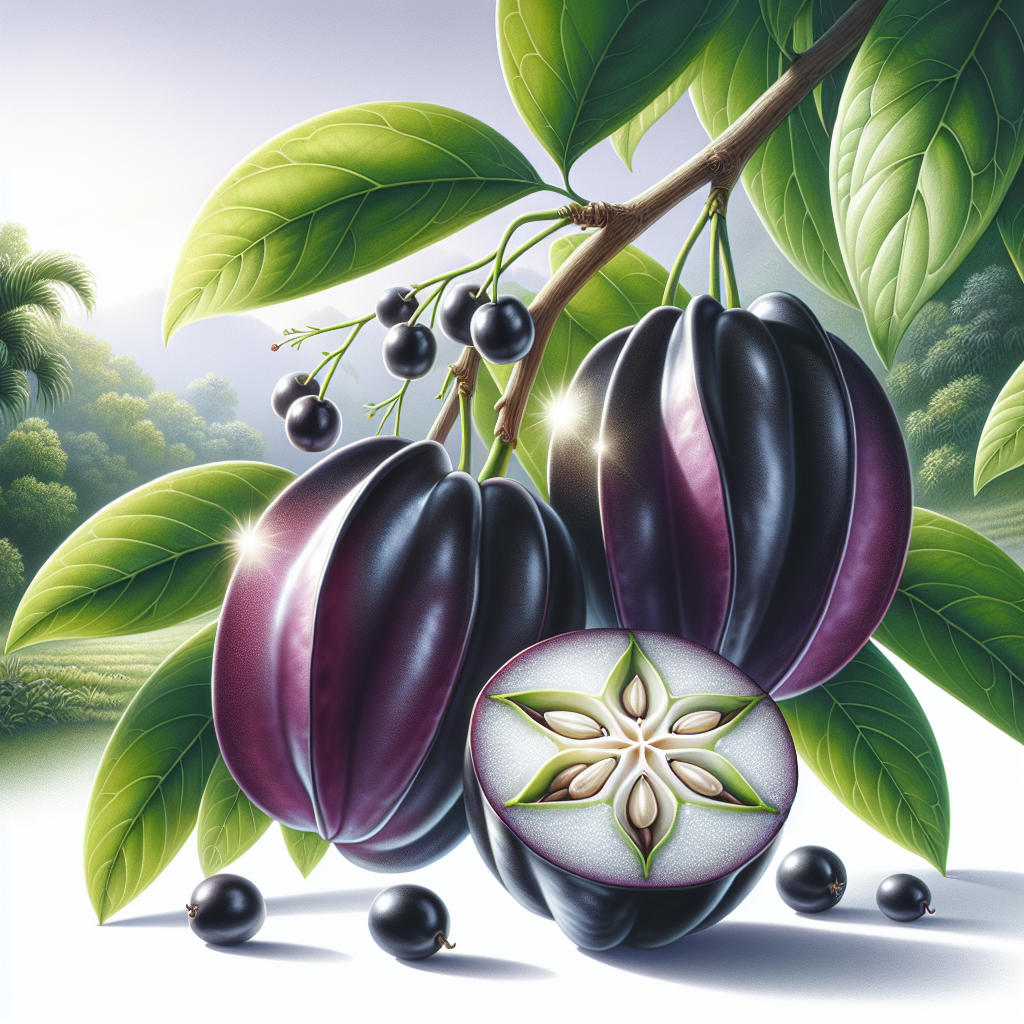
Introduction to Star Apple (Chrysophyllum cainito - Haitian)
Star Apple, scientifically known as Chrysophyllum cainito, is a captivating tropical fruit tree celebrated for its glossy green leaves that reveal a shimmering silver underside, earning it the poetic name 'caimito' in Spanish. The Haitian variety stands out among cultivars for its superior flavor profile—sweet, honey-like flesh with a subtle floral aroma—and its adaptability to diverse tropical growing conditions. Originating from the lush lowlands of Central America and the Caribbean, including Haiti, this tree has become a staple in home orchards, agroforestry systems, and small-scale commercial plantations across Southeast Asia, Florida, and Queensland.
What makes the Haitian Star Apple particularly appealing is its dual-purpose nature: not only does it produce delectable fruits averaging 5-10 cm in diameter with a distinctive star-shaped seed core visible when sliced, but it also serves as an excellent shade tree for intercrops like mango or coffee. Mature trees can yield 100-300 kg of fruit annually after 5-7 years, with peak production in the rainy season. For small farmers, its low maintenance and resistance to many common pests make it a profitable crop, especially when marketed fresh or processed into juices, jams, and desserts. This guide draws from decades of agronomic research and field trials to provide actionable, professional-grade advice for maximizing yields while promoting sustainable practices. Whether you're establishing a backyard grove or scaling up production, mastering Star Apple cultivation unlocks a reliable source of income and nutrition in tropical agriculture.
Botanical Profile of Star Apple (Chrysophyllum cainito - Haitian)
Chrysophyllum cainito belongs to the Sapotaceae family, closely related to mamey sapote and sapodilla. The Haitian cultivar is a selection prized for its vigorous growth, reaching 10-20 meters in height with a broad, spreading canopy up to 12 meters wide. Leaves are elliptical, 5-15 cm long, leathery, and obovate, with a golden-brown pubescence beneath that creates a striking contrast when rustled by wind—a key identifying feature.
Trees are evergreen in frost-free zones but may shed leaves during extreme dry periods. Flowers are small (1 cm), hermaphroditic, white to purplish, clustered in leaf axils, and pollinated primarily by bees and other insects. Fruit development takes 90-120 days post-anthesis. Fruits are round to oblate, green-skinned when unripe, turning purple to black at maturity, with 5-10 carpels forming the iconic star pattern around 1-5 large seeds. Flesh is white, translucent, juicy, and custard-like, with Brix levels of 18-25°—higher than many tropical fruits like papaya.
Root system is taproot-dominant with extensive laterals, aiding drought tolerance once established. Haitian strains show genetic vigor from local selections, exhibiting better fruit size uniformity (up to 200g per fruit) and latex content that deters some borers. Phenologically, flowering peaks twice yearly in response to dry spells, with main harvest December-March in the Northern Hemisphere.
Soil, pH, and Climate Requirements for Star Apple (Chrysophyllum cainito - Haitian)
Star Apple demands well-drained, fertile soils rich in organic matter, thriving in loamy sands to clay loams. Avoid heavy clays prone to waterlogging, which invite root rot. Optimal pH is 5.5-7.0; test soil annually and amend with dolomite lime if below 5.5 to prevent micronutrient lockout. Incorporate 10-20 kg compost per planting hole for microbial activity.
Climatically, USDA zones 10b-12 are ideal, with temperatures of 21-32°C daytime and no lower than 5°C. It tolerates brief dips to -1°C but suffers leaf scorch below 10°C. Annual rainfall of 1500-2500 mm is perfect, supplemented by irrigation during <3-month dry spells. High humidity (70-90%) boosts fruit set, but windbreaks are essential in exposed sites to prevent flower drop. For more on heat management, see Why Summer Heatwaves Are Silently Killing Small Farm Yields - And 7 Organic Strategies to Fight Back.
Full sun (6-8 hours) promotes vigorous growth; partial shade suits young trees. Salinity tolerance is moderate (EC <4 dS/m), but flushing is needed in coastal areas. Mulch with 10 cm organic matter to retain moisture and suppress weeds.
Step-by-Step Planting & Propagation
Propagation
Seed propagation is simplest for Haitian Star Apple: extract seeds from ripe fruit, wash off pulp, and sow fresh in 1:1:1 sand-compost-perlite mix. Germination occurs in 2-4 weeks at 25-30°C under mist. True-to-type success is 70-80%; select from high-yielding mother trees. For uniformity, air-layer (marcotting) 2-year branches in rainy season—roots form in 8-12 weeks. Grafted plants (veneer or cleft on 1-year rootstock) fruit 2-3 years earlier, with 90% take using beeswax sealant.
Planting
Site prep: Dig 60x60x60 cm holes, fill with topsoil + 20 kg compost + 500g rock phosphate + 200g wood ash. Space trees 8-10 m apart (100-150 trees/ha). Plant at rainy onset: set graft union 10 cm above soil, stake, and mulch. Initial irrigation: 50-100 L/week until established (6 months). For cold climates, use Winter Sowing Mastery techniques for seedlings.
Care & Maintenance regimes for Star Apple (Chrysophyllum cainito - Haitian)
Prune annually post-harvest: remove deadwood, watersprouts, and crossing branches for open canopy and light penetration. Tip young trees to encourage bushiness. Fertilize 3-4 times/year: young trees 500g NPK 10-20-20/tree; mature 2-3 kg split into 3 apps, plus micronutrients (Zn, Fe via foliar). Irrigate deeply (40-60 L/week) during fruit swell; deficit irrigation enhances sweetness.
Weed control via mulch or shallow cultivation; cover crops like pigeon pea fix nitrogen. Thin heavy crops to 50-100 fruits/tree for size. Monitor for nutrient deficiencies: yellowing veins indicate iron lack—apply chelated Fe.
Pests, Diseases & Organic Management
Common pests include scale insects, mealybugs, and fruit-piercing moths. Scout weekly; control with neem oil (2% weekly sprays) or introduce ladybugs. Aphids curl leaves—blast with water or use insecticidal soap. Borers attack trunks: wrap bases with tanglefoot.
Diseases: Anthracnose causes fruit rot (copper fungicide pre-monsoon); Phytophthora root rot from poor drainage—improve aeration, apply Trichoderma. Powdery mildew: sulfur sprays. For broader strategies, check Why 90% of Small Farms Fail at Pest Management - And 8 Organic Fixes That Actually Work. Cultural IPM: sanitation, resistant rootstocks, biodiversity.
Harvesting, Curing & Optimal Storage
Harvest when fruit detaches easily with gentle twist (specific gravity >1.0) or skin dulls to purple-black. Yield peaks at 7-10 years; pick every 3-5 days to avoid bird damage. Use clippers for clusters; handle gently to prevent latex staining.
Cure at 25-28°C, 85-90% RH for 3-5 days to soften skin and peak sweetness. Store ripe fruit at 13-15°C (90% RH) for 3-4 weeks; unripe at 20°C for 2 weeks. Process rejects into puree (freeze at -18°C for 12 months). Market fresh for premium prices.
Companion Planting for Star Apple (Chrysophyllum cainito - Haitian)
Pair with nitrogen-fixers like pigeon pea or gliricidia for soil enrichment. Understory: pineapple, ginger, or turmeric suppress weeds and provide ground cover. Avoid water-hungry crops like banana near young trees. Repellents: marigold deters nematodes; thyme confuses moths. For expert tips, explore Why Companion Planting Feels Like Guesswork for Small Farms - And How AI Makes It Foolproof. This synergy boosts biodiversity, reduces pests, and optimizes space.