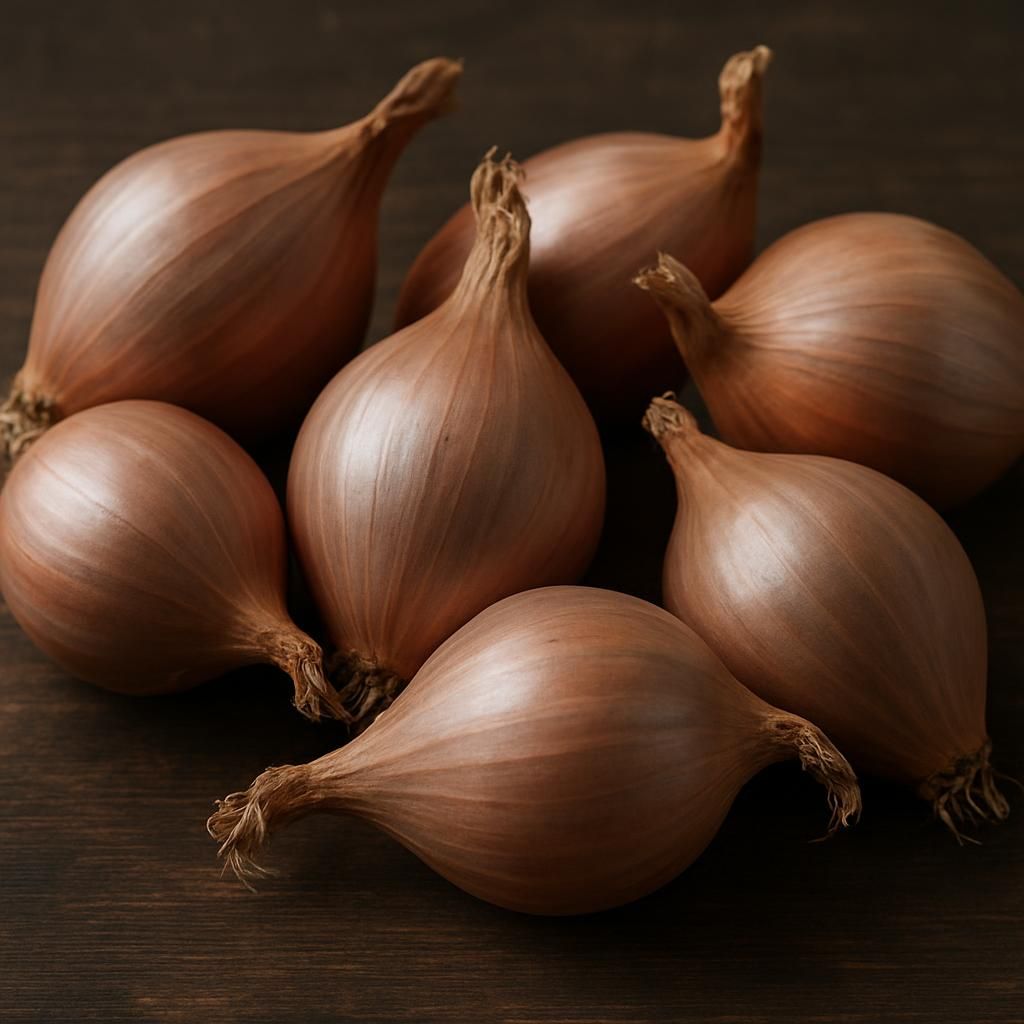
Introduction to Shallot (French Grey)
French Grey shallots represent one of the most flavorful and storable members of the Allium family. These elongated, copper-skinned bulbs originated in northern France and have been cultivated for centuries for their intense aromatic qualities and resistance to bolting. Unlike common onions, shallots form clusters of smaller bulbs from a single planted clove, offering higher yields per square foot and exceptional culinary versatility. Professional growers value French Grey shallots for their consistent performance in cool climates and their ability to store for up to 10 months when properly cured. This guide delivers practical, research-backed methods for successful cultivation from seed to storage.
Botanical Profile of Shallot (French Grey)
French Grey shallots belong to the Amaryllidaceae family and are botanically classified as a vegetatively propagated form of the common onion. The plant produces hollow, cylindrical leaves that emerge from a basal plate and develop into a cluster of 4–12 individual bulbs per mother clove. Each bulb features a distinctive grey-brown to copper skin with purple-tinged flesh and a pronounced neck. The variety exhibits strong cold tolerance, entering dormancy during winter and resuming growth in early spring. Flowering is rare in this clone, with propagation almost exclusively achieved through division of offset bulbs rather than true seed.
Soil, pH, and Climate Requirements for Shallot (French Grey)
French Grey shallots demand well-drained, fertile loam or sandy loam soils with high organic matter content. Heavy clay soils must be amended with compost or raised beds to prevent waterlogging and bulb rot. The ideal soil pH ranges from 6.0 to 7.0, with optimal nutrient availability around 6.5. These shallots perform best in cool temperate climates with daytime temperatures between 15–24 °C during active growth and require a minimum of 6 hours of direct sunlight daily.
| Parameter | Ideal Range | Notes |
|---|---|---|
| Soil Type | Loam / Sandy Loam | Excellent drainage essential |
| Soil pH | 6.0 – 7.0 | Target 6.5 for maximum nutrient uptake |
| Temperature (Growth) | 15 – 24 °C | Cool-season crop; tolerates light frost |
| Temperature (Dormancy) | -10 – 5 °C | Requires vernalization for bulbing |
| Sunlight | 6+ hours direct | Full sun maximizes bulb size |
| Soil Organic Matter | 3–5 % | Incorporate well-rotted compost |
| Drainage | Excellent | Raised beds recommended on heavy soils |
Step-by-Step Planting & Propagation
- Site Selection & Preparation: Choose a location with full sun and well-drained soil. Remove all perennial weeds and incorporate 5–8 cm of mature compost two weeks before planting.
- Bulb Selection: Use certified disease-free French Grey shallot sets or cloves approximately 1.5–2 cm in diameter. Discard any soft or moldy material.
- Planting Window: In temperate regions, plant in early spring as soon as soil can be worked (soil temperature ≥7 °C). In milder climates, autumn planting (October–November) allows overwintering for earlier spring harvest.
- Spacing & Depth: Plant individual cloves 10–12 cm apart in rows 30–40 cm apart, pointed end up, at a depth of 2–3 cm. Shallots may also be grown in 10 cm deep raised beds or containers with similar spacing.
- Mulching: Apply a 5 cm layer of straw or leaf mulch immediately after planting to suppress weeds and maintain consistent soil moisture.
Care & Maintenance regimes for Shallot (French Grey)
Consistent moisture and balanced nutrition are critical during the 90–120 day growing cycle. Avoid over-fertilization, which promotes foliage at the expense of bulb development. Hand-weed or shallow cultivate regularly to prevent competition.
| Growth Stage | Watering Schedule | Fertilizer Application | Pruning / Other Tasks |
|---|---|---|---|
| Establishment (0–4 wks) | 2.5 cm/week; keep soil moist but not saturated | None; rely on pre-plant compost | Remove weeds; maintain mulch |
| Vegetative (4–10 wks) | 2.5–3.5 cm/week; deep soak every 5–7 days | Side-dress with 5-10-10 at 4 weeks (50 g/m²) | Remove flower stalks if they appear |
| Bulbing (10–14 wks) | Reduce to 1.5 cm/week as necks soften | No additional N; optional K boost | Cease irrigation 2–3 weeks before harvest |
| Maturation & Harvest | Withhold water 10–14 days prior | None | Allow foliage to yellow naturally |
Pests, Diseases & Organic Management
French Grey shallots are susceptible to Onion thrips, aphids, and onion maggot (new_internal_link). Fungal issues include downy mildew and botrytis neck rot. Implement a 3–4 year rotation away from other Alliums. Use floating row covers at planting to exclude onion maggot flies. Apply neem oil or insecticidal soap at the first sign of thrips. Improve air circulation and avoid overhead irrigation to reduce fungal pressure. Copper-based fungicides may be used organically when disease pressure is high.
Harvesting, Curing & Optimal Storage
Harvest when 50–75 % of tops have fallen and begun to yellow, typically 90–120 days after planting. Gently lift clusters with a fork, shake off soil, and avoid bruising. Cure in a warm (24–27 °C), dry, well-ventilated area for 10–14 days until necks are completely dry and papery. Trim roots and tops to 2 cm. Store cured bulbs in mesh bags or slatted crates at 0–4 °C with 60–70 % relative humidity. Properly cured French Grey shallots maintain quality for 8–10 months.
Companion Planting for Shallot (French Grey)
French Grey shallots benefit from strategic companions that deter pests and improve soil health. Carrot and lettuce are excellent neighbors; their differing root depths minimize competition. Aromatic herbs such as thyme and rosemary repel onion thrips and aphids. Avoid planting near beans or peas, which can inhibit shallot growth through allelopathy. Interplanting with marigold provides additional pest suppression while attracting beneficial insects.