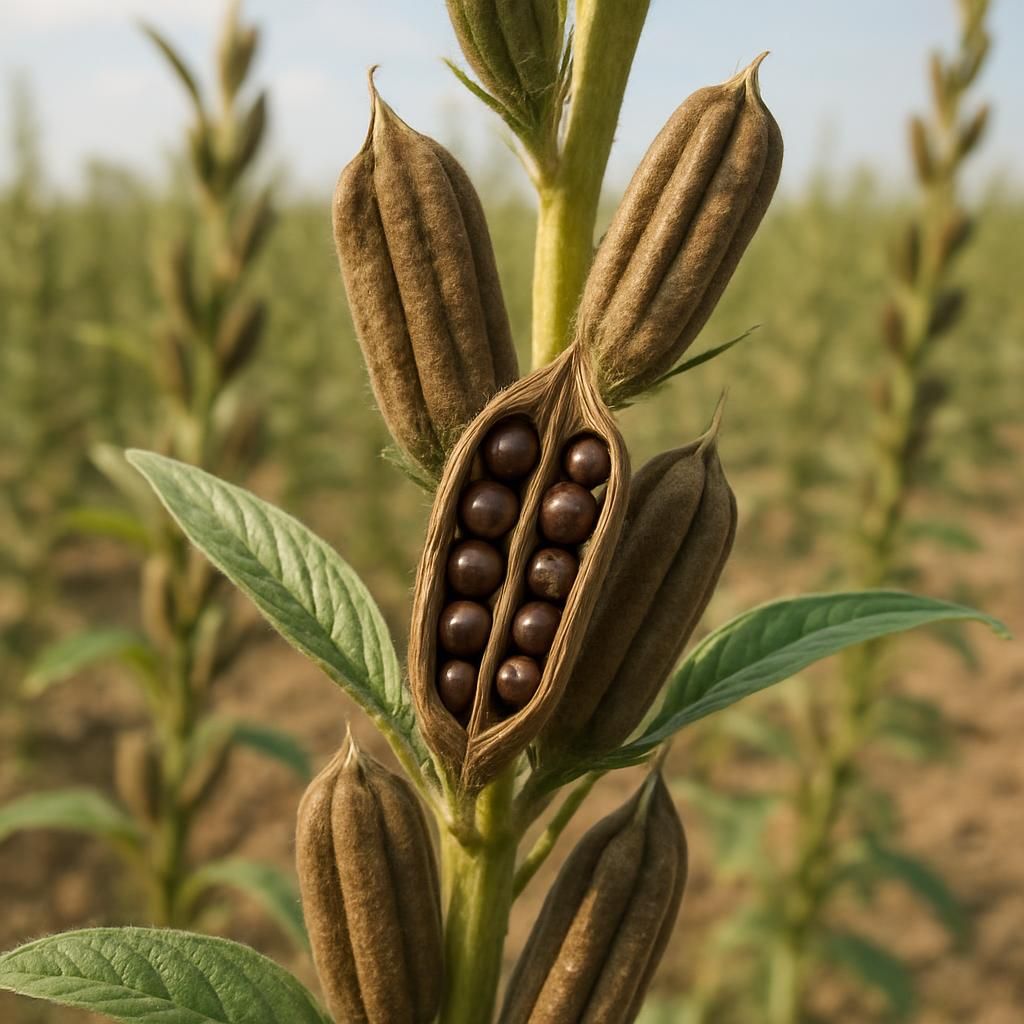
Introduction to Sesame Seed (Brown)
Brown sesame (Sesamum indicum) is one of the oldest cultivated oilseed crops in the world, valued for its high-quality edible oil, protein-rich seeds, and adaptability to marginal soils. Grown for thousands of years across Africa, Asia, and the Middle East, the crop has become increasingly important in sustainable agriculture because of its drought tolerance and low input requirements. Brown varieties are especially sought after in both culinary and industrial markets for their robust flavor and stable oil.
Modern production focuses on optimizing yield, oil percentage, and seed quality while minimizing environmental impact. With rising global demand for natural oils and gluten-free products, brown sesame offers excellent returns for small and large-scale farms. This guide provides professional-grade, field-tested advice for successful cultivation.
Botanical Profile of Sesame Seed (Brown)
Sesamum indicum belongs to the Pedaliaceae family and is an annual herbaceous plant that reaches 1–2 meters in height. The plant produces opposite, lanceolate leaves and tubular flowers that range from white to pale purple. Brown sesame varieties are distinguished by their darker seed coats, which contain higher levels of antioxidants compared to white types.
The root system is deep and taprooted, allowing efficient uptake of water and nutrients from lower soil horizons. After pollination, the plant develops dehiscent capsules containing 50–100 seeds each. The crop typically matures in 90–120 days depending on cultivar and climate.
Soil, pH, and Climate Requirements for Sesame Seed (Brown)
Sesame thrives in well-drained sandy loam to loam soils with good aeration. Heavy clay soils should be avoided unless heavily amended. The crop performs best in slightly acidic to neutral conditions.
| Parameter | Ideal Range | Notes |
|---|---|---|
| Soil Type | Sandy loam to loam | Excellent drainage essential |
| Soil pH | 5.5 – 7.5 | Optimal nutrient uptake |
| Temperature (Day) | 25–35 °C | Sensitive to frost |
| Temperature (Night) | 15–22 °C | Avoid prolonged cold |
| Annual Rainfall | 400–800 mm | Supplemental irrigation improves yields |
| Growing Season | 90–120 days | Warm-season crop |
Step-by-Step Planting & Propagation
- Select certified disease-free seed of a high-yielding brown variety suited to your region.
- Prepare the field by deep plowing followed by harrowing to create a fine seedbed.
- Sow seeds when soil temperature reaches 20 °C or higher, typically 2–3 weeks after the last frost.
- Use a seed rate of 4–6 kg/ha for row planting at 30–45 cm between rows and 10–15 cm between plants.
- Plant seeds 2–3 cm deep; maintain consistent moisture until germination (5–7 days).
- Thin seedlings to the recommended spacing once they reach 10 cm in height.
Care & Maintenance regimes for Sesame Seed (Brown)
Proper irrigation, nutrition, and canopy management are critical for maximizing oil content and seed yield.
| Growth Stage | Water Schedule | Fertilizer Application | Pruning / Other Care |
|---|---|---|---|
| Pre-plant | Ensure field capacity at 60–70% | Incorporate 20–30 kg N, 40–50 kg P₂O₅, 30 kg K₂O per ha | Remove weeds; level field |
| Vegetative (0–40 days) | Light irrigation every 7–10 days | Side-dress 15–20 kg N at 25–30 days | Weed control; avoid waterlogging |
| Flowering (40–70 days) | Moderate irrigation; avoid stress | Optional foliar micronutrients (Zn, B) | Monitor for capsule development |
| Maturation (70–100 days) | Reduce irrigation; stop 2 weeks before harvest | None | No pruning required; watch for lodging |
Pests, Diseases & Organic Management
Sesame is relatively hardy but can be affected by several pests and diseases. Key threats include Aphids, Spider mites, cutworms, capsule borers, Alternaria leaf spot, Cercospora leaf spot, charcoal rot, and phyllody.
Organic management emphasizes prevention: rotate with non-host crops such as Sorghum or Millet, maintain field sanitation, and encourage beneficial insects. Neem-based sprays, insecticidal soaps, and Bacillus thuringiensis (Bt) are effective against chewing insects. For fungal issues, improve drainage and apply compost teas or copper-based fungicides as a last resort.
Harvesting, Curing & Optimal Storage
Harvest when the lower leaves turn yellow and capsules begin to dry but before they shatter. Cut plants at the base and bundle them for 7–10 days of field curing. Thresh by beating bundles over a clean tarp, then winnow to remove chaff.
Dry seeds to 6–8% moisture content before storage. Store in cool, dry, airtight containers or silos. Properly stored brown sesame seeds retain viability and oil quality for 12–18 months.
Companion Planting for Sesame Seed (Brown)
Sesame benefits from strategic companions that improve soil fertility, deter pests, or provide physical support. Recommended pairings include Pigeon pea, Cowpea, Marigold, and Sorghum. These combinations enhance biodiversity, suppress weeds, and can increase overall system resilience.
Avoid planting near crops that share similar pests or diseases, such as cotton or sunflower, unless rigorous rotation is practiced. Intercropping with legumes also supplies atmospheric nitrogen, reducing fertilizer needs.