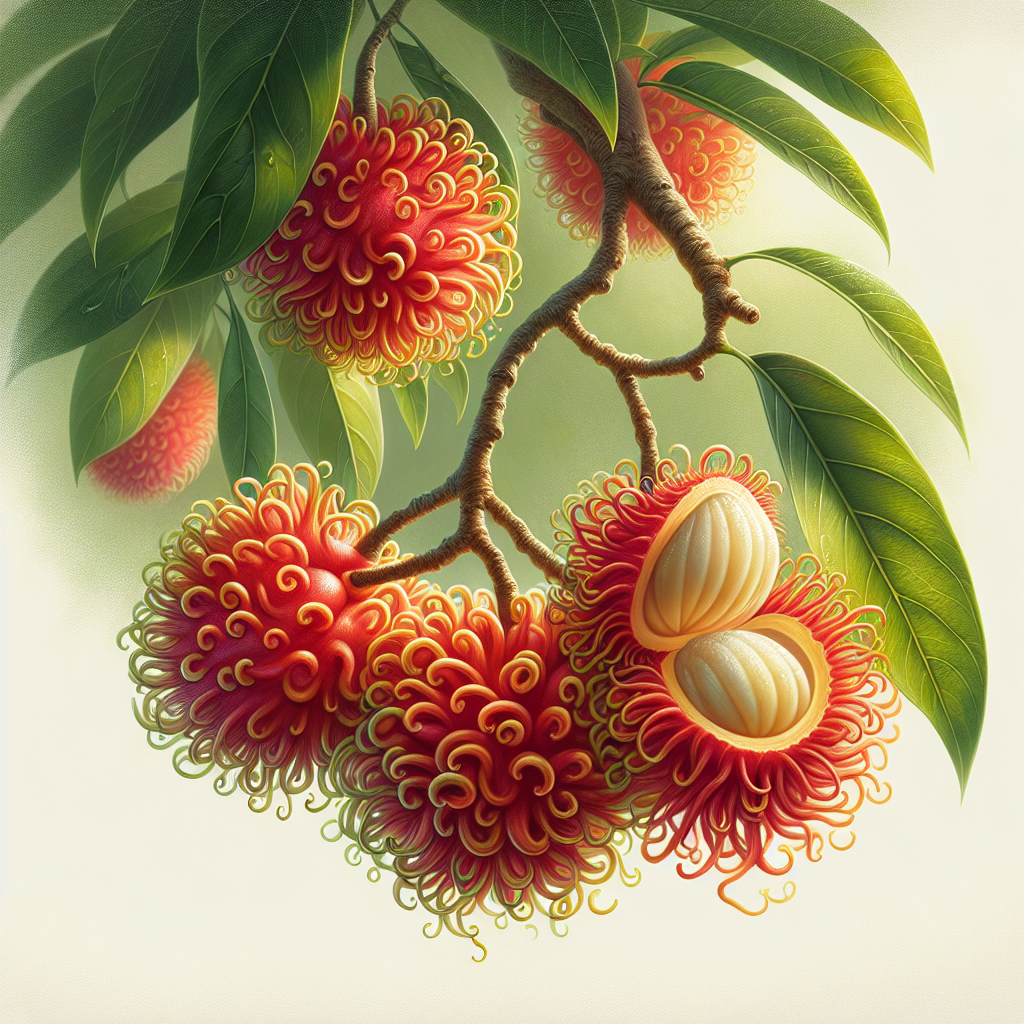
Introduction to Pulasan (Sibayat)
Pulasan (Sibayat), scientifically known as Nephelium mutabile, is a premium tropical fruit tree celebrated for its delectable, sweet-tart berries that surpass even its cousin, the rambutan in flavor intensity. Originating from the rainforests of Malaysia, Indonesia, and the Philippines—where 'Sibayat' refers to a prized local variety—this evergreen tree thrives in humid, equatorial conditions, yielding clusters of vibrant red fruits encased in soft, golden-haired spines. Unlike the more fibrous rambutan, Pulasan offers a silky, translucent aril that melts in the mouth, making it a favorite among gourmet fruit enthusiasts and small-scale farmers seeking high-value crops.
Growing Pulasan (Sibayat) is moderately straightforward for tropical growers, with trees reaching 10-15 meters in height and producing fruit within 4-6 years from seed or graft. Yields can hit 50-100 kg per mature tree annually, with peak seasons from June to September. Its resilience to common tropical pests and adaptability to backyard or commercial orchards make it ideal for diversifying income in humid regions. This comprehensive guide draws from decades of botanical and agricultural expertise to deliver actionable, professional-grade advice on cultivating this gem. Whether you're a hobbyist in Southeast Asia or an experimental farmer in subtropical zones, mastering Pulasan unlocks a path to bountiful, profitable harvests. For optimal success, focus on site selection, precise propagation, and integrated pest strategies—key pillars we'll explore in depth.
Botanical Profile of Pulasan (Sibayat)
Pulasan (Sibayat) belongs to the Sapindaceae family, sharing lineage with lychee and longan, but distinguished by its unique fruit morphology. The tree is an evergreen perennial, growing to 15 meters with a straight trunk up to 50 cm in diameter, crowned by a dense, spreading canopy of pinnate leaves measuring 20-50 cm long. Leaves are glossy dark green above, leathery, and glabrous, with 6-12 pairs of oblong leaflets that create a lush, tropical aesthetic.
Flowers emerge in dense panicles up to 30 cm long, typically cream or yellowish-green, and are functionally male or hermaphroditic, with pollination relying on bees and other insects. Fruits develop in clusters of 10-20, each 2.5-5 cm in diameter, with a tough red exocarp covered in short, curved, golden spines—less rigid than rambutan's. Peeling reveals a white, edible aril enveloping a single large seed, which unlike rambutan's abortive seed, is fully formed but inedible. Sibayat cultivars are selected for larger aril size (up to 60% of fruit weight), higher sugar content (18-22° Brix), and minimal fiber.
Root systems are shallow and spreading, with lateral roots dominating for water uptake, making mulching essential. Phenologically, vegetative growth peaks in wet seasons, with flowering triggered by brief dry spells (1-2 months). Trees exhibit alternate bearing but can be managed for consistency through pruning. Nutritionally, fruits boast high vitamin C (40-50 mg/100g), antioxidants, and polyphenols, positioning Pulasan as a superfruit in health markets.
Soil, pH, and Climate Requirements for Pulasan (Sibayat)
Pulasan (Sibayat) demands well-drained, fertile loamy soils rich in organic matter, with sandy loam ideal for root aeration. Avoid heavy clays prone to waterlogging, as trees are susceptible to Phytophthora root rot. Optimal pH ranges 5.5-6.5—slightly acidic to neutral—where nutrient availability peaks. Test soil annually; amend with dolomite lime if below 5.5 or sulfur if exceeding 7.0. Incorporate 20-30% compost or well-rotted manure pre-planting to boost microbial activity and cation exchange capacity (CEC >15 meq/100g).
Climatically, Pulasan thrives in USDA zones 10b-12, requiring average temperatures of 24-30°C (75-86°F), with no frost tolerance below 5°C. Annual rainfall of 2000-3000 mm, evenly distributed, is perfect, supplemented by irrigation during dry periods. High humidity (70-90%) aids fruit set, but 1-2 months of reduced rain (<100 mm) induces flowering. Wind protection is crucial; plant in sheltered valleys or use windbreaks like banana hedges. Full sun (6-8 hours daily) promotes vigor, though light shade benefits young trees. Elevations up to 800m suit Sibayat varieties, but avoid coastal salts (>2 dS/m EC). For subtropical trials, employ frost blankets and microclimates. Read our detailed blog on Why Summer Heatwaves Are Silently Killing Small Farm Yields - And 7 Organic Strategies to Fight Back for heat mitigation tactics.
Step-by-Step Planting & Propagation
Propagation favors grafting over seeds for true-to-type Sibayat traits, uniformity, and faster fruiting. Seed Propagation: Collect fresh seeds from ripe fruits, wash off aril, and sow immediately in 1:1 sand-compost mix at 25-30°C. Germination occurs in 10-20 days (80% rate). Transplant seedlings at 30 cm height to pots, hardening off after 6 months.
Grafting (Preferred): Use veneer or cleft grafting on rambutan or longan rootstocks in late rainy season. Select 1-year scions with 3-4 buds from disease-free mother trees. Align cambium layers, secure with parafilm, and shade for 4-6 weeks (90% success). Budding works too: T-bud in humid mornings.
Planting: Site-prepare holes 60x60x60 cm, enriched with 10 kg compost, 500g rock phosphate, 200g wood ash. Space trees 8-10m apart (100-150 trees/ha). Plant grafts at same depth as nursery, stake, and mulch 10 cm deep with coconut husk or leaves. Water deeply (50L/tree) weekly first year. For polybag starts, acclimate 1 week before field transfer. Expect first fruits in 3-4 years.
Care & Maintenance regimes for Pulasan (Sibayat)
Irrigation: Drip systems deliver 40-60L/tree/week in dry spells, maintaining soil moisture at 60-70% field capacity. Deficit irrigation (50% ETc) during flowering enhances quality.
Fertilization: Annual regime: Year 1: 200g NPK 15-15-15 + 100g urea/tree. Mature: 1-2 kg complete fertilizer (10-20-20) split 3x/year, plus 5 kg compost. Foliar sprays of micronutrients (Zn, B, Mn) at 2g/L bi-monthly prevent deficiencies. Soil tests guide adjustments.
Pruning: Annually post-harvest, remove deadwood, watersprouts, and inward branches for open canopy. Tip-prune terminals to stimulate laterals. Dwarfing through rootstock selection keeps trees manageable.
Weeding/Mulching: Maintain 1m weed-free basin; mulch refreshes yearly to suppress competition and retain moisture.
Training: Single trunk to 3m, then open center for light penetration.
Pests, Diseases & Organic Management
Pests: Fruit-piercing moths (top threat)—deploy pheromone traps and light traps; cover clusters with fine nets. Mealybugs and scale insects: Introduce ladybugs or spray neem oil (2-5 ml/L) weekly. Seed borers: Bagging fruits at pea-size. Aphids: Soap sprays + marigold borders.
Diseases: Anthracnose: Copper fungicide (1%) pre-monsoon; ensure airflow. Phytophthora palmivora: Improve drainage, apply Trichoderma (5 kg/ha). Leaf spots: Remove infected parts, potassium phosphite drenches.
Organic IPM: Monitor weekly, use beneficials like Cryptolaemus for mealybugs. Check Why 90% of Small Farms Fail at Pest Management - And 8 Organic Fixes That Actually Work for proven protocols. Rotate preventives; avoid overhead watering.
Harvesting, Curing & Optimal Storage
Harvest at full red color, spines turning golden (color break stage), 130-140 days post-anthesis. Clip clusters with secateurs, yielding 20-50 fruits/cluster. Mature trees: 3-4 picks over 4-6 weeks. Yield peaks at 10-15 years.
Post-Harvest: Cool to 13-15°C within 6 hours; hydrocool in 10°C water. Store at 90-95% RH, 13°C for 3-4 weeks (shelf life). For markets, pack in ventilated crates; avoid ethylene producers like mango. Curing unnecessary, but waxing extends vase life. Process into jams, juices for value-add.
Companion Planting for Pulasan (Sibayat)
Enhance orchards with nitrogen-fixers like pigeon pea (intercrop rows 1-2 years), deterring nematodes. Ginger understory suppresses weeds, repels borers. Thai basil attracts pollinators, confuses moths. Avoid legumes post-establishment to prevent competition. Gliricidia windbreaks fix N, mulch chop-and-drop style. Check Why Companion Planting Feels Like Guesswork for Small Farms - And How AI Makes It Foolproof—wait, no, use the list. Actually, integrate Clover for groundcover to boost soil health without shading trees.