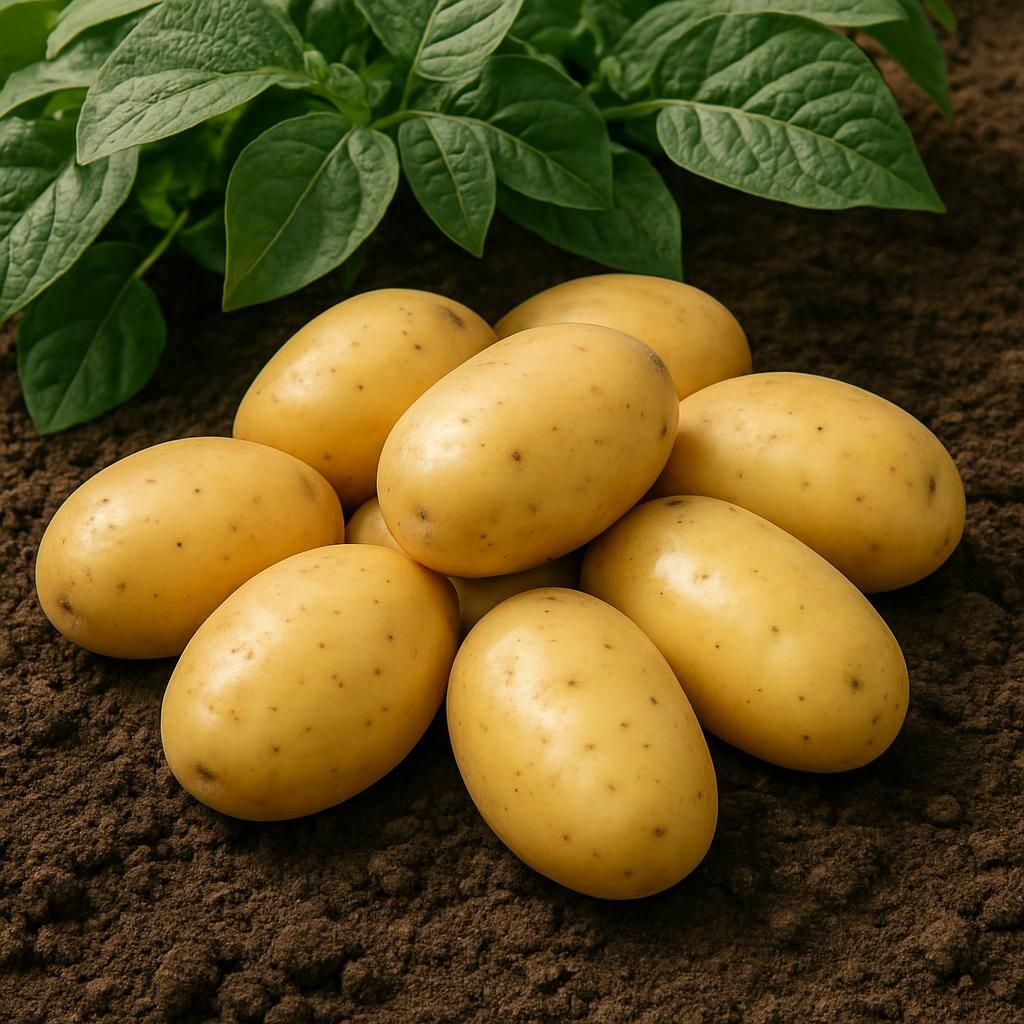
Introduction to Potato (Vivaldi)
Vivaldi is a second-early potato variety developed in the Netherlands and widely adopted across temperate growing regions for its combination of high marketable yield, attractive yellow tubers, and resistance to common scab. Growers value its smooth skin, low tuber defects, and reliable performance in both conventional and organic systems. The variety matures in approximately 90–110 days from planting, bridging the gap between first earlies and maincrop types.
Its waxy texture and buttery flavor make Vivaldi a favorite for boiling, steaming, and cold salads, while its moderate dry-matter content also suits roasting. Because the plants produce compact, upright foliage, they are well-suited to both open-field production and protected cropping under low tunnels. Commercial trials consistently show strong skin finish and minimal internal defects when grown on well-managed soils.
Botanical Profile of Potato (Vivaldi)
Vivaldi belongs to the species Potato (Solanum tuberosum) and is classified as a diploid or tetraploid cultivar with yellow flesh and smooth, oval to long-oval tubers. The plants exhibit medium-height, semi-erect stems with dark green leaves and produce white to pale lilac flowers. Tubers have shallow eyes, thin yellow skin, and firm, waxy yellow flesh that retains shape after cooking.
The variety shows moderate resistance to common scab and good tolerance to mechanical damage during harvest. It is susceptible to late blight and requires standard protective measures in high-pressure regions. Storage performance is good when cured properly, with low sprouting under cool, dark conditions.
Soil, pH, and Climate Requirements for Potato (Vivaldi)
Vivaldi performs best on deep, well-drained sandy loam or silt loam soils with good structure and moderate organic matter. Heavy clay soils should be avoided or improved with raised beds and organic amendments to prevent waterlogging and tuber deformation.
| Parameter | Ideal Range | Notes |
|---|---|---|
| Soil Type | Sandy loam to silt loam | Good drainage essential |
| Soil pH | 5.5 – 6.5 | Avoid liming immediately before planting |
| Soil Temperature | 10–18 °C at planting | Warmer soils speed emergence |
| Air Temperature | 15–22 °C daytime | Cool nights improve tuber set |
| Frost Tolerance | Light frost only | Protect emerging shoots below –1 °C |
| Rainfall / Irrigation | 500–700 mm season total | Consistent moisture critical during tuber bulking |
Step-by-Step Planting & Propagation
Select certified seed tubers of 35–55 mm diameter that are free of disease symptoms. Pre-sprout (chit) seed in a cool, bright location 4–6 weeks before planting to encourage strong, multiple sprouts. Plant when soil temperature at 10 cm depth reaches at least 8 °C and the risk of heavy frost has passed.
Rows should be spaced 75–90 cm apart with in-row spacing of 25–30 cm for seed-sized tubers. Plant at a depth of 10–12 cm, covering with soil and forming a slight ridge. In heavier soils, plant on 15–20 cm ridges to improve drainage and ease of harvest. Maintain a final plant population of 35,000–45,000 plants per hectare depending on target tuber size.
Care & Maintenance regimes for Potato (Vivaldi)
Consistent moisture and balanced nutrition are essential for high-quality tubers. Begin irrigation when soil moisture drops below 60 % field capacity and maintain even moisture, especially during tuber initiation and bulking. Avoid water stress followed by heavy irrigation, which can cause growth cracks.
| Growth Stage | Water (mm/week) | Fertilizer (N-P-K) | Pruning / Hilling |
|---|---|---|---|
| Pre-emergence | 10–15 | 40-60-80 basal | Light ridge formation |
| Emergence to flowering | 20–25 | 30-0-40 side-dress | Hill to 15–20 cm when shoots 15 cm |
| Tuber bulking | 25–30 | 20-0-60 potassium focus | Maintain ridge height |
| Maturation | 10–15 | None | Cease irrigation 2–3 weeks pre-harvest |
Apply organic mulch such as straw or compost between rows after the final hilling to suppress weeds and conserve moisture. Scout regularly for nutrient deficiencies and adjust fertigation or foliar feeds accordingly.
Pests, Diseases & Organic Management
The most significant insect threat is the Colorado potato beetle, whose larvae can defoliate plants rapidly. Hand-pick adults and larvae in small plantings or apply approved organic insecticides such as spinosad or neem when thresholds are reached. Aphids vector viruses; deploy yellow sticky traps and encourage natural enemies with flowering strips.
Late blight remains the primary disease concern. Use resistant varieties where available, practice strict 3–4 year rotations, and apply copper-based fungicides preventively during humid periods. Common scab incidence is low in Vivaldi but can be further reduced by maintaining soil pH below 6.0 and avoiding fresh manure applications.
Harvesting, Curing & Optimal Storage
Harvest Vivaldi when the majority of foliage has senesced naturally or after vine killing with approved methods. Lift tubers carefully with a fork or mechanical harvester, avoiding skinning. Allow tubers to cure for 10–14 days at 12–15 °C and 90–95 % relative humidity to heal harvest wounds.
Store cured tubers in darkness at 4–7 °C with 85–90 % humidity and good ventilation. Monitor regularly for sprouting and soft rots. Under optimal conditions, Vivaldi maintains quality for 4–6 months.
Companion Planting for Potato (Vivaldi)
Plant Garlic or Onion nearby to deter aphids and Colorado potato beetle. Low-growing herbs such as Thyme and Rosemary provide additional pest confusion and attract beneficial insects. Avoid planting near Tomato or other Solanaceae to reduce shared disease pressure. Include Nasturtium as a trap crop for aphids at field edges.