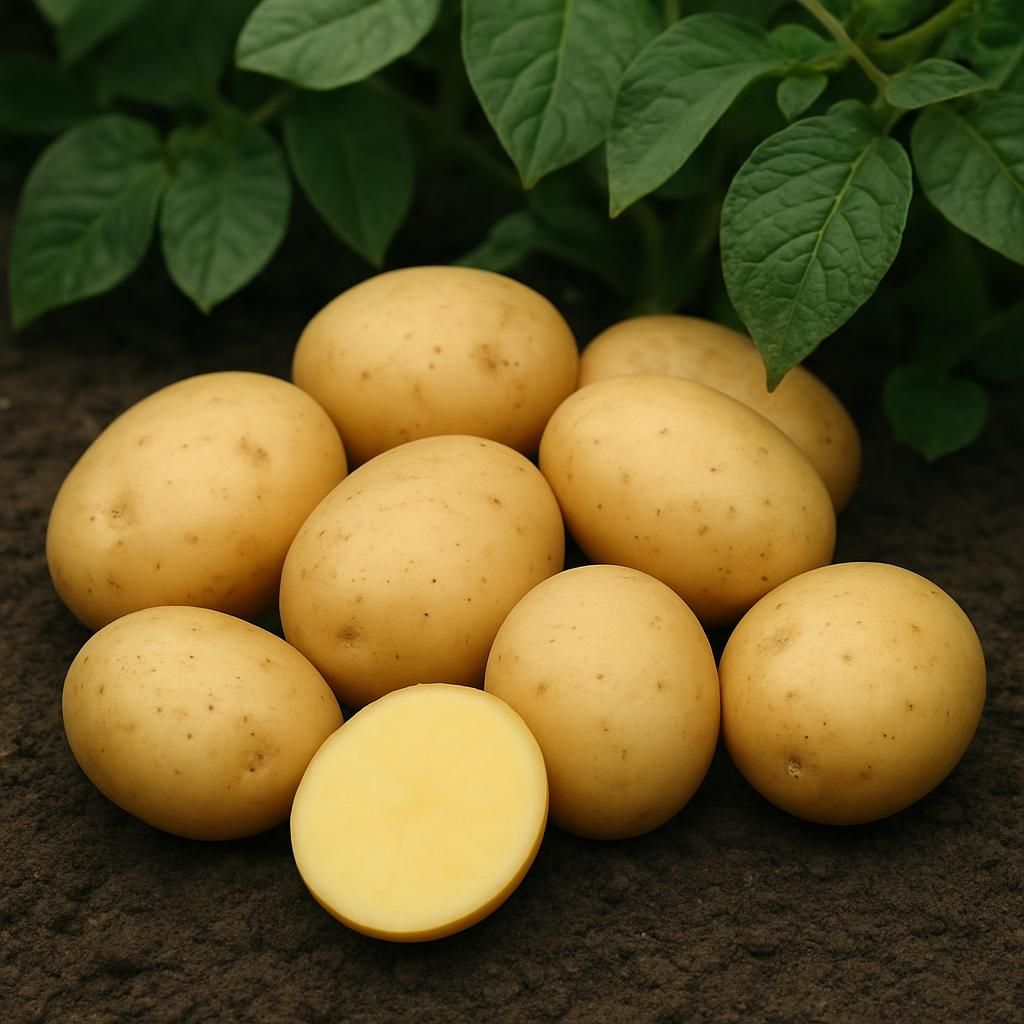
Introduction to Potato (Bintje)
Bintje is a mid-season, yellow-fleshed potato developed in the Netherlands in 1904 that has become one of Europe's most widely grown table varieties. It produces oval to long tubers with smooth, light-yellow skin and firm, waxy yellow flesh that holds shape well during boiling, frying, and roasting. The cultivar is valued for its high tuber set, moderate drought tolerance, and good storability when cured properly.
Commercial growers favor Bintje for its consistent yields of 35–45 t/ha under optimal management, while home gardeners appreciate its resistance to common scab and relatively low susceptibility to bruising. Because it is a determinate variety, plants reach maturity in 90–110 days depending on soil temperature and day length. Bintje performs best in cool, moist conditions but adapts to a range of temperate climates when provided with adequate irrigation and nutrition.
Botanical Profile of Potato (Bintje)
Bintje belongs to the nightshade family (Solanaceae) and is botanically identical to other Potato (crop) cultivars. The plant produces compound leaves with 6–8 pairs of leaflets and bears white to pale lavender flowers that rarely set true seed. Underground stolons elongate from the base of the stem and swell at their tips to form tubers. Each tuber contains multiple buds (eyes) arranged in a spiral pattern that serve as vegetative propagation sites.
The cultivar exhibits moderate vine vigor reaching 60–80 cm in height with an upright to semi-spreading habit. Tuber skin is thin and light yellow; flesh is firm with low reducing-sugar content, making it suitable for both fresh market and light processing. Bintje shows intermediate resistance to late blight but remains susceptible to early blight and several viral diseases.
Soil, pH, and Climate Requirements for Potato (Bintje)
Bintje thrives in well-drained, fertile loamy soils with good structure. Heavy clay soils should be amended with organic matter or grown on raised beds to prevent waterlogging and tuber rot. Ideal soil pH ranges from 5.5–6.5; values above 6.8 increase the risk of common scab while values below 5.0 may induce aluminum toxicity.
| Parameter | Ideal Range | Notes |
|---|---|---|
| Soil Type | Sandy loam to loam | Good drainage essential |
| Soil pH | 5.5–6.5 | Avoid liming unless pH <5.0 |
| Organic Matter | 3–5% | Improves structure and water retention |
| Temperature (soil) | 7–20 °C at planting | 10 °C optimum for rapid sprout growth |
| Air Temperature | 15–22 °C daytime | Night temperatures 10–15 °C ideal |
| Frost Tolerance | None after emergence | Protect with row cover if frost forecast |
| Day Length | 12–16 hours | Long days promote tuberization |
Step-by-Step Planting & Propagation
- Source certified seed tubers free of virus and bacterial diseases. Select Bintje seed of 35–55 mm diameter with at least 3–5 viable eyes.
- Pre-sprout (chit) tubers 4–6 weeks before planting at 12–15 °C under diffuse light to produce 1–2 cm sturdy sprouts.
- Prepare soil by incorporating 3–5 cm well-rotted compost or aged manure. Avoid fresh manure which promotes scab.
- Plant when soil temperature reaches 7 °C and rising. Rows spaced 75–90 cm apart; set tubers 25–30 cm apart within row at 10–12 cm depth.
- Cover with soil and firm gently. In heavier soils, plant 8 cm deep on 10 cm ridges to improve drainage.
- Apply a balanced starter fertilizer (e.g., 5-10-10) banded 5 cm to the side and below the seed piece.
Care & Maintenance regimes for Potato (Bintje)
Bintje requires consistent moisture, especially during tuber initiation (4–6 weeks after emergence) and bulking. Overhead irrigation should be avoided after flowering to reduce foliar disease pressure; drip irrigation is preferred.
| Growth Stage | Water (mm/week) | Fertilizer (N-P-K kg/ha) | Pruning / Hilling Schedule |
|---|---|---|---|
| Pre-emergence | 15–20 | 40-60-80 at planting | None |
| Emergence to flowering | 25–30 | 30-0-40 at 4 weeks | Hill once when vines 15 cm tall |
| Flowering to maturity | 20–25 | 20-0-60 sidedress at flowering | Hill again if tubers exposed |
| 2 weeks pre-harvest | Withhold 7–10 days | None | Remove dead vines (optional) |
Monitor petiole nitrate levels weekly; maintain 1.2–1.8% NO3-N during bulking. Mulch with 5–8 cm straw after final hilling to suppress weeds and stabilize soil temperature.
Pests, Diseases & Organic Management
Major insect pests include Colorado potato beetle, aphids, and wireworms. Handpick beetle adults and larvae; apply Bacillus thuringiensis var. tenebrionis when first-generation larvae are small. Use yellow sticky traps and reflective mulch to deter aphids that vector Potato virus Y and Potato leafroll virus.
Common diseases are early blight, late blight, and common scab. Rotate with non-host crops for at least three years. Apply copper-based fungicides preventively when weather favors late blight (temperature 10–25 °C and >80% RH for 48 h). Avoid overhead irrigation and remove volunteer potato plants to break disease cycles.
Harvesting, Curing & Optimal Storage
Bintje reaches physiological maturity when vines begin to yellow and skins set firmly. Harvest 10–14 days after vine kill for optimal skin set. Dig on a dry day; avoid bruising by using wide forks or mechanical harvesters with padded chains.
Cure tubers at 12–15 °C and 90–95% RH for 10–14 days to heal wounds. Store at 4–7 °C with 85–90% humidity and good air circulation. Maintain darkness to prevent greening. Under proper conditions Bintje stores 4–6 months with minimal weight loss and sprouting.
Companion Planting for Potato (Bintje)
Plant Nasturtium and Marigold as trap crops to attract beneficial insects and deter aphids. Garlic and Onion interplanted in rows help repel wireworms and Colorado potato beetle. Avoid planting near Tomato and other nightshades to reduce shared disease pressure. Bush beans and peas can be grown in adjacent beds to improve soil nitrogen for subsequent potato crops.
Stop Treating Tomato Blight Like a Spray Problem: Here Is What Works Better