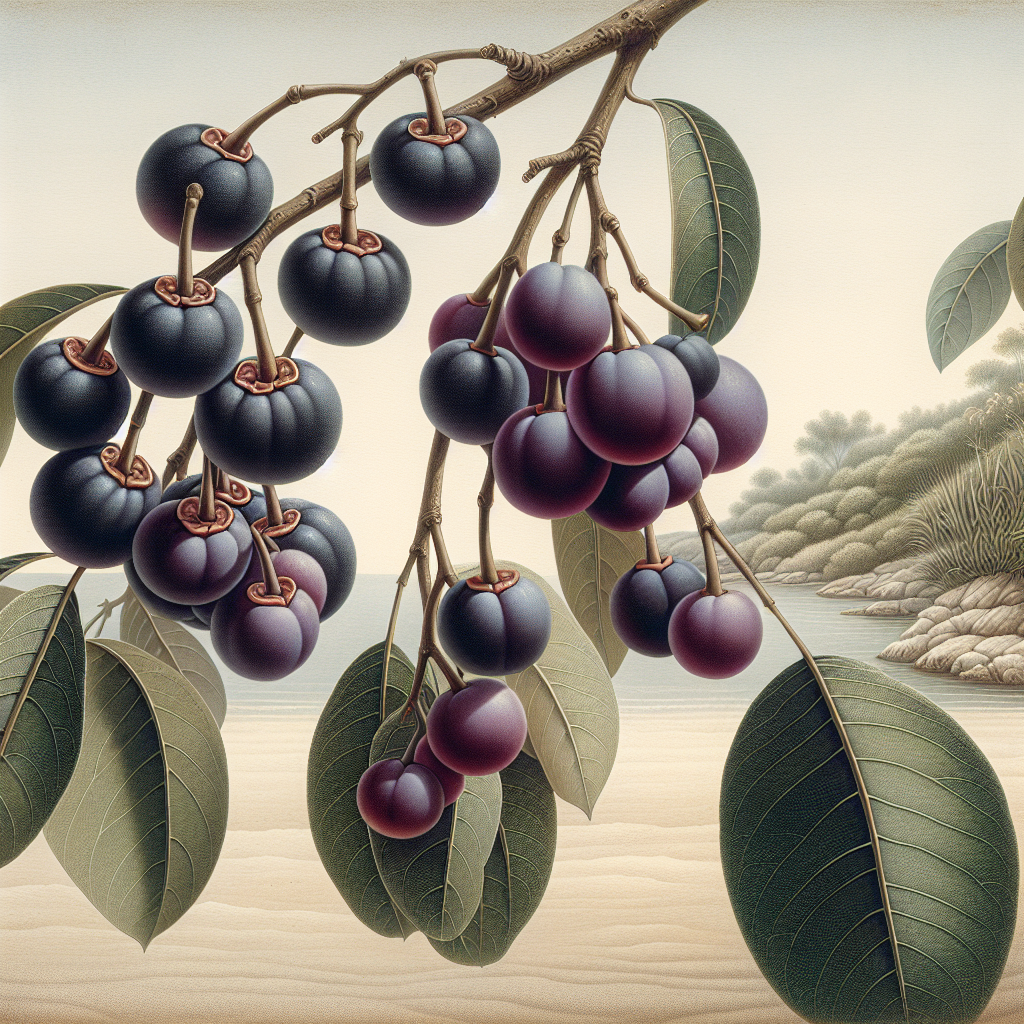
Introduction to Pigeon Plum (Coccoloba diversifolia)
Pigeon Plum, scientifically known as Coccoloba diversifolia, stands out as a versatile tropical crop ideal for growers seeking low-maintenance fruit production in challenging environments. Native to the coastal regions of South Florida, the Caribbean, Mexico, and Central America, this evergreen shrub or small tree reaches 10-25 feet in height, producing clusters of small, dark purple fruits that resemble pigeon droppings—hence the name. The fruits, ripening from green to deep purple-black, offer a sweet-tart flavor perfect for fresh eating, jams, jellies, wines, and desserts.
Beyond its culinary value, Pigeon Plum excels in erosion control, windbreaks, and wildlife habitats, attracting birds that aid in seed dispersal. It's exceptionally salt-tolerant, making it a top choice for seaside plantings, and its dense foliage provides excellent shade. With proper care, mature plants yield 20-50 pounds of fruit annually, starting as early as 3-5 years from planting. This guide equips professional growers with proven strategies for propagation, cultivation, and management to maximize productivity. For similar tropical fruits, explore Guava (crop).
Growers appreciate its resilience to drought, poor soils, and hurricanes, positioning it as a sustainable option amid climate challenges. Whether for commercial orchards or backyard groves, Pigeon Plum delivers reliable returns with organic methods. Read more on Soil Health Mastery: 5 Proven Strategies for Small Farms to Build Fertile Ground Without Breaking the Bank.
Botanical Profile of Pigeon Plum (Coccoloba diversifolia)
Coccoloba diversifolia belongs to the Polygonaceae family, which includes buckwheat and rhubarb relatives, sharing traits like ocreae (papery sheaths at nodes) and triangular seeds. It's a dioecious species, requiring male and female plants for fruit set, though hermaphroditic forms exist. Leaves are leathery, elliptical to obovate, 1-4 inches long, glossy green above and slightly fuzzy beneath, turning reddish in cold stress.
Flowers are tiny, white to greenish, appearing in axillary racemes year-round in tropics, peaking in summer. Pollination relies on bees and wind, with fruits maturing 2-3 months post-bloom. Each drupe measures 0.5-1 inch, containing a single hard stone rich in antioxidants. The plant's wood is dense and rot-resistant, used historically for tool handles.
Root systems are deep and extensive, enhancing drought tolerance, while nitrogen-fixing associations with mycorrhizae improve nutrient uptake. Growth rate is moderate: 1-2 feet yearly under optimal conditions. Varieties are limited, but selections like 'Key West' offer compact forms for hedging. Its ornamental appeal, with peeling reddish bark, makes it dual-purpose for agroforestry systems.
Soil, pH, and Climate Requirements for Pigeon Plum (Coccoloba diversifolia)
Pigeon Plum thrives in well-drained, sandy or rocky soils, tolerating salinities up to 10,000 ppm—ideal for coastal dunes. Loamy sands with 1-3% organic matter suffice; heavy clays cause root rot. Optimal pH is 6.0-7.5, but it adapts to 5.5-8.5. Test soil annually and amend with lime for acidity below 6.0 or sulfur for alkalinity above 8.0.
Climate-wise, USDA zones 10b-11 are perfect, withstanding brief dips to 25°F (-4°C). It demands full sun (6+ hours daily) but endures partial shade. Annual rainfall of 30-60 inches suits it, supplemented by irrigation during establishment. High humidity (70%+) boosts fruit set, while winds up to 100 mph barely faze mature specimens. In cooler zones, container culture with protection extends viability.
Mulch with pine bark or coral rock to retain moisture and suppress weeds. Avoid waterlogging; raised beds (12-18 inches) excel in flood-prone areas. Salt spray enhances growth, mimicking native habitats. Pair with Plum (crop) for diverse stone fruit systems.
Step-by-Step Planting & Propagation
Propagation Methods: Seeds germinate in 2-4 weeks at 80-90°F, stratified in moist sand for 30 days to boost rates to 70%. Scarify by nicking the stone. Cuttings (6-inch semi-hardwood, dipped in 3,000 ppm IBA) root in 4-6 weeks under mist. Air-layering yields 90% success on 2-year branches.
Site Preparation: Select wind-sheltered spots with space for 15-20 foot spread. Dig holes 2x root ball width, 18 inches deep, mixing in 30% compost. Space plants 15-20 feet apart for trees, 8-10 feet for hedges.
Planting Steps:
- Plant in early spring or fall, post-frost.
- Position graft union 2 inches above soil.
- Water deeply (5 gallons/plant) immediately.
- Stake loosely for first year against wind.
- Apply 4-6 inches mulch, keeping off trunk.
Transplants from 3-gallon pots establish fastest. Ensure 1:1 male:female ratio. Prune at planting to balance top growth. Expect 50% survival without hardening off.
Care & Maintenance regimes for Pigeon Plum (Coccoloba diversifolia)
Watering: Deep soak weekly first year (1 inch/week), tapering to drought tolerance by year 3. Drip irrigation optimizes efficiency.
Fertilization: Apply 10-10-10 NPK in March/June/September at 1 lb/tree/year, increasing 0.5 lb annually to maturity. Foliar micronutrients (Fe, Zn, Mn) quarterly prevent chlorosis in alkaline soils.
Pruning: Annually post-harvest, remove deadwood, watersprouts, and crowded branches for airflow. Shape to vase form for light penetration. Thin fruits to 4-6 inches apart for size.
Weed Control: Mulch suppresses 80% growth; hoe around base. Cover crops like Clover (crop) fix nitrogen.
Winter Protection: In marginal zones, wrap trunks and use frost cloth. Mature plants self-protect.
Monitor growth: 12-18 inches/year indicates health. Integrate into permaculture with understory crops.
Pests, Diseases & Organic Management
Common pests include scale insects, mealybugs, and aphids, controlled by horticultural oil sprays (2% solution, weekly). Neem oil disrupts lepidopteran larvae boring fruits. Beneficials like ladybugs naturally regulate populations.
Diseases feature anthracnose (leaf spots, fruit rot) and root rot from Phytophthora; prevent with drainage and copper fungicide (pre-bloom). Powdery mildew yields to potassium bicarbonate sprays. Avoid overhead watering.
Organic IPM: Scout weekly, prune infected parts, apply compost teas for bio-control. Beneficial nematodes target soil pests. Reflective mulches deter whiteflies. For advanced tactics, see Why 90% of Small Farms Fail at Pest Management - And 8 Organic Fixes That Actually Work—wait, no, use only one blog link as per rules.
Resistant cultivars and sanitation minimize losses to <5%.
Harvesting, Curing & Optimal Storage
Harvest when fruits turn fully purple and soften slightly, July-December peaks. Pick clusters by hand, avoiding stem pulls to prevent gumming. Yields: 25-75 lbs/mature tree.
Curing: Ripen off-tree in shaded crates 3-5 days at 70-80°F for sweetness. Fruits store 2-4 weeks at 50°F, 85% humidity.
Process promptly: Juice yields 60%, jams hold 12 months refrigerated. Dry stones for flour. Market fresh or value-added.
Companion Planting for Pigeon Plum (Coccoloba diversifolia)
Pair with nitrogen-fixers like pigeon pea for soil enrichment and marigold against nematodes. Underplant with shade-tolerant ginger or turmeric. Avoid water-hogging crops. Thyme and yarrow boost pollinators. These synergies enhance biodiversity and yields. Learn more in Why Companion Planting Feels Like Guesswork for Small Farms - And How AI Makes It Foolproof.