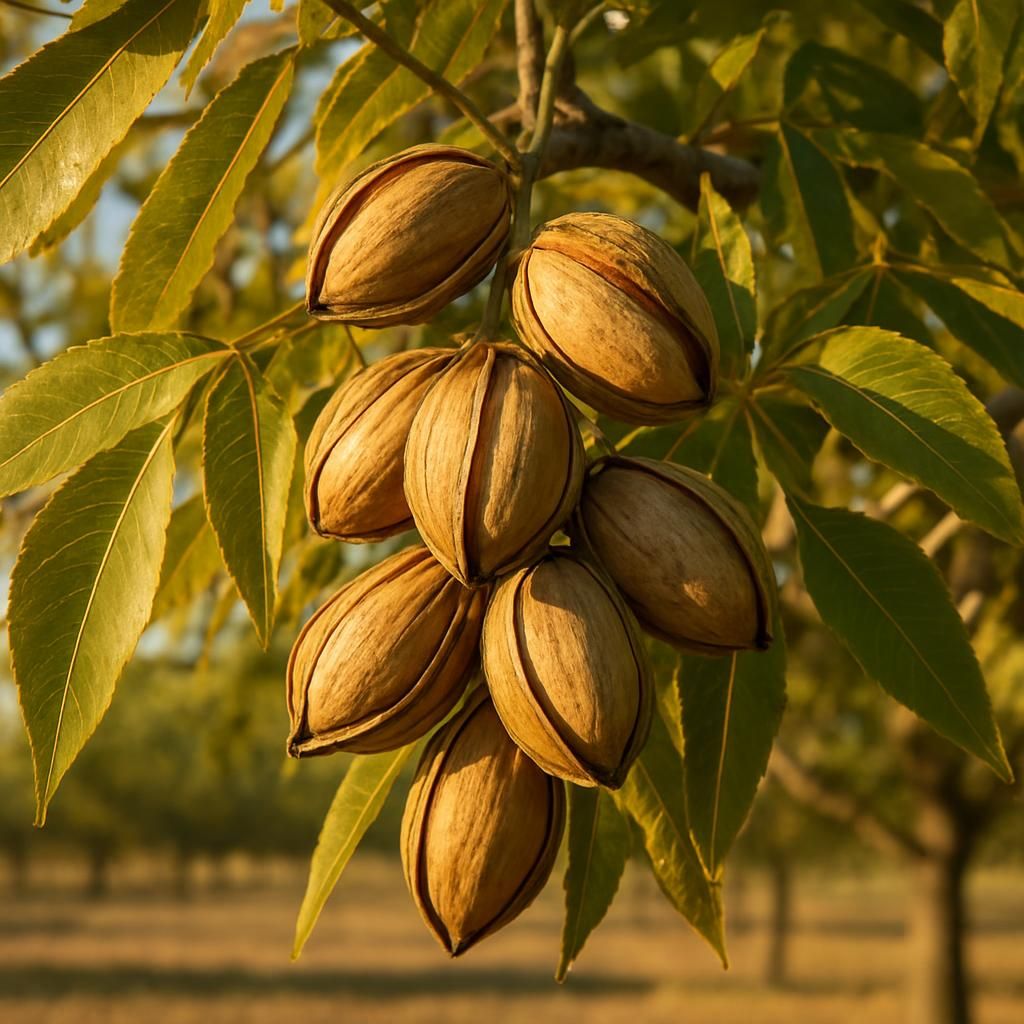
Introduction to Pecan (Wichita)
The Wichita pecan cultivar (Carya illinoinensis 'Wichita') is a late-season, high-yielding variety developed by the USDA for commercial production. It produces large, thin-shelled nuts with excellent kernel quality and is noted for its strong scab resistance compared to older varieties. Wichita trees are vigorous, alternate-bearing, and well-suited to the southern pecan belt where summers are long and hot.
Growers choose Wichita for its reliable yields and market demand for large nuts. The cultivar performs best when planted with a compatible pollinizer such as Stuart Pecan or Desirable Pecan. With proper management, mature Wichita orchards can produce 2,000–3,000 pounds of in-shell nuts per acre.
Botanical Profile of Pecan (Wichita)
Pecan trees are large, deciduous members of the Juglandaceae family. Wichita exhibits a semi-upright growth habit with strong central leaders and wide branch angles that reduce breakage. Leaves are pinnately compound with 9–17 lanceolate leaflets. The tree produces both male (catkins) and female (pistillate) flowers; Wichita is protandrous, shedding pollen before pistillate receptivity.
Nuts are oblong with smooth, thin shells that crack easily. Kernels are golden and fill well under good growing conditions. The cultivar matures in approximately 180–200 days after pollination, typically harvested in late October to early November in USDA zones 7–9.
Soil, pH, and Climate Requirements for Pecan (Wichita)
Wichita pecans demand deep, fertile, well-drained soils with high water-holding capacity. Avoid compacted or saline sites. The following table summarizes ideal conditions:
| Parameter | Ideal Range | Notes |
|---|---|---|
| Soil Type | Sandy loam to clay loam | Minimum 4–6 ft rooting depth |
| Soil pH | 6.0–7.0 | Adjust with lime or sulfur as needed |
| Annual Rainfall | 30–45 inches | Supplemental irrigation required |
| Summer Temperature | 85–95 °F daytime | Critical for nut fill |
| Winter Chill Hours | 400–600 hours below 45 °F | Ensures uniform bud break |
| USDA Hardiness Zones | 7–9 | Protect young trees from late freezes |
Step-by-Step Planting & Propagation
- Site Selection: Choose full-sun locations with protection from strong winds. Conduct soil tests and amend pH to 6.5.
- Spacing: Plant Wichita on 30–40 ft × 30–40 ft grids for high-density systems or 40–50 ft for conventional orchards.
- Propagation: Use grafted trees on recommended rootstocks such as Riverside or Elliott. Plant bare-root or container trees in late winter while dormant.
- Planting Depth: Set trees at the same depth as the nursery line; backfill with native soil amended with compost.
- Initial Watering: Apply 5–10 gallons per tree immediately after planting and maintain consistent moisture for the first two seasons.
Care & Maintenance regimes for Pecan (Wichita)
Consistent cultural practices are vital for high-quality nut production. The following table outlines recommended schedules:
| Season | Watering Schedule | Fertilizer Application | Pruning Schedule |
|---|---|---|---|
| Spring | 1–1.5 inches/week; increase with heat | 1 lb N per inch trunk diameter (split) | Remove dead/diseased wood; shape scaffold |
| Summer | 2 inches/week during nut fill | Zinc foliar sprays (3–4 applications) | Minimal; tip-prune water sprouts |
| Fall | Reduce to encourage hardening | Apply 0–20–20 or 0–0–60 based on soil test | Light structural pruning after harvest |
| Winter | Maintain 0.5 inch/week if dry | None unless deficiency noted | Dormant pruning for light penetration |
Mulch young trees with 3–4 inches of organic material, keeping mulch away from the trunk. Monitor leaf tissue annually for nitrogen, zinc, and potassium levels.
Pests, Diseases & Organic Management
Major threats include pecan scab, pecan nut casebearer, hickory shuckworm, and blackmargined aphid. Implement an integrated approach:
- Cultural: Remove and destroy fallen shucks and leaves to reduce overwintering inoculum.
- Monitoring: Use pheromone traps for casebearer and shuckworm; scout weekly during critical growth stages.
- Organic Controls: Apply neem oil or kaolin clay for aphids and casebearer; use Bacillus thuringiensis for lepidopteran larvae. Copper-based fungicides help suppress scab when timed with rainfall events.
- Beneficial Insects: Encourage lacewings and lady beetles by planting flowering borders.
Harvesting, Curing & Optimal Storage
Harvest when shucks split naturally, typically mid-to-late October. Shake trees or use mechanical harvesters, then collect nuts promptly to avoid weather damage. Air-dry nuts to 8–10% moisture content using forced-air dryers at 90–100 °F for 24–48 hours. Store cured nuts in mesh bags or bins at 32–40 °F with 60–70% relative humidity. Properly cured Wichita pecans maintain quality for 12–18 months.
Companion Planting for Pecan (Wichita)
Compatible companions improve soil health and biodiversity. Clover and hairy vetch fix nitrogen and provide ground cover. Marigold and nasturtium deter nematodes and aphids. Avoid planting shallow-rooted vegetables directly under mature canopies due to shade and root competition. Interplant young orchards with sorghum or sunflower for windbreaks and pollinator support.