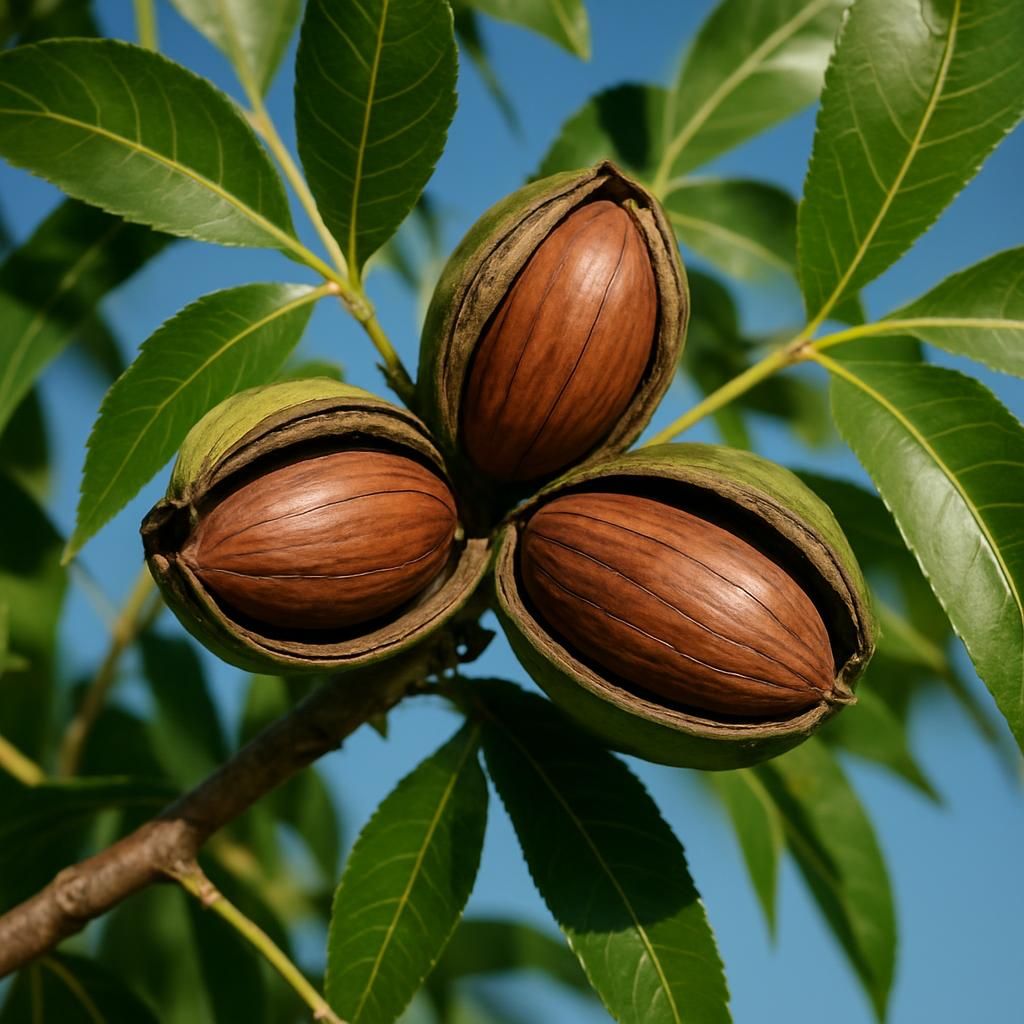
Introduction to Pecan (Sumner)
The Sumner pecan cultivar stands out among commercial varieties for its balance of disease resistance, nut size, and kernel quality. Developed in the southeastern United States, this selection has become a favorite for growers seeking reliable production with reduced fungicide inputs. Its vigorous growth habit and consistent bearing pattern make it suitable for both large-scale orchards and smaller diversified farms. The nuts feature thin shells that crack easily, revealing plump, high-quality kernels with excellent flavor and color. Because of its scab resistance, Sumner reduces the need for intensive spray programs compared to older cultivars, supporting more sustainable production systems.
Botanical Profile of Pecan (Sumner)
Pecan (Sumner) belongs to the Juglandaceae family and is botanically classified as Carya illinoinensis 'Sumner'. The tree is a large, deciduous hardwood that can reach 70–100 feet at maturity with a broad, spreading canopy. Leaves are compound and alternate, typically bearing 9–17 lanceolate leaflets that turn golden-yellow in autumn. Sumner produces both male and female flowers on the same tree, with male catkins appearing earlier than the female flowers, requiring cross-pollination from compatible cultivars such as Stuart Pecan or Desirable Pecan for optimal nut set. The nuts are large, averaging 50–60 per pound, with thin shells and well-filled kernels that exhibit a light color and mild, sweet flavor. Sumner is known for its alternate bearing tendency, which can be managed through proper nutrition and pruning.
Soil, pH, and Climate Requirements for Pecan (Sumner)
Pecan (Sumner) performs best in deep, fertile, well-drained soils with good water-holding capacity. The variety tolerates a range of soil types but yields highest on sandy loam to clay loam soils with high organic matter. Poor drainage leads to root diseases and reduced vigor, so raised beds or drainage tiles are recommended in heavy soils. Sumner requires a long growing season with at least 200 frost-free days and benefits from hot summers and mild winters typical of USDA zones 7–9.
| Parameter | Ideal Range | Notes |
|---|---|---|
| Soil Type | Sandy loam to clay loam | Deep profile preferred |
| Soil pH | 6.0–7.0 | Slightly acidic to neutral |
| Drainage | Excellent | Avoid waterlogged conditions |
| Temperature Range | 75–95°F (24–35°C) during growing season | Requires 200+ frost-free days |
| Annual Rainfall | 30–50 inches (762–1270 mm) | Supplemental irrigation needed in dry periods |
| Chill Hours | 400–600 hours below 45°F | Adequate winter chilling for bud break |
Step-by-Step Planting & Propagation
Site selection is critical for long-term success with Pecan (Sumner). Choose an open area with full sun exposure and protection from strong winds. Soil testing should be conducted at least six months before planting to correct pH and nutrient deficiencies. Trees are typically propagated by grafting onto seedling rootstocks such as 'Elliott' or 'Riverside' for improved disease resistance and vigor. Plant bare-root or container-grown trees in late winter to early spring while dormant. Dig holes twice the width of the root ball and at the same depth as the nursery container. Space trees 35–50 feet apart in rows 40–60 feet wide to allow for mature canopy development. Backfill with native soil amended with compost, water thoroughly, and apply a 3–4 inch layer of organic mulch around the base, keeping it away from the trunk. Stake young trees if needed and install tree guards to protect against rodents and sunscald.
Care & Maintenance regimes for Pecan (Sumner)
Consistent care throughout the year ensures healthy growth and maximum nut production. Young trees require regular irrigation and fertilization to establish strong root systems, while mature trees benefit from targeted nutrient applications and annual pruning. Sumner responds well to integrated management that includes soil testing every two to three years and leaf analysis to fine-tune fertilizer programs.
| Season | Water Schedule | Fertilizer Application | Pruning Schedule |
|---|---|---|---|
| Spring | 1–2 inches per week during bud break | Apply 1 lb N per inch trunk diameter; include zinc and boron | Remove dead/diseased wood; shape scaffold branches |
| Summer | Deep watering every 7–10 days | Side-dress with potassium and magnesium if leaf analysis indicates deficiency | Light tipping of new growth to encourage branching |
| Fall | Reduce watering as dormancy approaches | Apply compost or aged manure; no high-nitrogen | Remove crossing branches; open canopy for light penetration |
| Winter | Minimal unless drought persists | Soil test and amend pH if needed | Dormant pruning of major limbs |
Pests, Diseases & Organic Management
Pecan (Sumner) exhibits strong resistance to pecan scab, one of the most serious diseases affecting pecan orchards. However, it can still be affected by other fungal issues and insect pests. Common challenges include pecan nut casebearer, hickory shuckworm, blackmargined aphid, and Black pecan aphids. Regular scouting and the use of pheromone traps help monitor populations. Organic management relies on cultural practices such as sanitation, beneficial insect habitat, and approved sprays like horticultural oil and neem-based products. Maintaining tree vigor through balanced nutrition reduces susceptibility to both pests and diseases.
Harvesting, Curing & Optimal Storage
Sumner pecans typically mature in mid to late October in the southeastern United States. Nuts are ready for harvest when the shuck splits and the kernel reaches 4–6% moisture. Shake or mechanically harvest when at least 75% of the shucks have opened. Collect nuts promptly to prevent ground loss and quality deterioration. Air-dry or use forced-air dryers to reduce moisture to 4.5% or lower for safe storage. Store in-shell nuts in cool, dry conditions at 32–40°F with 60–70% relative humidity for up to 12 months. Shelled kernels maintain quality for 6–9 months when refrigerated and up to 18 months when frozen in airtight containers.
Companion Planting for Pecan (Sumner)
Strategic companion planting enhances biodiversity and can improve soil health around pecan orchards. Leguminous cover crops such as clover and hairy vetch fix nitrogen and support beneficial insects. Marigold and nasturtium planted in row middles help deter nematodes and attract pollinators. Avoid planting shallow-rooted crops too close to young trees to prevent competition for water and nutrients. Establishing windbreaks with compatible species like gliricidia can reduce wind damage and create microclimates favorable for pecan growth.