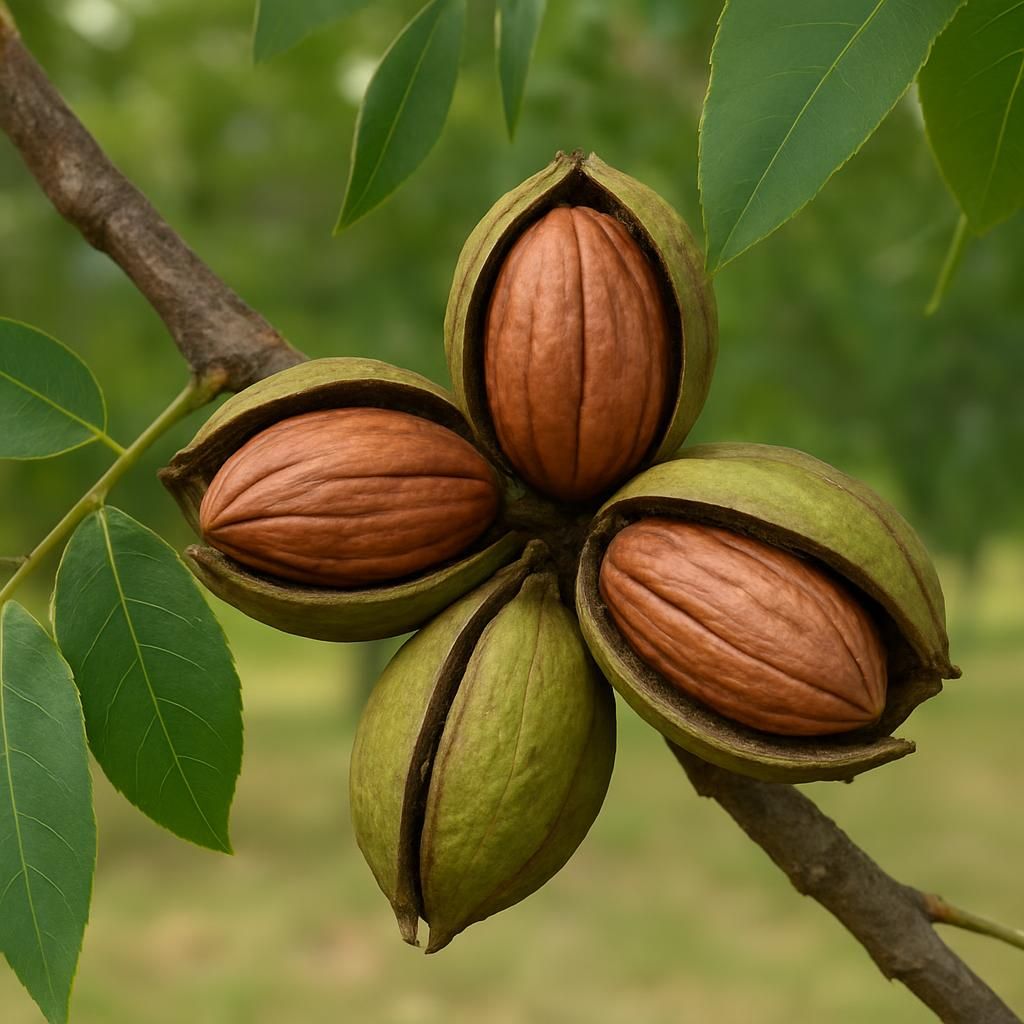
Introduction to Pecan (Cape Fear)
Pecan (Cape Fear) is a leading cultivar developed in North Carolina, renowned for its early maturity, large kernel size, and strong resistance to pecan scab. It produces heavy crops of thin-shelled nuts that are easy to shell and highly marketable. Growers value its consistent performance in humid regions where scab pressure is intense.
The cultivar matures in mid-season and offers excellent kernel quality with a bright color and high oil content. Cape Fear trees exhibit strong vigor and a spreading canopy that responds well to training. With proper management, orchards can achieve commercial yields within 8–10 years.
This definitive guide covers every stage from site selection through harvest and storage, providing tables, schedules, and organic strategies for sustainable production.
Botanical Profile of Pecan (Cape Fear)
Pecan belongs to the Juglandaceae family. The Cape Fear selection features compound leaves with 9–17 lanceolate leaflets and produces monoecious flowers. Male catkins appear in spring before female flowers, requiring cross-pollination from compatible cultivars such as Stuart Pecan or Desirable Pecan.
Mature trees reach 70–100 feet with a broad, rounded crown. Nuts are oblong, averaging 60–70 per pound, with kernels comprising 55–60% of nut weight. The cultivar shows moderate alternate bearing but responds well to zinc and nitrogen management.
Soil, pH, and Climate Requirements for Pecan (Cape Fear)
Cape Fear pecans thrive in deep, well-drained soils with good water-holding capacity. Avoid heavy clays or sites with shallow hardpans that restrict root development.
Ideal Growing Conditions
| Parameter | Ideal Range | Notes |
|---|---|---|
| Soil Type | Sandy loam to loam | Deep profile (>4 ft) preferred |
| Soil pH | 6.0–7.0 | Adjust with lime if below 5.8 |
| Temperature Range | 15°F–95°F | Protect young trees from late spring frosts |
| Annual Rainfall | 40–60 inches | Supplemental irrigation essential in dry spells |
| USDA Zones | 7b–9a | Performs best in southeastern states |
| Chill Hours | 400–600 hours below 45°F | Ensures uniform bud break |
Step-by-Step Planting & Propagation
- Select certified, grafted Cape Fear trees on rootstocks adapted to local soil conditions.
- Plant in late winter or early spring when soil temperatures reach 50°F.
- Dig holes twice the width of the root ball and at the same depth as the nursery container.
- Space trees 40–50 feet apart in rows 50–60 feet wide for commercial orchards.
- Backfill with native soil amended with aged compost; avoid fresh manure.
- Water deeply after planting and apply 3–4 inches of organic mulch, keeping it 6 inches from the trunk.
- Stake young trees in windy sites and install tree guards against rodent damage.
Grafting is the primary propagation method; seedlings are used only for rootstock production.
Care & Maintenance regimes for Pecan (Cape Fear)
Consistent care ensures strong growth and high-quality nuts. Focus on balanced nutrition, timely irrigation, and annual pruning.
Water, Fertilizer, and Pruning Schedule
| Season | Water (per tree/week) | Fertilizer (N-P-K) | Pruning Focus |
|---|---|---|---|
| Early Spring | 15–25 gallons | 1–2 lbs 10-10-10 + zinc sulfate | Remove dead/diseased wood |
| Late Spring | 25–40 gallons | 0.5 lb actual nitrogen | Tip-prune to encourage lateral branching |
| Summer | 40–60 gallons | Foliar zinc every 3–4 weeks | Minimal; remove water sprouts |
| Fall | Reduce to 10–15 gallons | 1 lb potassium sulfate if needed | Structural pruning of young trees |
| Winter | Dormant; minimal | Compost top-dress | Major dormant pruning |
Monitor leaf zinc levels annually; deficiency causes rosetting and small nuts.
Pests, Diseases & Organic Management
Cape Fear shows strong resistance to pecan scab, but remains susceptible to pecan nut casebearer, hickory shuckworm, and aphids. Monitor with pheromone traps starting at bud break.
Organic controls include:
- Bacillus thuringiensis for casebearer larvae
- Horticultural oil for overwintering scales and mites
- Kaolin clay sprays to deter weevils
- Beneficial nematodes for soil-dwelling pests
Scout weekly during nut fill. Maintain orchard floor sanitation to reduce overwintering disease inoculum.
Harvesting, Curing & Optimal Storage
Harvest when shucks split and nuts begin to drop, typically October in the Southeast. Use mechanical shakers for commercial orchards or hand-pick for smaller plantings.
Cure nuts by spreading in a single layer at 70–80°F with good airflow for 2–3 weeks until kernel moisture reaches 4–5%. Store in-shell at 32–40°F with 60–70% relative humidity for up to 12 months. Shelled kernels keep best vacuum-packed at 0°F.
Companion Planting for Pecan (Cape Fear)
Compatible understory plants improve biodiversity and soil health. Consider Crimson Clover or Hairy Vetch as winter cover crops to fix nitrogen. Summer options include Southern Peas and Sorghum-Sudangrass for biomass.
Avoid planting Tomato or Potato near young trees due to shared disease risks. Tall legumes and native bunch grasses support beneficial insects while suppressing weeds.