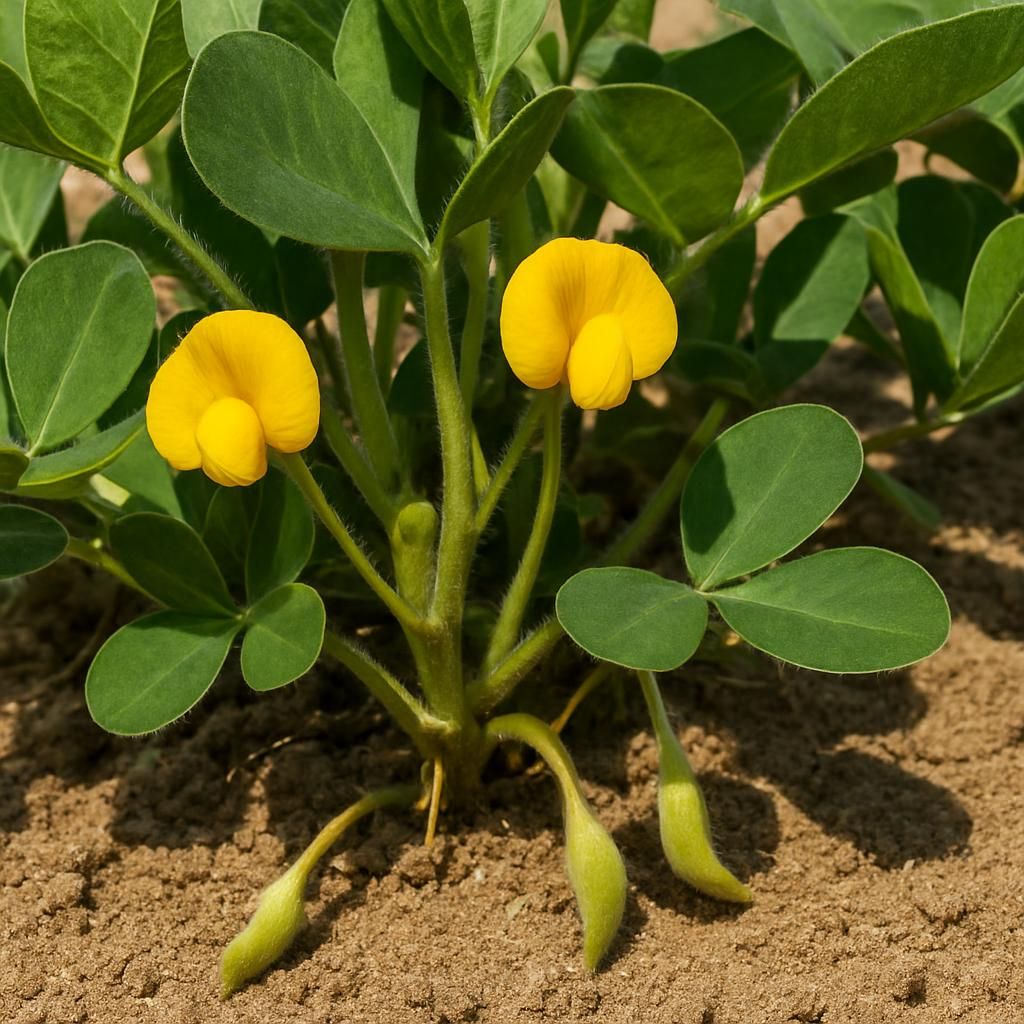
Introduction to Peanut (Valencia)
Valencia peanuts (Arachis hypogaea) are an early-maturing, bunch-type cultivar favored by commercial growers and home gardeners for their sweet kernels and three-to-five seeds per pod. Originating from South American landraces, Valencia types reach maturity in 90–110 days, making them ideal for short-season regions. Their upright growth habit and concentrated pod set simplify mechanical or hand harvesting.
Botanical Profile of Peanut (Valencia)
Valencia peanuts belong to the Fabaceae family and develop pegs that penetrate the soil to form subterranean pods. Plants produce compound leaves with four leaflets and yellow-orange flowers that self-pollinate. The variety typically grows 30–50 cm tall with a compact canopy that minimizes disease pressure compared with spreading runner types.
Soil, pH, and Climate Requirements for Peanut (Valencia) (MUST INCLUDE A MARKDOWN TABLE OF IDEAL CONDITIONS)
Valencia peanuts demand well-drained, sandy-loam soils with moderate fertility. Heavy clays restrict peg penetration and increase disease incidence. The crop thrives in warm climates with consistent moisture during flowering and pegging.
| Parameter | Ideal Range | Notes |
|---|---|---|
| Soil Type | Sandy loam to loamy sand | Ensures peg penetration and drainage |
| Soil pH | 6.0–6.5 | Prevents nutrient lock-up |
| Temperature (Day) | 24–32 °C | Optimal for flowering and pod fill |
| Temperature (Night) | 18–22 °C | Avoids chilling injury |
| Growing Season Length | 90–110 frost-free days | Matches Valencia maturity window |
| Annual Rainfall | 500–750 mm | Supplemental irrigation if <400 mm |
Step-by-Step Planting & Propagation
- Select certified seed treated with rhizobial inoculant specific to peanuts.
- Plant when soil temperature at 10 cm depth reaches 18 °C.
- Sow seeds 5–7 cm deep, 10 cm apart in rows spaced 76–91 cm.
- Maintain soil moisture at 60–70 % field capacity until emergence.
- Thin seedlings to one vigorous plant per 15 cm once true leaves appear.
Care & Maintenance regimes for Peanut (Valencia) (MUST INCLUDE A MARKDOWN TABLE OF WATER, FERTILIZER, AND PRUNING SCHEDULES)
Consistent moisture and balanced nutrition are critical from flowering through pod fill. Avoid excessive nitrogen; peanuts fix their own via symbiotic Rhizobium. Light cultivation controls weeds without damaging pegs.
| Growth Stage | Water (mm/week) | Fertilizer (N-P-K) | Pruning / Cultivation |
|---|---|---|---|
| Pre-plant | 0 | 0-20-20 at 200 kg/ha | Incorporate lime if pH <6.0 |
| Emergence–Flowering | 25–30 | 0-0-0 (side-dress K if low) | Shallow cultivation at 3–4 weeks |
| Pegging–Pod Fill | 35–40 | 10-10-10 at 150 kg/ha | Avoid root disturbance |
| Maturation | 15–20 | None | Cease irrigation 2 weeks before harvest |
Pests, Diseases & Organic Management
Key threats include cutworms, thrips, and leaf spot diseases. Rotate with non-hosts such as corn or sorghum to break pest cycles. Apply neem-based sprays at early infestation and release predatory mites for spider-mite suppression. Mulch with straw to suppress weeds and moderate soil temperature.
Harvesting, Curing & Optimal Storage
Harvest when 70 % of pods show dark veining and kernels are firm. Dig plants carefully, shake soil, and invert windrows for 3–5 days of field curing. Finish drying to 10 % moisture in forced-air bins at 35 °C. Store in cool, dry conditions (≤10 °C, <65 % RH) for up to 12 months.
Companion Planting for Peanut (Valencia)
Pair Valencia peanuts with sweet corn for nitrogen synergy and marigold to repel nematodes. Avoid planting near onion or garlic families that may inhibit rhizobia. Interplant with squash to maximize land use and create beneficial insect habitat.