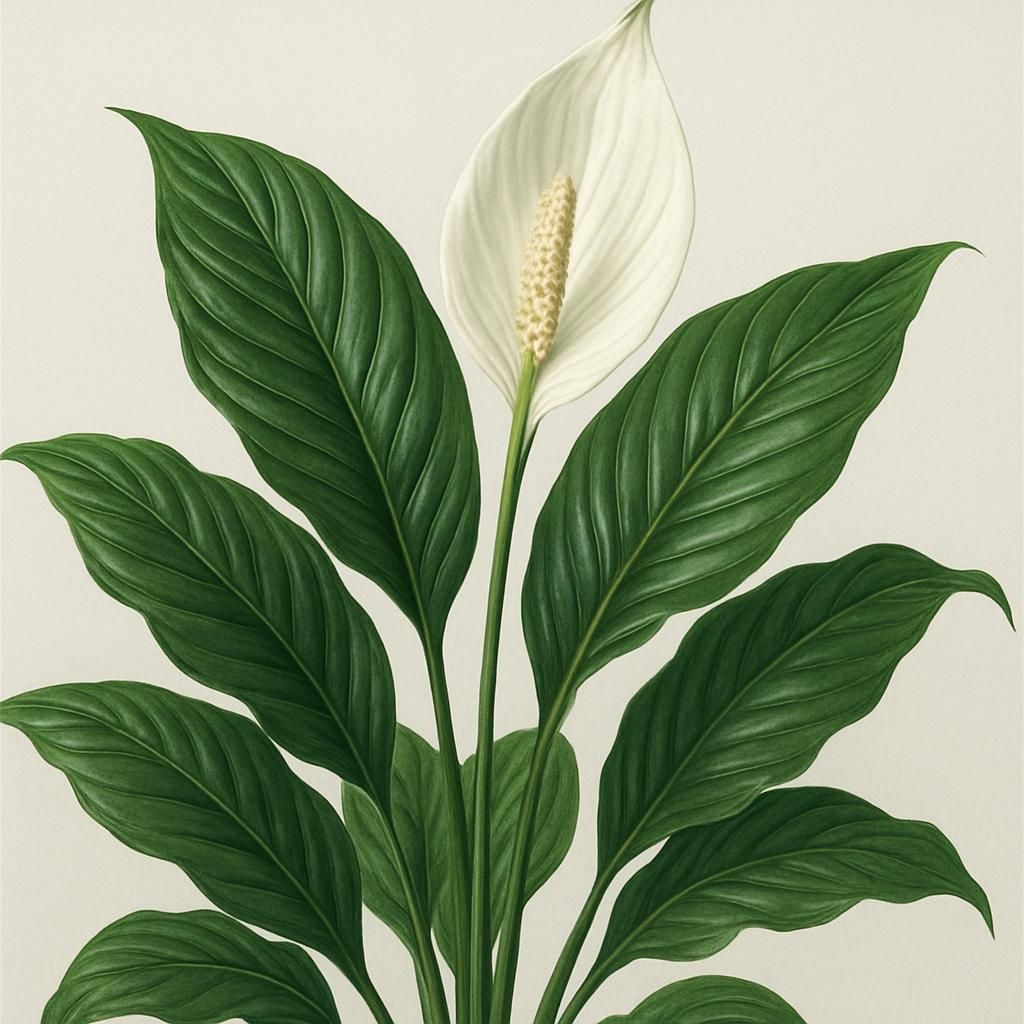
Introduction to peace lily
The peace lily (Spathiphyllum spp.) is one of the most widely cultivated ornamental aroids, prized for its glossy dark-green leaves and distinctive white spathes that resemble calla lilies. Originally native to the understory of Central and South American rainforests, it has become a staple houseplant and interior landscape specimen due to its tolerance of low light and ability to improve indoor air quality by removing volatile organic compounds. Professional growers value peace lilies for their year-round flowering potential under controlled environments and their relatively straightforward propagation. This comprehensive guide covers every stage of cultivation from soil preparation to post-harvest handling, providing actionable recommendations suitable for both commercial production and high-end interior installations.
Botanical Profile of peace lily
Spathiphyllum belongs to the Araceae family and comprises approximately 50 species. Plants produce basal rosettes of lanceolate to elliptic leaves supported by long petioles arising from a short rhizome. The inflorescence consists of a creamy-white spathe surrounding a spadix that transitions from white to green as it ages. Roots are fibrous and adventitious, allowing the plant to colonize moist, organic-rich substrates. Most commercial cultivars are hybrids selected for compact growth, darker foliage, and prolonged flowering. The plant is evergreen and can reach 30–120 cm in height depending on cultivar and growing conditions.
Soil, pH, and Climate Requirements for peace lily
Peace lilies perform best in a light, airy, peat-based or coco-coir substrate amended with perlite or orchid bark to maintain aeration while retaining moisture. The ideal pH range is slightly acidic to neutral. Temperature must remain above 15 °C at night; prolonged exposure below this threshold causes leaf yellowing and reduced flowering. Relative humidity of 50–70 % supports healthy foliage and prevents tip burn. The following table summarizes optimal environmental parameters.
| Parameter | Ideal Range | Notes |
|---|---|---|
| Soil pH | 5.8 – 6.5 | Maintain with buffered peat or coco blends |
| Temperature (day) | 21 – 29 °C | Avoid drafts and sudden fluctuations |
| Temperature (night) | 18 – 21 °C | Critical for spathe initiation |
| Relative Humidity | 50 – 70 % | Use pebble trays or humidifiers indoors |
| Light | 1,000 – 2,500 lux (low–medium) | Direct sun causes leaf scorch |
| EC (electrical conductivity) | 0.8 – 1.2 mS/cm | Reduce during winter rest |
Step-by-Step Planting & Propagation
- Select healthy mother plants free of mealybugs and root rot.
- Prepare a sterile mix of 50 % peat or coco coir, 30 % perlite, and 20 % fine orchid bark; adjust pH to 6.0.
- Divide rhizomes in early spring using a sterilized knife, ensuring each division has at least two leaves and intact roots.
- Pot divisions into 10–15 cm containers with drainage holes; firm the medium gently around roots.
- Water thoroughly with lukewarm water and place in 70–80 % shade for 7–10 days to reduce transplant shock.
- Maintain soil moisture at field capacity; new roots typically emerge within 14–21 days.
- Once established, gradually increase light intensity to the target range listed in the climate table.
Care & Maintenance regimes for peace lily
Consistent cultural practices prevent physiological disorders and maximize flowering cycles. The schedule below outlines routine tasks for commercial and interior growers.
| Task | Frequency | Details |
|---|---|---|
| Watering | Every 5–7 days (summer) | Use room-temperature water; allow top 2–3 cm to dry between irrigations |
| Every 10–14 days (winter) | Reduce volume; never let pots stand in water | |
| Fertilizer | Every 4 weeks (spring–fall) | 20-20-20 NPK at ½ strength or balanced liquid organic feed |
| Every 8 weeks (winter) | Skip or apply at ¼ strength to avoid salt buildup | |
| Pruning | As needed | Remove spent spathes and yellow leaves at base; wipe blades between cuts |
| Repotting | Every 18–24 months | Upgrade one pot size when roots fill container; best done in spring |
Pests, Diseases & Organic Management
Common arthropod pests include spider mites, mealybugs, and scale insects. Early detection through weekly scouting is essential. Organic controls begin with strong water sprays to dislodge mites, followed by horticultural oil or insecticidal soap applications at 7–10 day intervals. Root and crown rots caused by Pythium and Phytophthora are managed by improving drainage, using sterile media, and drenching with beneficial Bacillus subtilis or Trichoderma harzianum products. Leaf spot diseases respond to copper-based organic fungicides and increased air circulation. Always isolate new acquisitions for 30 days before introducing them to production areas.
Harvesting, Curing & Optimal Storage
Peace lilies are primarily ornamental; “harvest” refers to cutting mature inflorescences for floral arrangements. Select spathes that are fully open but still creamy white. Use sharp, sterilized shears and cut at the base of the peduncle. Immediately place stems in 4–6 °C water with floral preservative for 2–4 hours to harden. Store finished bouquets at 7–10 °C and 85–90 % humidity away from ethylene-producing fruits. Under these conditions, vase life averages 7–12 days. Foliage can be harvested year-round for greenery; condition similarly and store flat in perforated sleeves at 5–8 °C.
Companion Planting for peace lily
In interior landscapes, peace lilies pair effectively with other shade-tolerant species such as Thai Basil and ferns to create layered humidity pockets. In greenhouse benches, interplanting with Elephant Ear Garlic or Dwarf Cavendish Banana provides microclimate moderation and visual contrast. Avoid placing peace lilies near ethylene-sensitive crops or high-light succulents that may compete for humidity. Strategic grouping also reduces pest pressure by increasing beneficial insect habitat within mixed plantings.
For additional background on aroid cultivation techniques, consult the Spathiphyllum Wiki entry. Growers seeking deeper economic analysis of shade crops may also read The Economics of Basil: A Brutal Breakdown.