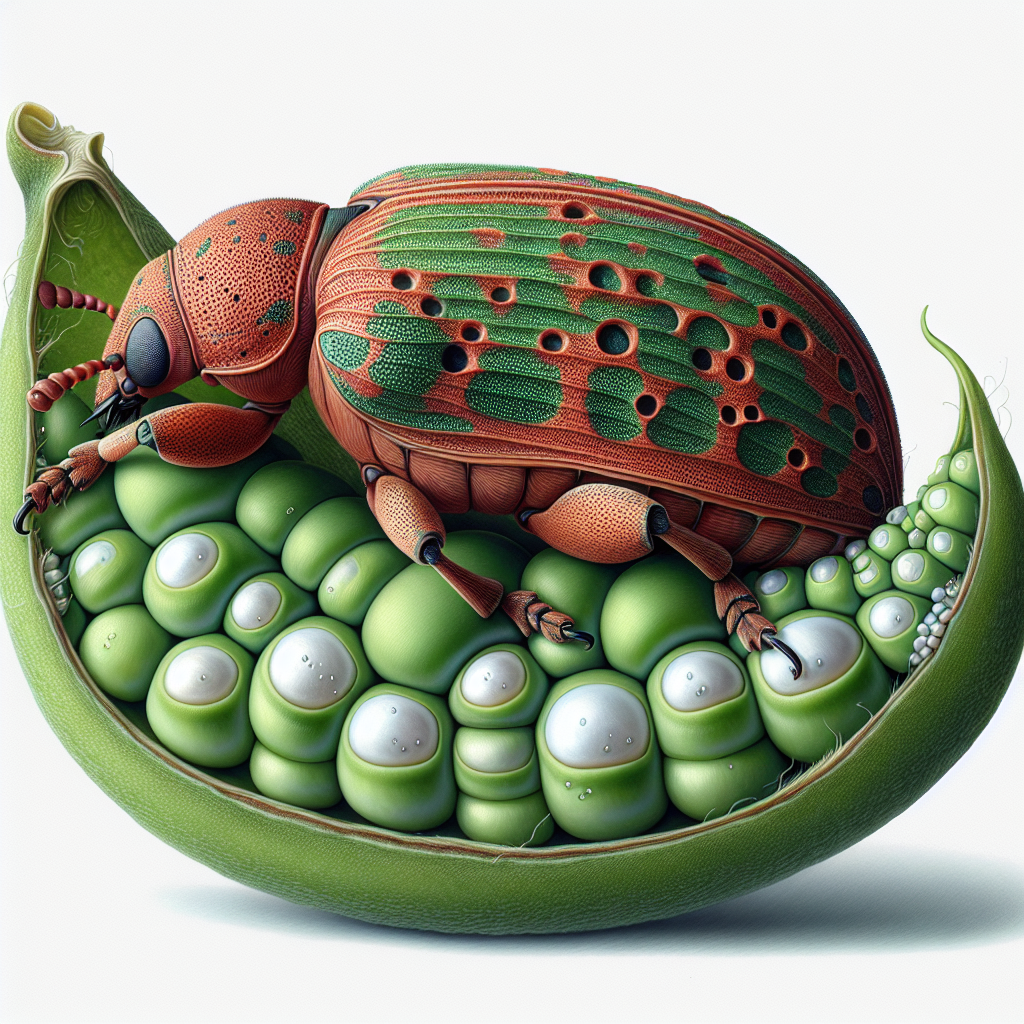
Introduction to Pea weevils
Pea weevils, scientifically known as Bruchus pisorum, represent one of the most insidious threats to pea production worldwide. These small, reddish-brown beetles belong to the Bruchidae family and are specialized pests of legumes, particularly peas. Unlike many foliar pests, pea weevils target the seeds directly, with females laying eggs on developing pods and larvae burrowing inside to feed and develop. This internal feeding disrupts seed formation, leading to shriveled, unmarketable grains riddled with exit holes. Global pea production, valued at billions annually, suffers substantial losses—up to 30-50% in untreated fields—making effective management essential for commercial growers, small farms, and home gardeners alike.
Originating from the Middle East, pea weevils have spread across Europe, North America, and parts of Asia through contaminated seed and trade. Adults are 3-4 mm long, with a distinctive 'W' or 'M' pattern on the wing covers, and they overwinter in crop residues or stored grains. Detection is challenging because much of the damage occurs internally, often unnoticed until harvest. Early intervention is critical, as a single female can lay 50-100 eggs, rapidly escalating infestations. This definitive guide equips you with diagnostic tools, lifecycle knowledge, organic controls, and prevention strategies to safeguard your peas and related legumes like chickpeas and lentils. For small farms, check out this Spring Pest Patrol: Organic AI Strategies to Shield Your Crops from Common Invaders for tech-enhanced monitoring tips.
Understanding pea weevils goes beyond mere identification; it's about integrating cultural, biological, and mechanical controls into a holistic IPM (Integrated Pest Management) framework. This pest thrives in warm, dry conditions but can persist in diverse climates, demanding region-specific tactics. Whether you're growing field peas for dry harvest or garden peas for fresh pods, proactive management ensures bountiful yields and premium quality.
Identifying Symptoms & Damage
Spotting pea weevil damage requires vigilance during pod development and harvest. Adult feeding creates characteristic notches on leaves and pods, but the real devastation happens inside. Look for:
- Pods with eggs: Tiny, white, kidney-shaped eggs (0.6-0.8 mm) glued to pod surfaces, often in clusters of 2-5 near the suture line. Eggs hatch in 7-10 days.
- Larval entry holes: Small, round punctures (0.5 mm) where neonate larvae burrow into seeds. Infested pods may appear normal externally but contain chalky, hollowed seeds.
- Seed damage: At harvest, affected seeds show large, irregular exit holes (2-3 mm), frass (insect waste), and shriveled interiors. Healthy seeds are plump and solid; infested ones rattle in pods.
- Powdery residue: Fine, flour-like frass around exit holes, often mixed with seed dust.
- Adult presence: Beetles on foliage or pods during bloom to pod-fill stages, causing minor leaf notching.
Damage severity correlates with infestation levels: light (1-5% seeds affected) yields minor losses; heavy (>20%) can render entire crops unviable for seed or food use. Differentiate from similar pests like bean weevils or storage beetles, which attack post-harvest. Use a seed flotation test: infested seeds float in water due to internal voids. Scout weekly from flowering, shaking plants over a white tray to count adults (action threshold: 1-2 per 10 sweeps). Yield impacts include 10-40% weight loss per seed, plus downgraded quality for canning or drying.
Lifecycle and Progression of Pea weevils
Pea weevils complete one generation per year, with all stages synchronized to pea phenology. Understanding this univoltine cycle is key to timing interventions:
- Overwintering adults: Emerge from diapause in spring (March-May in temperate zones) when soil temps hit 10-15°C. Drawn to blooming peas by plant volatiles.
- Egg laying (5-10 days): Females chew slits in pods, deposit 50-100 eggs. Peak at early pod set.
- Larva (3-5 instars, 20-30 days): Hatch in 7-10 days, bore into seeds, feed on cotyledons. Full-grown larvae (4-5 mm, white/creamy) pupate inside seed coats.
- Pupa (10-14 days): Occurs within seed; adults chew exit holes but remain until maturity.
- New adults: Emerge late summer but stay in pods/soil until next spring.
Total cycle: 40-60 days at 20-25°C. Development accelerates with heat (optimum 28°C); cold delays emergence. Infested seeds serve as 'Trojan horses' for spread via harvest, storage, or trade. Monitor with pheromone traps or sweep nets during bloom.
Environmental Triggers & Risk Factors
Pea weevils exploit specific conditions for outbreaks:
- Warm, dry springs: Optimal adult flight at 15-30°C; drought stresses peas, enhancing susceptibility.
- Early planting: Extends exposure window; late-maturing varieties risk higher infestations.
- Crop residues: Overwintering sites; no-till fields harbor 10x more adults.
- Contaminated seed: Primary dispersal vector; even 1% infested seed infests fields.
- Monoculture: Legume rotations amplify populations; proximity to last year's peas boosts risk 5-fold.
- Soil type: Sandy loams favor pupation; heavy clays reduce survival.
High-risk zones include Mediterranean climates, US Pacific Northwest, and Australian grain belts. Climate change extends seasons, increasing pressures. Assess farm history: prior infestations predict 80% recurrence without rotation.
Organic Control & Treatment Plans
Organic management emphasizes prevention and biologicals over chemicals:
Cultural controls:
Biological controls:
- Natural enemies: Parasitoids (Triaspis thoracicus), predators (ladybugs).
- Release braconid wasps; encourage marigold borders for beneficials.
Mechanical/physical:
- Pheromone traps (10-20/ha) for monitoring/mass-trapping.
- Seed screening/vacuum harvest to remove weevils.
- Diatomaceous earth on pods at egg-lay (2-5 kg/ha).
Approved organics:
- Neem oil (0.5-1%) sprays at bloom (3x, 7-day intervals).
- Spinosad (OMRI-listed) for adults (target 80% control).
- Kaolin clay barriers to deter oviposition.
Treatment plan: Scout weekly; at 1 adult/10 plants, deploy traps + neem. Post-harvest, solarize residues. IPM success: 70-90% reduction in trials.
Preventing Pea weevils in the Future
Long-term prevention builds resilient systems:
- Varietal resistance: Plant tolerant cultivars like 'Arvika' or 'CDC Golden' (20-50% less damage).
- Sanitation: Zero-tolerance for volunteer peas; clean equipment.
- Trap crops: Border strips of susceptible peas, destroy pre-egg lay.
- Timing: Sow post-weevil flight (use degree-day models: 200 DD base 10°C).
- Barriers: Row covers until pod set; reflective mulches confuse adults.
- Monitoring: Sticky traps + apps for hyper-local alerts.
- Storage: Freeze seeds (-18°C/48h) or CO2 fumigation.
Integrated over 3 years, reductions exceed 95%. Track progress with yield audits.
Crops Most Affected by Pea weevils
Primarily field and dry peas (Pisum sativum subsp. sativum), including sugar snap peas and snow peas. Vining types suffer most due to prolonged pod exposure. Secondary hosts: faba beans, lentils (low preference), chickpeas. Avoids fresh market peas if harvested green. Global hotspots: Canada (50% losses), France, Australia. Diversify with resistant legumes to mitigate.