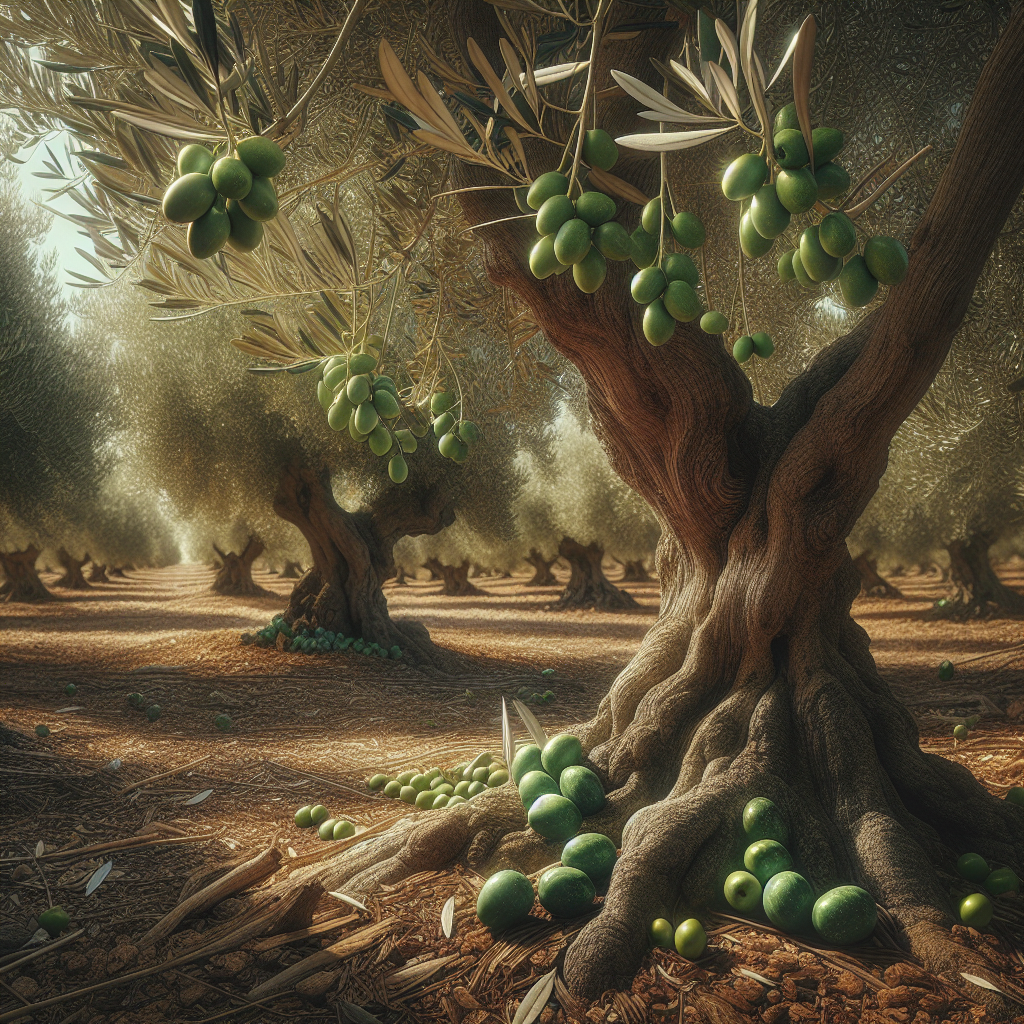
Introduction to Olive (Sevillano)
A traditional Spanish-type table olive, this cultivar is best known for producing very large, attractive fruit that is commonly harvested green for curing rather than grown primarily for oil. Sevillano has long been favored in warm, dry olive districts because its fruit size commands premium fresh-curing value, but that same large-fruit character also means orchard management must be more precise than with many small-fruited oil cultivars.
This is a vigorous tree with a broad, spreading canopy and a tendency toward alternate bearing if crop load, irrigation, pruning, and nutrition are not balanced. In practical terms, one heavy crop year can easily be followed by a lighter year if the tree is allowed to overfruit and exhaust carbohydrate reserves. Growers targeting consistent commercial yields focus on canopy light penetration, moderate nitrogen, adequate potassium, and careful irrigation from pit hardening through fruit enlargement.
Sevillano is often grouped among premium table olives because the fruit is fleshy, relatively low in oil compared with specialized oil cultivars, and visually appealing after lye curing or Spanish-style processing. In California and other Mediterranean-climate regions, it has historically been associated with warm inland valleys where winter chill is sufficient for flowering but spring weather remains dry enough to reduce blossom diseases. For a broader olive context, see our Olive guide.
Botanical Profile of Olive (Sevillano)
This cultivar belongs to Olea europaea, an evergreen subtropical-to-warm-temperate tree in the Oleaceae family. Like other olives, it bears opposite, narrow lanceolate leaves with a gray-green upper surface and silvery underside, an adaptation that helps reduce transpiration under intense sun and dry air. The root system is fibrous and opportunistic in well-aerated soils, but it performs poorly in saturated or compacted ground where oxygen diffusion is restricted.
Sevillano trees are generally medium to large, often developing a rounded to vase-like canopy if trained properly. Shoots can be vigorous, especially in fertile soils or under excess irrigation, and unregulated vigor can reduce flowering by favoring vegetative growth over fruitful one-year wood. Flower buds are formed on the previous season's growth, so pruning strategies must preserve enough productive wood while renewing the canopy.
Flowers are small, creamy white, and borne in panicles. Most olives exhibit some degree of imperfect flowering, meaning not every flower is functionally perfect or capable of setting fruit. Fruit set is influenced by winter chilling, spring temperatures, tree nutrition, and pollination compatibility. Sevillano is often considered to benefit from cross-pollination, and orchard performance may improve when planted near compatible pollinizers, particularly in sites with marginal flowering conditions.
The fruit is the defining trait: large, oval to slightly asymmetric, with a relatively high flesh-to-pit ratio. Skin color changes from green to straw-yellow, then reddish-purple to black as fruit ripens. For table use, it is typically harvested while still green and firm, before full coloration. Because the fruit is large, it is more sensitive to irregular irrigation, calcium imbalance, and physical bruising than many oil olives.
Soil, pH, and Climate Requirements for Olive (Sevillano)
This cultivar demands excellent drainage above all else. If forced to choose between low fertility and poor drainage, olives will tolerate the former far better than the latter. Ideal soil textures include sandy loam, gravelly loam, loam, or well-structured clay loam with internal drainage. Heavy clay can work only if planted on berms, ripped deeply before establishment, and never allowed to remain waterlogged after rain or irrigation.
The preferred soil pH range is about 6.0 to 8.5, with best nutrient balance often achieved around pH 6.5 to 7.8. Olive trees tolerate moderately alkaline soils better than many fruit crops, but very high pH soils can induce iron, zinc, or manganese deficiencies. In calcareous sites, monitor new growth for interveinal chlorosis; young leaves turning pale yellow with green veins often indicates iron chlorosis rather than nitrogen deficiency.
Salinity tolerance is moderate, but Sevillano grown for table fruit quality should not be pushed on poor-quality irrigation water if avoidable. Excess salts reduce shoot growth, impair fruit sizing, and can cause leaf tip burn. Soil electrical conductivity should ideally remain below levels associated with yield reduction, and sodium accumulation should be managed through gypsum where appropriate and periodic leaching in soils with adequate drainage.
Climatically, this is a classic Mediterranean crop: cool, somewhat wet winters and hot, dry summers. It needs enough winter chill to induce good flowering, but not the prolonged severe cold tolerated by the hardiest deciduous fruit trees. Mature trees can survive brief dips below freezing, but young trees are vulnerable to trunk splitting, canopy burn, and scaffold injury below about -5 to -7°C (23 to 19°F), especially if cold follows late-season nitrogen or drought stress.
Spring weather is critical. Warm, stable conditions during bloom favor pollination and fruit set, while rain, high humidity, or cold winds can sharply reduce yield. Summer heat is usually beneficial, but extreme heat above 40°C (104°F), especially under hot winds and low soil moisture, can cause fruit shrivel, sunburn, and reduced final size. Deep, infrequent watering in hot periods is better than shallow frequent irrigation because it supports deeper rooting and steadier fruit expansion.
Air movement matters. Plant on gentle slopes or open sites where cold air drains away and foliage dries quickly after rain. Frost pockets, valley bottoms with stagnant air, and poorly ventilated orchard blocks increase disease pressure and reduce bloom success.
Step-by-Step Planting & Propagation
Begin with certified disease-free nursery trees propagated from semi-hardwood cuttings or rooted liners. While olives can be grown from seed, seedling trees are genetically variable and unsuitable for maintaining true Sevillano characteristics. Commercial plantings nearly always rely on vegetative propagation to preserve fruit size, growth habit, and curing quality.
- Select the site carefully. Choose full sun, at least 8 hours daily, with no seasonal standing water. If soil stays wet for more than 24 to 48 hours after heavy rain, improve drainage first or choose another site.
- Test the soil before planting. Analyze pH, organic matter, sodium, chloride, boron, and major nutrients. Correct severe pH extremes and drainage issues before trees go in; post-planting correction is much harder.
- Prepare the planting zone. Rip compacted subsoil to 18 to 30 inches deep if needed. In heavy soils, plant on raised berms 12 to 18 inches high and 3 to 5 feet wide. Avoid amending only the planting hole with rich compost, which can create a bathtub effect and trap water.
- Time planting for mild conditions. Early spring is ideal in cooler olive areas after frost risk declines. In warm winter climates, late fall to winter planting is also effective if soils are workable and not saturated.
- Space properly. Traditional spacing for vigorous table olives may range from about 20 x 20 feet to 24 x 24 feet, depending on vigor, irrigation, and pruning style. Closer spacing increases early yield but requires stricter canopy management.
- Plant at the original nursery depth. Do not bury the trunk flare. Set the tree so the root crown sits slightly above finished soil grade in heavier soils.
- Water immediately after planting. Apply enough water to settle soil around the root ball and eliminate air pockets. For the first season, keep the root zone evenly moist but never saturated.
- Stake only if necessary. Use a flexible tie and remove support once the trunk is stable. Overstaking weakens trunk development.
- Mulch carefully. Apply 2 to 4 inches of coarse mulch over the root zone, but keep it 4 to 6 inches away from the trunk to reduce crown rot and rodent damage.
For propagation at small scale, semi-hardwood cuttings 6 to 8 inches long taken from healthy current-season growth root best under mist with bottom heat and rooting hormone. However, rooting percentage can be inconsistent, and nursery stock is usually more reliable for orchard establishment.
If using pollinizer rows or interplants, design them before planting rather than retrofitting later. Even self-fruitful olives often perform better with pollen diversity, especially in years with unsettled bloom weather.
Care & Maintenance regimes for Olive (Sevillano)
Young trees need formative training more than heavy pruning. During the first 2 to 3 years, develop a strong trunk and 3 to 4 well-spaced scaffold limbs beginning about 30 to 40 inches above ground if mechanical access is desired. Remove suckers from the base and vigorous water sprouts that shade the interior, but avoid excessive heading cuts that delay bearing.
Once trees reach bearing age, pruning should aim for light penetration, air movement, and renewal of fruitful one-year wood. Sevillano fruits best when the canopy is not overly dense. A practical rule is that dappled sunlight should reach into the middle canopy during midday. Dense shade reduces flower bud formation, increases disease risk, and pushes production to the outer shell of the tree.
Irrigation is the single biggest lever for fruit size in table olives. Mature olives are drought tolerant, but drought tolerance is not the same as premium-fruit productivity. For Sevillano, soil should generally cycle between moist and moderately dry, not wet and not bone dry. In the active root zone, a target of roughly 50% to 80% of field capacity works well through most of the growing season. If using tensiometers, many growers irrigate loamy soils when tension approaches roughly 25 to 40 centibars, adjusting for soil texture. Sandy soils require more frequent irrigation; clay loams require less frequent but deeper sets.
Critical irrigation windows include:
- Pre-bloom to fruit set: avoid severe stress, which can reduce set.
- Pit hardening: mild deficit can be tolerated, but do not induce leaf curl or prolonged midday wilting.
- Fruit enlargement: this is the most important period for table olive size. Maintain steady moisture.
- Pre-harvest: avoid sudden heavy irrigation after drought, which can promote fruit splitting or dilute quality.
Signs of underwatering include dull gray-green foliage, inward leaf folding, reduced shoot extension, poor fruit sizing, and excessive fruit drop. Signs of overwatering include persistently wet soil, yellowing leaves without dry stress symptoms, sour-smelling soil, weak pale shoots, and in severe cases dieback from root asphyxia or Phytophthora infection.
Fertilization should be based on leaf analysis, ideally midsummer from non-fruiting shoots. Nitrogen is most often limiting, but overapplication causes excessive vigor, soft growth, poorer light penetration, and potentially reduced flowering the following year. Young nonbearing trees may receive split nitrogen applications in spring and early summer. Bearing trees often respond well to modest nitrogen in late winter or early spring, with follow-up only if leaf analysis indicates need.
Potassium is especially important for fruit sizing, stress tolerance, and regular bearing. Low potassium may show as marginal leaf scorch on older leaves and small fruit. Boron is required in tiny amounts but is important for flowering and fruit set; deficiency can reduce reproductive performance, yet excess boron is toxic, so apply only according to test results.
Keep a weed-free strip around the tree during establishment, especially the first 3 years. Grass competition can severely reduce early growth by stealing water and nitrogen from shallow feeder roots. In mature orchards, managed alley covers can improve infiltration and reduce erosion. For orchard floor management ideas, a soil-building cover such as Clover can be useful between rows if moisture competition is managed.
Thinning is not routine in olives the way it is in peaches, but crop regulation matters. In heavy set years, good irrigation and nutrient balance help the tree carry fruit without extreme size loss or severe alternate bearing the next year. Pruning after a heavy crop year should favor renewal wood and balance vigor.
For broader orchard ecology and understory planning, growers often benefit from principles similar to those outlined in soil health strategies.
Pests, Diseases & Organic Management
Olive fruit fly is often the most economically important pest where established. Females lay eggs in developing fruit, and larvae feed inside, causing direct damage, premature fruit drop, and entry points for rot organisms. Large-fruited table olives like Sevillano can be especially attractive. Organic management relies on monitoring with traps, sanitation, timely harvest, kaolin clay barriers, bait sprays approved for organic systems, and area-wide suppression where possible.
Black scale can weaken trees by sucking sap and producing honeydew that supports sooty mold. Heavy infestations reduce photosynthesis and vigor. Natural enemies often provide substantial control if broad-spectrum insecticides are avoided. Pruning for airflow, washing dusty canopies, and applying horticultural oils at the correct dormant or crawler timing are standard organic-compatible tactics.
Olive knot, caused by Pseudomonas savastanoi, produces rough tumor-like galls on twigs and branches, usually entering through wounds from pruning, hail, frost, or harvest injury. Avoid pruning during wet weather, disinfect tools when moving between symptomatic trees, and remove infected wood well below visible knots. Copper-based protectants may help reduce spread when timed around wounding events, especially after storms.
Peacock spot is a fungal leaf disease favored by cool, wet conditions. Circular dark lesions on leaves lead to premature defoliation, weakening the tree and reducing productivity. Good canopy ventilation, avoidance of overhead irrigation, sanitation, and copper sprays in autumn and late winter are core preventive measures in organic programs.
Phytophthora root and crown rot is associated with poor drainage and overirrigation rather than simply the presence of the pathogen. Symptoms include reduced vigor, leaf yellowing, canopy thinning, branch dieback, and bark discoloration near the crown. The best control is prevention: berm planting, careful irrigation scheduling, and keeping emitters a short distance away from the trunk rather than soaking the crown directly.
Verticillium wilt can occur in soils with a history of susceptible crops. Symptoms include sudden branch wilt, leaf retention on dead shoots, and vascular discoloration. Avoid planting olives immediately after highly susceptible hosts, and do not use sites with known severe Verticillium history if alternatives exist. For example, former Tomato ground with disease issues warrants extra caution.
Birds can damage ripening fruit, and rodents may gnaw bark on young trunks. Tree guards, habitat management, owl boxes, and trunk protection are useful low-toxicity interventions.
Harvesting, Curing & Optimal Storage
Sevillano is primarily harvested for table use when fruit is full size, firm, and green to straw-green, before full black ripening. Exact timing depends on intended curing style, local climate, and processor requirements. Harvest too early and the fruit may be undersized with lower flesh recovery; harvest too late and texture softens while bruising risk increases.
For high-grade table olives, hand harvest is preferred because large fruit bruise easily. Pick into shallow containers, avoid dropping fruit, and keep harvest bins shaded. Bruising may not show immediately but can become obvious during curing as darkened blemishes or soft spots.
If curing at small scale, fruit must first be sorted to remove damaged, insect-stung, diseased, or overripe olives. Sevillano is commonly processed as a green olive using lye treatment followed by repeated washing and then brining. The lye removes bitterness by hydrolyzing oleuropein and improving brine penetration, but concentration, exposure time, and rinsing must be handled precisely for food safety and texture retention. Natural brine curing without lye is possible, though slower and often less uniform.
Brine strength for storage and fermentation commonly falls in the range of about 8% to 10% salt depending on method, temperature, and desired fermentation profile. Lower salt may encourage lactic fermentation but requires tighter control; higher salt is more suppressive but can slow desirable fermentation. Always use food-grade containers and non-iodized salt.
Freshly harvested uncured olives are not ready to eat and store only briefly. Keep them cool, ideally around 41 to 50°F (5 to 10°C), and process within a few days for best quality. Cured olives, once stabilized in proper brine and kept under refrigeration or in cool storage, last much longer. Exclude air exposure as much as possible because floating fruit and oxygen promote spoilage yeasts and surface molds.
For oil use, if any fruit is diverted from table grade, process quickly after harvest because free fatty acid levels and defects rise when fruit sits warm or damaged. However, Sevillano is not primarily prized as an oil cultivar, so maximum value usually comes from high-quality table fruit.
Companion Planting for Olive (Sevillano)
Companion planting around olives works best when it supports pollinators, beneficial insects, erosion control, and soil structure without creating excessive water competition close to the trunk. The most successful companions are usually low-growing, drought-tolerant, and easy to mow or manage.
Clover is one of the best understory choices in wider-spaced orchards where winter rainfall supports seasonal growth. It helps protect soil, adds organic matter, and can contribute biologically fixed nitrogen when managed as a cover rather than allowed to compete aggressively in the dry season. Keep it out of the immediate trunk zone of young trees.
Thyme is especially useful on berm edges and dry margins. Its low habit attracts beneficial insects, tolerates lean soils, and does not create the dense, thirsty biomass that tall grasses can. It also fits aesthetically and ecologically with Mediterranean orchard systems.
Yarrow is valuable for attracting predatory wasps, hoverflies, and other beneficials. Its deep-rooting habit can help improve soil structure over time, though it should be placed where it will not overcrowd irrigation emitters or trunk collars.
In small diversified plantings, Garlic can be used in outer rings or row edges as a seasonal companion to suppress some weeds and make efficient use of winter moisture, but it should not be packed densely into the active root zone of young olive trees. The principle is support, not competition: companions belong in the orchard ecosystem, not directly against the trunk.