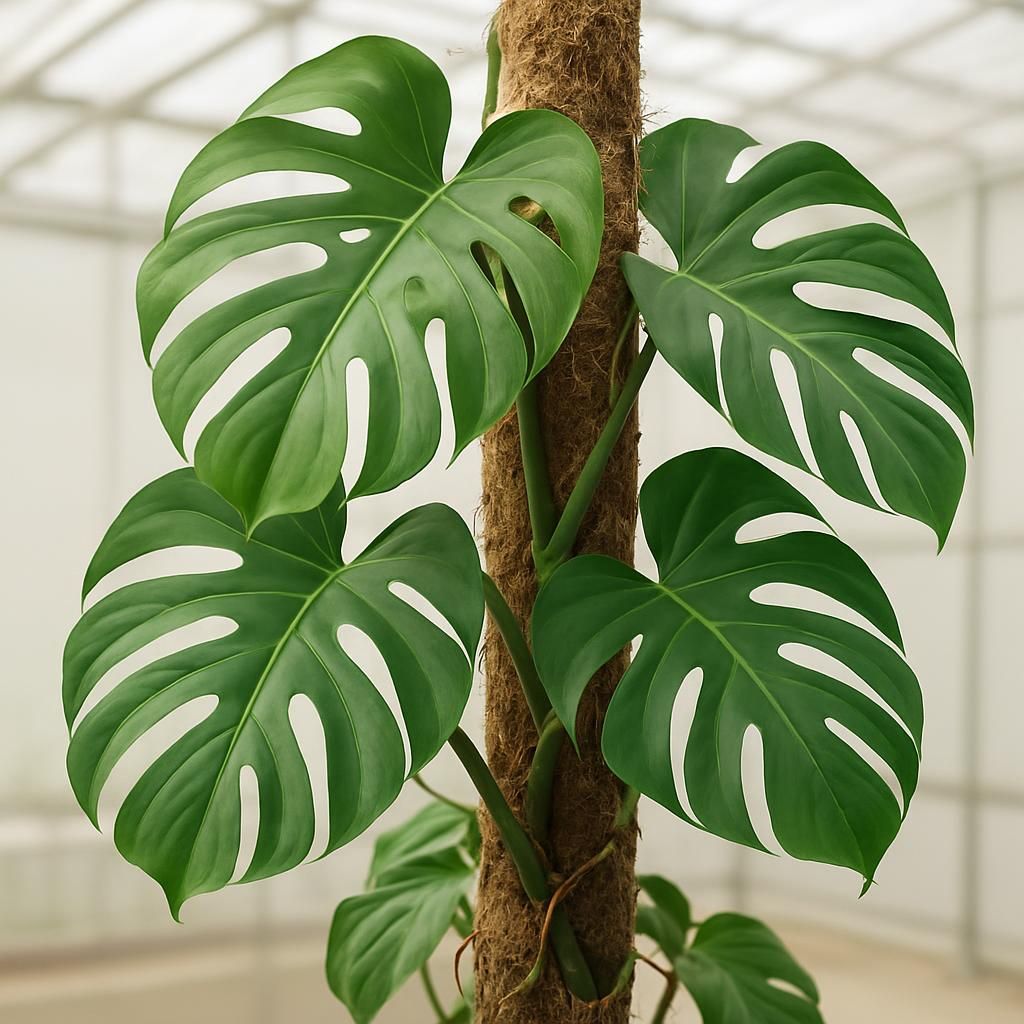
Introduction to Monstera
Monstera deliciosa, commonly known as the Swiss cheese plant, is a perennial evergreen vine native to the tropical rainforests of southern Mexico and Central America. Valued worldwide for its dramatic, perforated foliage and rapid vertical growth, it has become a staple in both interior landscaping and commercial foliage production. Professional growers appreciate its resilience, high propagation success rate, and ability to produce marketable plants within 12–18 months under optimized conditions. This guide delivers practical, research-backed protocols for scaling Monstera cultivation while maintaining plant health and aesthetic quality.
Botanical Profile of Monstera
Monstera deliciosa belongs to the Araceae family and exhibits a hemiepiphytic growth habit, beginning life on the forest floor before climbing toward the canopy using aerial roots. Mature specimens develop deeply lobed and perforated leaves up to 90 cm wide, a phenomenon known as fenestration that increases light penetration and reduces wind resistance. The plant produces a creamy-white spadix surrounded by a white spathe, followed by an edible compound fruit that ripens over 12–18 months. Stems are thick, cylindrical, and capable of producing numerous adventitious roots that anchor the plant and absorb atmospheric moisture. Understanding these botanical traits is essential for replicating natural climbing and light-capture conditions in cultivation systems.
Soil, pH, and Climate Requirements for Monstera (MUST INCLUDE A MARKDOWN TABLE OF IDEAL CONDITIONS)
Successful Monstera production begins with a well-aerated, moisture-retentive substrate that mimics the loose, organic-rich litter of tropical forest floors. A chunky, bark-based mix prevents compaction while allowing rapid root expansion. Ideal conditions are summarized below:
| Parameter | Ideal Range/Value | Notes |
|---|---|---|
| Soil Composition | 40% orchid bark, 30% coco coir, 20% perlite, 10% horticultural charcoal | Provides aeration and moderate water retention |
| pH | 5.5–6.5 | Slightly acidic range maximizes nutrient uptake |
| Temperature | 18–30 °C daytime; 15–24 °C nighttime | Avoid prolonged exposure below 12 °C |
| Relative Humidity | 60–80 % | Supplemental misting recommended below 50 % |
| Light | 1,000–2,500 foot-candles (bright indirect) | Direct midday sun causes leaf scorch |
| Spacing | 60–90 cm between plants | Allows air circulation and climbing support |
Growers in temperate regions should maintain minimum night temperatures above 15 °C and provide supplemental LED lighting during winter months to sustain growth rates.
Step-by-Step Planting & Propagation
- Select healthy mother plants with at least two nodes and visible aerial roots.
- Using sterilized shears, cut 15–20 cm stem sections immediately below a node.
- Remove lower leaves, leaving two to three at the apex.
- Place cuttings in either water (changed weekly) or moist sphagnum moss until roots reach 5–8 cm.
- Transplant rooted cuttings into 15 cm pots filled with the soil mix described above.
- Position each pot against a moss pole or trellis to encourage vertical growth and fenestration development.
- Maintain 24–27 °C and 70 % humidity under bright indirect light for the first four weeks.
- Begin a light fertilization regime once new growth appears, typically after 3–4 weeks.
Care & Maintenance regimes for Monstera (MUST INCLUDE A MARKDOWN TABLE OF WATER, FERTILIZER, AND PRUNING SCHEDULES)
Consistent care schedules prevent common physiological disorders and maintain commercial-grade foliage. The following table outlines recommended intervals:
| Task | Frequency | Details |
|---|---|---|
| Watering | Every 7–10 days | Allow top 5 cm of substrate to dry; reduce to every 14 days in winter |
| Fertilizer | Every 4 weeks (spring–fall) | Balanced 20-20-20 NPK at ½ strength; switch to high-nitrogen formula during active flush |
| Pruning | Every 6–8 weeks | Remove damaged or yellowing leaves; cut back stems above nodes to encourage branching |
| Leaf Cleaning | Monthly | Wipe leaves with damp cloth to remove dust and improve photosynthesis |
| Support Check | Quarterly | Inspect and secure aerial roots to moss poles or trellises |
Monitor electrical conductivity of the root zone monthly; flush substrate with clear water if EC exceeds 1.8 mS/cm.
Pests, Diseases & Organic Management
Common pests include Aphids, Mealybugs, Spider Mites, and Scale insects. Early detection through weekly scouting prevents outbreaks. Apply insecticidal soap or neem oil at 7–10 day intervals for soft-bodied insects. For persistent Spider Mites, increase humidity and introduce predatory mites (Phytoseiulus persimilis). Root and stem issues such as Pythium and Phytophthora are mitigated by maintaining proper substrate aeration and avoiding overwatering. Remove and destroy severely infected tissue; drench remaining plants with beneficial Bacillus subtilis or Trichoderma harzianum. Quarantine new acquisitions for 30 days before integrating into production areas.
Harvesting, Curing & Optimal Storage
Monstera is primarily grown for foliage rather than fruit. Harvest mature leaves when they reach full size and exhibit 8–12 fenestrations by cutting the petiole at the stem junction. For commercial sale, bundle 5–10 leaves with stems in breathable sleeves and store at 15–18 °C with 80–90 % humidity for up to 10 days. Avoid ethylene exposure from ripening fruit to prevent premature yellowing. Aerial root cuttings can be harvested year-round for propagation stock and stored in moist sphagnum at 20 °C for 2–3 weeks without loss of viability.
Companion Planting for Monstera
Monstera performs well when paired with other tropical foliage crops that share similar humidity and light requirements. Compatible companions include Thai Basil for natural pest deterrence and Dwarf Cavendish Banana to create microclimate humidity. Interplanting with Elephant Ear Taro provides contrasting leaf texture while maintaining consistent moisture levels. Avoid placing Monstera near Tomato or Cucumber due to differing light intensity needs and potential transfer of Tobacco mosaic virus. Strategic grouping reduces pest pressure and improves overall greenhouse microclimate stability.