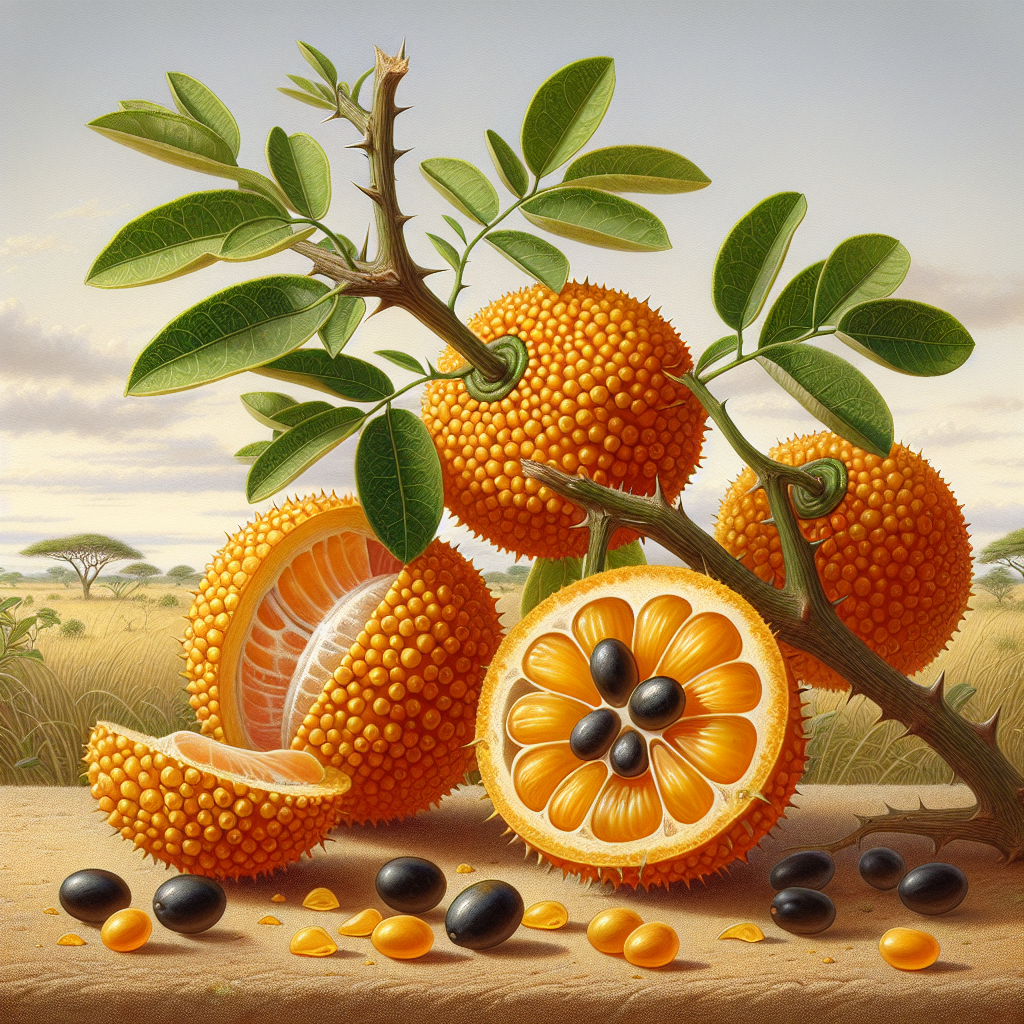
Introduction to Monkey Orange (Strychnos spinosa)
Monkey Orange, scientifically known as Strychnos spinosa, is a remarkable drought-resistant shrub native to the savannas and dry woodlands of sub-Saharan Africa. Unlike its toxic relative Strychnos nux-vomica, this species produces edible, orange-yellow fruits that are a staple in local diets, offering a tangy, citrus-like flavor packed with vitamin C, antioxidants, and essential minerals. The plant's hard-shelled fruits, which resemble small oranges, can be eaten fresh when ripe, juiced, or processed into jams, wines, and traditional beverages, making it a versatile crop for food security in arid regions.
Farmers value Monkey Orange for its low-maintenance nature and ability to thrive where other crops fail. It serves as a living fence due to its thorny branches, provides fodder for livestock from its leaves, and supports biodiversity by attracting pollinators. In commercial agriculture, it's gaining traction in agroforestry systems and as a niche superfood export. Successful cultivation yields 20-50 kg of fruit per mature bush annually, with trees living over 30 years. This guide equips growers with professional strategies for propagation, care, and harvest to maximize productivity in challenging climates. For more on resilient fruit crops, see our Guava (crop) page.
Botanical Profile of Monkey Orange (Strychnos spinosa)
Strychnos spinosa belongs to the Loganiaceae family and is classified as a deciduous to semi-evergreen shrub or small tree, reaching 3-6 meters in height with a spreading canopy. It features paired thorns up to 5 cm long on branches, simple opposite leaves (5-10 cm long, elliptic to ovate), and fragrant white to cream flowers in axillary clusters during the dry season. Pollination occurs via insects, leading to round fruits (4-8 cm diameter) that turn from green to bright orange when ripe, containing numerous black seeds embedded in juicy, yellow pulp.
Roots are deep and extensive, enabling drought tolerance, while the wood is hard and used locally for tools. Phenologically, flowering peaks in late dry season (September-November in native ranges), with fruits maturing 4-6 months later. Genetic diversity is high across African ecotypes, with superior cultivars selected for fruit size and sweetness. Unlike tropical fruits like Mango (crop), Monkey Orange excels in semi-arid zones (USDA zones 9-11), with minimal chilling requirements. Its ethnobotanical uses include medicinal applications for stomach ailments and as a natural hedge against wildlife.
Soil, pH, and Climate Requirements for Monkey Orange (Strychnos spinosa)
Monkey Orange thrives in well-drained, sandy-loam or loamy soils with low fertility, mimicking its native Kalahari and Sahel habitats. Optimal pH ranges from 6.0-8.0, tolerating alkaline conditions up to 8.5 better than acidic soils. Heavy clay or waterlogged soils lead to root rot, so incorporate 30-50% sand or gravel if needed, and elevate planting mounds by 30-50 cm in flood-prone areas.
Climatically, it demands hot, dry conditions: average annual rainfall 300-800 mm, temperatures 20-40°C daytime with minimal frost tolerance (down to -2°C briefly). It excels in semi-arid tropics/subtropics, resisting prolonged droughts via deep taproots accessing groundwater. Full sun (8+ hours daily) is essential; partial shade reduces yields by 40%. In marginal areas, mulching with organic matter conserves moisture. For heatwave strategies, check Why Summer Heatwaves Are Silently Killing Small Farm Yields - And 7 Organic Strategies to Fight Back. Windbreaks from Cashew (crop) hedges protect young plants.
Soil testing is crucial pre-planting: aim for <1% organic matter, testing for salinity (<4 dS/m). Amendments include gypsum for sodic soils and phosphorus (20-40 kg/ha) at establishment, avoiding excess nitrogen to prevent soft growth prone to pests.
Step-by-Step Planting & Propagation
Propagation Methods
Monkey Orange propagates best via seeds or semi-hardwood cuttings. Seed propagation: Collect ripe fruits, extract seeds (viability 80-90% if fresh), soak in water 24 hours, sow in seed trays with 1:1:1 sand-soil-perlite mix at 1-2 cm depth, 25-30°C germination in 2-4 weeks. Scarification with sulfuric acid boosts rates to 95% but requires safety protocols.
Cuttings: Take 10-15 cm semi-hardwood stems (July-August), dip in 3000 ppm IBA, root in mist propagation (70% success in 6-8 weeks). Grafting onto S. spinosa rootstock improves vigor.
Planting Steps
- Site Prep: Clear land, form mounds 1x1 m, 4-5 m spacing (400-625 plants/ha). Dig 50x50x50 cm holes, fill with topsoil + 5 kg compost + 100g superphosphate.
- Timing: Plant post-rains (October-December) or irrigated anytime.
- Planting: Place seedlings at soil line, firm soil, water deeply (20L/plant). Stake thorny plants.
- Initial Care: Shade cloth 50% for 2 weeks, irrigate weekly until established (3 months). Expect first fruits in 2-3 years from seeds, 1-2 from cuttings.
Density: 5x5 m for agroforestry, yielding 10-15 tons/ha at maturity.
Care & Maintenance regimes for Monkey Orange (Strychnos spinosa)
Irrigation: Deep, infrequent watering (500-1000 mm equivalent annually); deficit irrigation post-establishment boosts fruit quality. Drip systems ideal, avoiding wet foliage.
Fertilization: Minimal; annual NPK 10-20-20 at 200 g/plant, micronutrients (Zn, B) in deficient sands. Foliar sprays during flowering.
Pruning: Annually post-harvest, remove dead/thorny water sprouts, shape to open center for light penetration. Thorny branches deter animals.
Weeding/Mulching: Organic mulch 10 cm thick (straw, woodchips) suppresses weeds, retains moisture. Mechanical cultivation first 2 years.
Training: Single trunk to 1.5 m, then bushy. Monitor for coppicing after damage.
Growth cycle: 6-8 m canopy at 10 years. Integrate with livestock for leaf browse.
Pests, Diseases & Organic Management
Common pests include Aphids (pest), Scale insects (pest), fruit flies, and borers. Organic controls: Neem oil (2-5 ml/L weekly), ladybugs release, yellow sticky traps. Monitor thorns for hiding spots.
Diseases: Root rot (disease) from Phytophthora in wet soils (improve drainage, biofungicides like Trichoderma); anthracnose (copper sprays). Rare viral issues.
Wildlife: Birds/rodents target fruits—netting or reflective tape. For broader strategies, see Why 90% of Small Farms Fail at Pest Management - And 8 Organic Fixes That Actually Work. IPM emphasizes sanitation, resistant rootstocks.
Harvesting, Curing & Optimal Storage
Harvest when fruits turn orange, 4-6 months post-flowering (March-June). Hand-pick or shake branches over tarps; yield peaks years 5-15. Fruits store 2-4 weeks at ambient, 3-6 months at 10°C/85% RH.
Post-Harvest: Crack shells with mallet, extract pulp/seeds. Pulp freezes well (-18°C, 12 months). Dry seeds for 6 months viability. Process into juice (yield 40-50% pulp), ferment for alcohol.
Quality: Brix 12-18°, vitamin C 50-100 mg/100g. Market fresh, dried, or value-added.
Companion Planting for Monkey Orange (Strychnos spinosa)
Leverage Monkey Orange's thorny hedge as a barrier. Pair with nitrogen-fixers like Pigeon pea (crop) for soil enrichment, groundcovers Clover (crop) for moisture retention. Avoid water-hungry crops; interplant with Sorghum (crop) or Millet (crop) in dryland systems.
Benefits: Repels elephants/deer, attracts pollinators. Marigold (crop) deters nematodes. For more, explore Why Companion Planting Feels Like Guesswork for Small Farms - And How AI Makes It Foolproof.