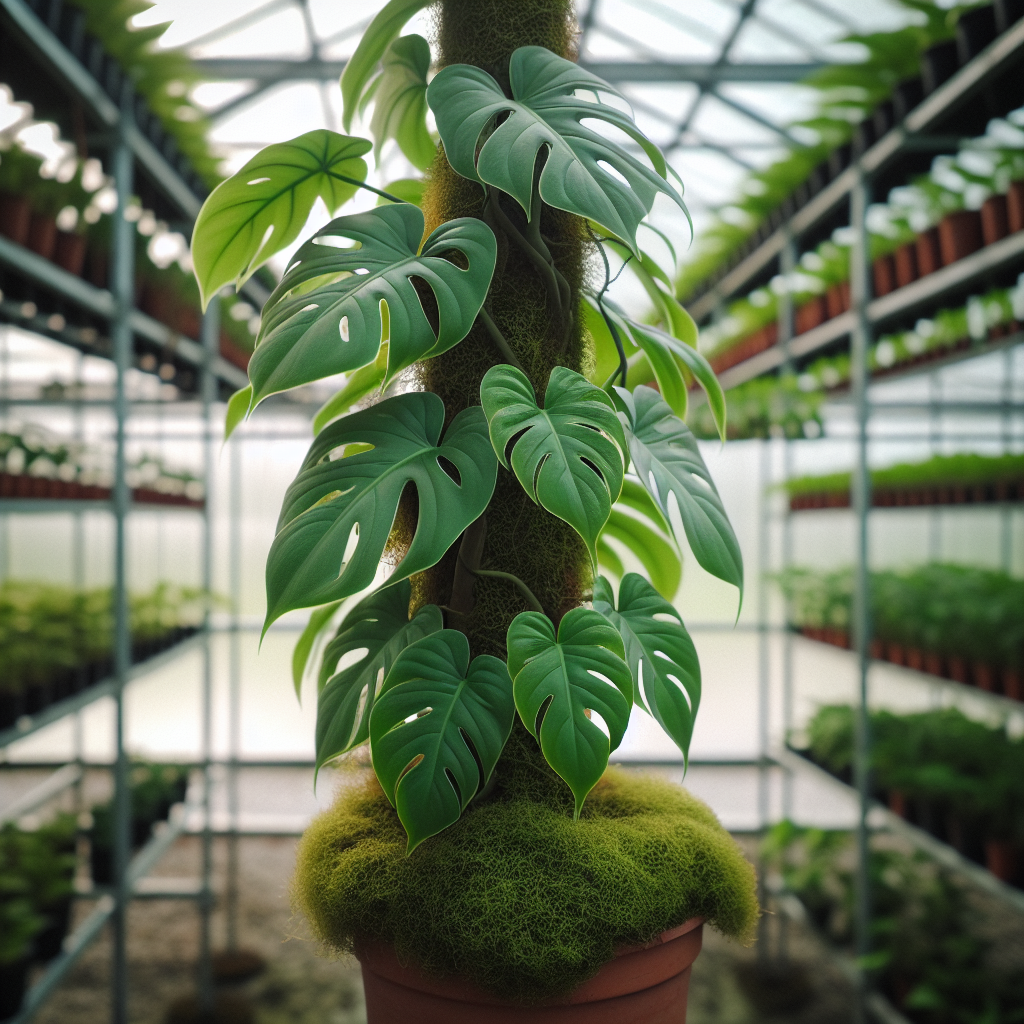
Introduction to Mini Monstera
Often sold as a compact substitute for Monstera deliciosa, this plant is actually Rhaphidophora tetrasperma, a vigorous climbing aroid native to tropical regions of southern Thailand and peninsular Malaysia. Its appeal comes from deeply green juvenile leaves that quickly develop elegant fenestrations, giving a "split-leaf" look on a much smaller frame than a full-size monstera. In commercial interiorscaping and specialty nursery production, it is valued for rapid turnover, strong consumer demand, and a manageable footprint.
Although popularly treated as a houseplant, Mini Monstera behaves like a true tropical vine in cultivation. It wants warmth, high ambient humidity, oxygen-rich root conditions, and vertical support that encourages larger foliage and tighter internode spacing. When grown without support, stems trail and leaves stay smaller; when trained upward on a moss pole, plank, or totem, the plant often shows a marked increase in leaf size and more regular fenestration. That climbing response is central to understanding how to produce premium specimens rather than merely keeping the plant alive.
Historically, Mini Monstera surged in popularity during the modern rare-aroid boom, but its ease relative to many collector aroids helped move it into mainstream retail. It has remained a favorite because it combines exotic appearance with forgiving propagation. For growers, that means it is both an ornamental crop and an efficient stock plant for vegetative multiplication.
Botanical Profile of Mini Monstera
This species belongs to the family Araceae, the same family as philodendrons, pothos, anthuriums, and true monsteras. Taxonomically, it is distinct from Monstera deliciosa and from Monstera adansonii, though casual buyers often confuse all three. The species name "tetrasperma" refers to the original botanical description, but in horticulture the plant is grown almost entirely from cuttings rather than seed.
Key identifying traits include slender vining stems, alternating leaves, visible nodes with aerial root initials, and glossy green blades that become pinnatifid or split as the plant matures. Juvenile leaves may be entire or only lightly cut, while stronger light, support, and maturity promote more defined fenestration. Stems are thinner and more delicate than many philodendrons, but growth is fast under warm conditions.
Roots are adapted to organic, well-aerated forest substrates rather than dense mineral soil. In nature, the plant scrambles up tree trunks and through leaf litter, using aerial roots to anchor and absorb surface moisture. This explains why it performs poorly in heavy potting mixes and excels in chunky media with abundant pore space.
Mini Monstera is considered moderately easy, but it is not indestructible. The most common production mistake is treating it like a drought-tolerant foliage plant. The second most common is overpotting into soggy media, which deprives roots of oxygen and leads to stem decline from the base upward.
Soil, pH, and Climate Requirements for Mini Monstera
The ideal root zone is airy, fibrous, and moisture-buffered rather than wet. A professional-grade mix typically contains 30-40% fine orchid bark, 20-30% coco coir or peat, 15-25% perlite or pumice, and 10-15% compost or worm castings, with optional horticultural charcoal for structure and odor control. The target is a substrate that holds moisture in thin films around particles while draining freely enough that excess water exits the pot within seconds, not minutes.
For potted production, a pH of 5.8 to 6.5 is ideal. At this slightly acidic range, micronutrients such as iron and manganese remain available without creating toxicity. If pH rises much above 6.8, new leaves may pale from micronutrient lockout, especially under hard-water irrigation. If pH falls too low, root stress and nutrient imbalance can follow. Testing media slurry periodically is worthwhile in greenhouse or nursery settings.
Climate matters more than many growers realize. Optimal temperature is 20-30°C (68-86°F). Growth slows noticeably below 16°C (61°F), and chilling injury may begin after sustained exposure below 10-12°C (50-54°F). Outdoor cultivation is therefore limited to frost-free tropical and subtropical zones, shaded patios in warm seasons, or controlled environments. The plant is especially sensitive to cold wet roots, a combination that often triggers yellowing and collapse.
Relative humidity of 60-80% is ideal for lush growth, though the plant can survive at 40-50% if watering and airflow are well managed. Higher humidity supports leaf expansion and reduces mechanical tearing during unfurling. However, stagnant, humid air is risky; airflow must accompany humidity to reduce bacterial and fungal issues.
Light should be bright and indirect, roughly equivalent to 8,000-20,000 lux for most of the day. Brief gentle morning sun may be tolerated, but harsh midday sun can bleach foliage and create tan necrotic patches. Too little light leads to stretched internodes, small leaves, delayed fenestration, and weak stems. In shadehouse systems, 30-50% shade cloth is often appropriate depending on latitude and season. For growers familiar with other tropical understory crops, its light preferences are broadly similar to Vanilla.
Water quality is also relevant. Mini Monstera prefers low-salinity irrigation, ideally under 1.0 mS/cm EC for routine watering. Excess fluoride, sodium, or bicarbonates may contribute to tip burn and nutrient antagonism over time. Rainwater, filtered water, or blended irrigation sources are advantageous where tap water is very hard.
Step-by-Step Planting & Propagation
Propagation is overwhelmingly done from stem cuttings, because each viable node can produce roots and a new shoot. Select healthy, pest-free mother plants with active growth. Each cutting should include at least one node and one leaf; two-node cuttings are even more forgiving because they provide redundancy if one node fails.
- Sterilize pruners with alcohol or a disinfectant.
- Cut 0.5-1 cm below a node.
- Remove any damaged leaf tissue and keep the node intact.
- Allow the cut surface to dry briefly for 15-30 minutes in clean shade if conditions are very wet, though long callusing is usually unnecessary.
- Root in water, sphagnum moss, perlite, coco-perlite, or a propagation plug.
Water propagation is visually convenient but often creates roots adapted to low-oxygen water, which can stall after transplanting. For commercial consistency, lightly moist sphagnum with high airflow or a 50:50 perlite-coco mix is usually better. Rooting conditions should stay around 24-28°C (75-82°F) with high humidity and bright filtered light. Roots often emerge in 2-4 weeks, with transplant readiness at roughly 3-7 cm (1-3 in) root length.
When potting rooted cuttings, avoid oversized containers. Choose a pot only 2-5 cm (1-2 in) wider than the root mass. Overpotting causes media to stay wet too long, raising risk of root rot. Set the node just at or slightly below media level, firm gently, and water until evenly moist. Do not bury stems deeply.
For specimen production, install support at planting time. A moss pole, coco pole, cedar plank, or rough bark slab encourages aerial root attachment. Keeping the pole lightly moist can improve adherence and leaf enlargement. Secure stems loosely with soft ties, never tight enough to constrict the vine.
Division is less common but possible in older, multi-stem pots. Seed propagation is rare and generally irrelevant outside breeding or botanical collections.
If you want broader principles on building resilient growing media and fertility programs, see soil health strategies.
Care & Maintenance regimes for Mini Monstera
Water management should be precise. The media should remain slightly to moderately moist, never bone-dry for long and never swampy. In practical terms, water when the top 2-4 cm (about 1-1.5 in) of the mix has dried, while the lower root zone still retains light moisture. In a well-structured aroid mix, that often means watering every 5-10 days indoors, every 2-5 days in hot greenhouse weather, and less frequently in cool, low-light conditions.
Signs the plant needs water include leaves losing some firmness, the pot becoming notably lighter, and aerial roots appearing dry and papery. Do not wait for dramatic wilt as a standard cue; repeated severe drying causes root dieback, brown margins, and stalled leaf development. On the other hand, overwatering symptoms include yellow lower leaves, soft stems near the base, sour-smelling media, Fungus gnats, and persistent wetness more than several days after irrigation.
The correct watering method is to drench thoroughly until 10-20% of the volume drains from the bottom, then allow the substrate to partially dry before watering again. Frequent tiny sips create uneven moisture zones and salt accumulation. Empty saucers or cachepots after watering so roots are not left submerged.
Fertilization should be steady but conservative. During active growth, apply a balanced liquid fertilizer at one-quarter to one-half strength every 2-4 weeks, or use a controlled-release product suitable for tropical foliage crops. A target feed around 3-1-2 or balanced NPK works well. Excess nitrogen under low light causes soft, elongated growth; insufficient nutrition produces pale foliage and reduced leaf size. Calcium and magnesium are important if using very pure water. Monthly leaching with plain water helps prevent salt buildup.
Pruning focuses on shaping and rejuvenation rather than heavy removal. Cut back long, bare vines just above a node to trigger branching. Remove yellow, damaged, or pest-infested leaves promptly. Every pruning event can also become a propagation opportunity.
Repotting is usually needed every 12-18 months, or sooner if roots circle densely and drying becomes too rapid. Move up only one pot size at a time. After repotting, keep the plant in warm, bright shade for 1-2 weeks and avoid heavy feeding until new growth resumes.
Leaf cleaning matters for photosynthesis and aesthetics. Dust accumulation reduces light interception and can harbor mites. Wipe leaves gently with water and a soft cloth; avoid oily shine products that clog stomatal surfaces.
In interiors or protected structures, rotation may be useful because vines orient strongly to light. Without periodic training, plants become one-sided. Tie new growth to support while stems are still flexible.
Pests, Diseases & Organic Management
Mini Monstera is vulnerable to several common tropical foliage pests, especially under dry indoor air or crowded greenhouse conditions. Spider mites are frequent when humidity is low; symptoms include fine stippling, dull foliage, and webbing on leaf undersides or petioles. Thrips cause silvery scarring, distorted new leaves, and black fecal specks. Mealybugs gather at nodes and root zones, sucking sap and weakening growth. Scale insects may attach to stems, while Fungus gnats indicate chronically wet media rather than causing primary damage themselves.
Organic control begins with prevention. Quarantine all new stock for 2-3 weeks. Inspect leaf undersides, nodes, and pot rims weekly. Maintain airflow, avoid excess nitrogen, and keep irrigation disciplined. Rinsing foliage with water can suppress Spider mites and dust simultaneously.
For active infestations, insecticidal soap or horticultural soap works well against soft-bodied pests if coverage is thorough, especially on undersides and stem joints. Neem-based products may help, though they should be tested first to avoid phytotoxicity under bright light. Repeated applications every 5-7 days are more effective than a single treatment because eggs and hidden pests often escape the first pass. Root Mealybugs may require unpotting, washing roots, replacing media, and sanitizing containers.
Disease problems are usually linked to excess moisture, poor airflow, cold stress, or contaminated tools. Root rot pathogens such as Pythium and Phytophthora are the major threat in saturated media. Above-ground bacterial soft rot can spread rapidly through wounded or chilled tissue, producing mushy stems and foul odor. Leaf spot diseases may appear as water-soaked or necrotic lesions where foliage stays wet for prolonged periods.
Management is largely cultural: use sterile media, clean pots, sharp sanitized tools, and fast-draining substrates. Water early in the day so surfaces dry quickly. Remove infected tissue well below visible damage and isolate symptomatic plants. If the base is rotting but upper nodes are healthy, salvage by taking clean cuttings from unaffected sections and discarding the diseased root system.
Physiological disorders are also common. Brown crispy margins usually indicate underwatering, low humidity, salt accumulation, or inconsistent moisture. Uniform yellowing may signal overwatering or low light. Small leaves and long gaps between nodes usually indicate insufficient light. Split or stuck new leaves often result from low humidity during expansion, erratic watering, or mechanical damage while unfurling.
Harvesting, Curing & Optimal Storage
As an ornamental foliage vine, Mini Monstera is not harvested in the food-crop sense. Instead, harvest refers to taking propagation material, marketable finished plants, or decorative cut foliage. The best time to harvest cuttings is during active growth, when nodes are swollen and leaves are fully expanded but still physiologically vigorous. Morning harvest is preferred because tissue hydration is highest.
For propagation cuttings, use clean, turgid stems with no signs of pests, nutrient stress, or edema. Keep harvested cuttings shaded, cool, and slightly humid. Do not expose them to direct sun or dry wind, as thin stems dehydrate quickly. If transport is required, wrap nodes in barely damp paper and place cuttings in ventilated packaging. They should be processed within 24 hours for best rooting performance.
For retail-ready potted plants, market quality depends on leaf symmetry, fenestration, support training, and the absence of mechanical scarring. Water thoroughly several hours before shipping so the root ball is evenly moist but not dripping. Secure vines to support to avoid snapping during transit.
There is no true curing stage, but an acclimation phase is useful. Plants moving from humid greenhouse conditions to homes, offices, or garden centers benefit from 5-10 days in slightly lower humidity and moderate light so they adjust gradually. Sudden transfer from ideal production conditions to dim retail shelves often causes leaf yellowing and stress.
Storage of finished plants should be short-term only. Hold at 18-24°C (64-75°F) with bright indirect light and good air circulation. Avoid temperatures below 15°C (59°F). Cuttings should not be refrigerated in the way produce is stored; chilling injury can reduce rooting and blacken tissue.
Companion Planting for Mini Monstera
Because this crop is usually grown in containers, greenhouses, patios, tropical understory beds, or interiorscapes, companion planting is less about field intercropping and more about creating compatible microclimates. The best companions are plants that appreciate similar moisture, filtered light, and warm temperatures without aggressively outcompeting the vine.
Thyme is not a moisture match and is therefore a poor direct root-zone companion in the same container, despite its usefulness elsewhere. Better companions are tropical or humidity-tolerant species placed nearby rather than mixed into the same pot. Nasturtium can function as a sacrificial aphid and pest-monitor plant in warm seasons if grown in a separate adjacent container, though it prefers brighter light and should not be shaded heavily. Yarrow is useful near greenhouse entrances or exterior beds for attracting beneficial insects, but it is too dry-loving for the same container. Clover can serve as a living mulch in large tropical planters if aggressively managed, though it may compete for nitrogen and should be trimmed regularly.
In most professional setups, the strongest companion strategy is environmental rather than botanical: pair Mini Monstera with other aroid or tropical foliage crops that need similar irrigation intervals and humidity. Avoid combining it in a single pot with drought-tolerant herbs or succulents. If using nearby companion species for pest ecology, keep them in separate containers so watering can be tailored correctly.
The simplest rule is this: choose companion plants that support humidity buffering, beneficial insect presence, and space efficiency without forcing the root zone to remain either too dry or too wet for the vine.