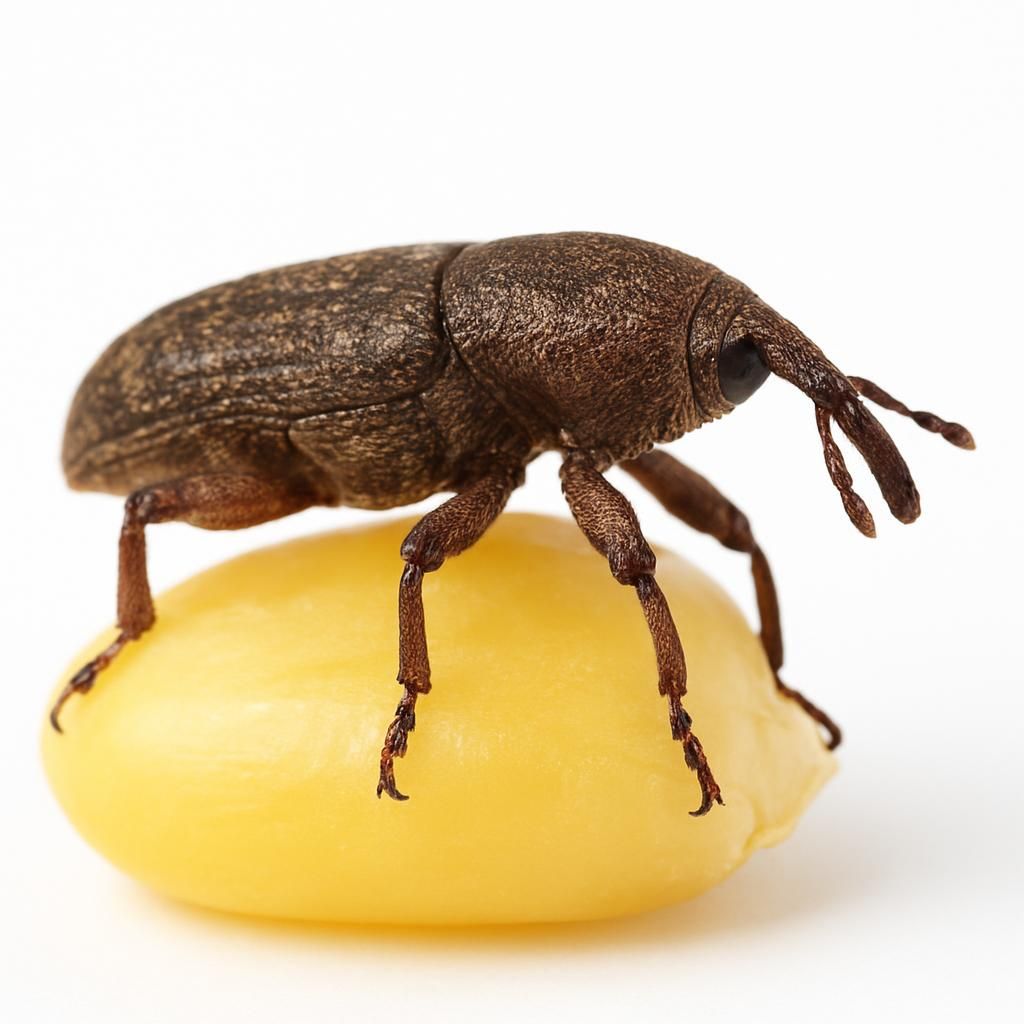
Introduction to Maize weevil
The maize weevil (Sitophilus zeamais) is one of the most destructive stored-product insects affecting maize worldwide. This small, dark-brown beetle belongs to the family Curculionidae and is closely related to the rice weevil (Sitophilus oryzae). Unlike many storage pests that only attack grain after harvest, the maize weevil can infest maize ears while still standing in the field, making it a dual threat during both pre-harvest and post-harvest stages. Its ability to fly allows rapid spread between fields and storage facilities, leading to significant economic losses for smallholder and commercial farmers alike.
Adult maize weevils measure approximately 2.5–4.5 mm in length and possess a characteristic elongated snout. They are strong fliers and can remain active at temperatures above 13 °C. Females chew small cavities into kernels and deposit single eggs inside each hole before sealing it with a gelatinous plug. The larvae develop entirely within the grain, feeding on the endosperm and germ until they pupate and emerge as adults through a circular exit hole. This internal feeding habit makes early detection difficult and allows populations to build rapidly under favorable conditions.
Because the maize weevil also attacks other cereals such as wheat, sorghum, and rice, it poses a broad risk to staple food security. Effective management therefore requires an integrated approach combining cultural, physical, biological, and, when necessary, chemical strategies. This guide provides diagnostic criteria, lifecycle details, environmental risk factors, and practical control recommendations tailored for professional agricultural use.
Identifying Symptoms & Damage
Visible signs of maize weevil infestation appear both on standing crops and in stored grain. On the ear, look for small round exit holes (approximately 1–2 mm) on kernels and the presence of adult weevils crawling on silk or husk. Damaged kernels often show a floury frass that accumulates at the base of the ear or inside storage bags.
In storage, the first indication is usually “hot spots” where grain temperature rises 5–10 °C above ambient due to insect metabolic activity. Heavily infested lots exhibit a sweet, musty odor and a noticeable reduction in test weight. Sifting grain through a 2 mm mesh reveals adult weevils and larvae. X-ray or near-infrared spectroscopy can detect internal infestation before exit holes appear, allowing early intervention.
Secondary damage includes increased moisture content that promotes growth of storage fungi such as Aspergillus and Penicillium, further degrading grain quality and producing mycotoxins. Farmers should inspect grain monthly during the first three months of storage when population growth is fastest.
Lifecycle and Progression of Maize weevil (MUST INCLUDE A MARKDOWN TABLE OF LIFECYCLE STAGES)
The maize weevil completes its entire development inside a single kernel. Under optimal conditions (25–30 °C and 65–70 % relative humidity), the cycle from egg to adult takes 25–35 days. Below 13 °C or above 35 °C development slows dramatically or stops. The following table summarizes each stage:
| Stage | Duration (at 27 °C) | Key Characteristics | Visible Signs |
|---|---|---|---|
| Egg | 3–5 days | White, oval, laid singly inside kernel | Gelatinous plug on kernel surface |
| Larva | 12–18 days | C-shaped, legless, feeds on endosperm | Frass and kernel weight loss |
| Pupa | 5–7 days | Transformation inside kernel | No external sign until emergence |
| Adult | 3–6 months | Dark brown, 3–4.5 mm, flight-capable | Exit hole (1–2 mm) and adults |
Multiple overlapping generations occur in tropical storage environments, allowing exponential population growth within 90 days if left unchecked.
Environmental Triggers & Risk Factors
Temperature and moisture are the primary drivers of maize weevil outbreaks. Optimal development occurs between 25–30 °C and 12–15 % grain moisture. Above 14 % moisture, fungal growth accelerates and provides additional food for larvae. Poorly sealed storage structures, cracked kernels from mechanical damage, and delayed drying all increase risk.
Field infestations are favored by late-season rainfall that keeps ears moist and by varieties with loose husks. Cross-infestation from nearby wheat or sorghum stores can initiate new cycles. High ambient humidity (>70 %) during storage further encourages rapid reproduction.
Organic Control & Treatment Plans (MUST INCLUDE A MARKDOWN TABLE OF TREATMENT OPTIONS AND FREQUENCIES)
An integrated organic program focuses on sanitation, temperature management, and botanical or biological agents. The following table outlines proven options and application frequencies:
| Treatment Option | Application Method | Frequency / Timing | Notes |
|---|---|---|---|
| Solarization (bags or bulk) | Spread grain 5–7 cm deep in direct sun | 2–3 consecutive sunny days | Achieves 55–60 °C lethal to all stages |
| Hermetic storage bags | Seal 50–100 kg lots in PICS or similar bags | At harvest and after any movement | Maintains <1 % O₂; monitor every 30 days |
| Diatomaceous earth | Dust at 0.5–1 g/kg grain | Once at loading; reapply if moved | Abrades cuticle; safe for organic use |
| Neem kernel powder | Mix 2–3 % w/w with grain | At storage and repeat after 60 days | Repellent and growth regulator |
| Beneficial nematodes | Apply Steinernema feltiae at 10⁶/m² | When grain moisture >12 % | Targets larvae; reapply if temperature >30 °C |
| Pheromone traps | Place 1 trap per 10 m² storage area | Monitor weekly; replace lures monthly | Early detection; mass trapping possible |
Combine at least three tactics for best results. Always dry grain to ≤12 % moisture before storage.
Preventing Maize weevil in the Future
Prevention starts at harvest. Select maize varieties with tight husks and harvest promptly once physiological maturity is reached. Dry grain within 48 hours to 12–13 % moisture using forced-air dryers or solar dryers. Clean all harvesting and handling equipment between lots to remove residual infested grain.
Store grain off the ground on pallets inside well-sealed, rodent-proof structures. Implement a three-month rotation schedule for inspection and aeration. Use hermetic technology or regular fumigation with approved organic options when monitoring indicates rising trap catches. Record temperature and moisture logs to predict risk periods.
Crops Most Affected by Maize weevil
While maize (Zea mays) is the primary host, the maize weevil readily infests sorghum, wheat, rice, barley, and millet. It has also been recorded on oats, rye, and occasionally on stored peanuts and sunflower seed when maize is unavailable. Cross-infestation between these crops is common in mixed smallholder storage systems.