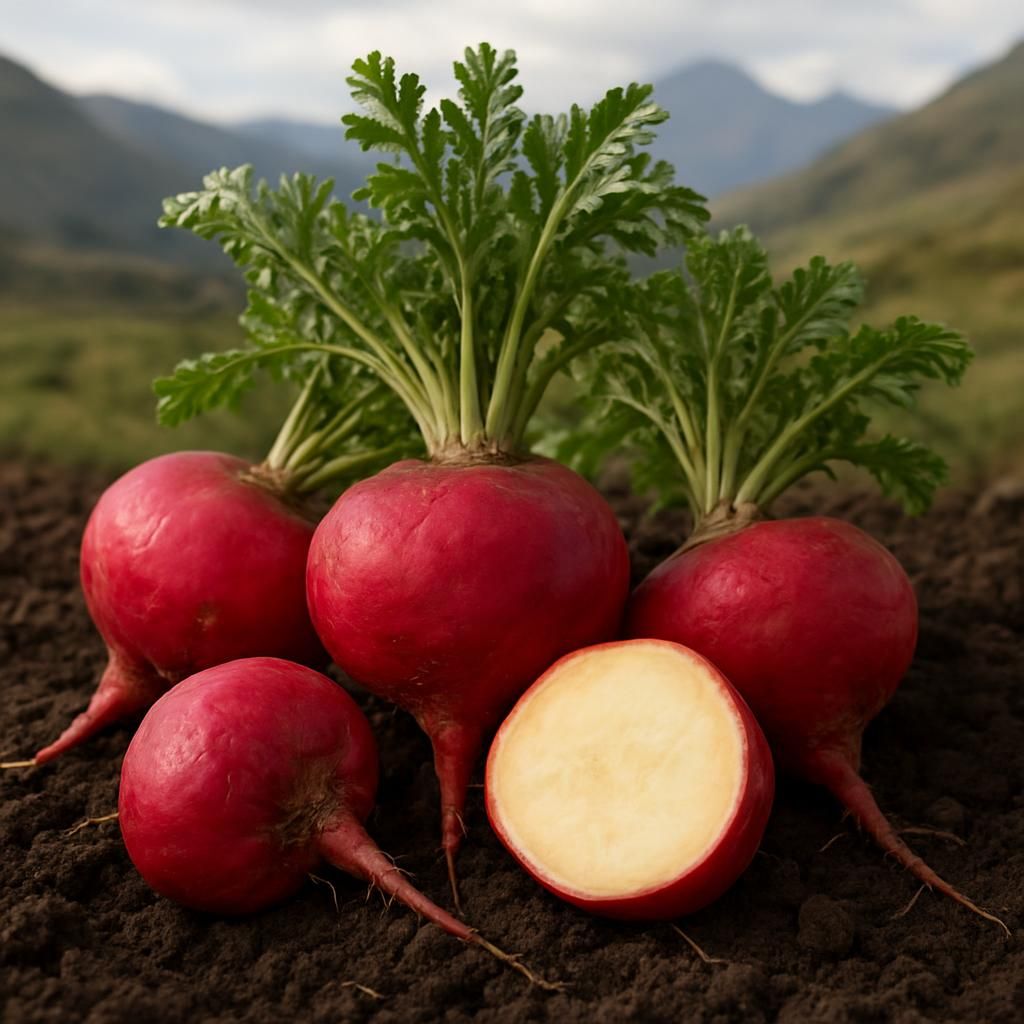
Introduction to Maca (Lepidium meyenii - Red)
Red maca (Lepidium meyenii) is a biennial herbaceous plant in the Brassicaceae family, cultivated for its swollen hypocotyl that develops at elevations between 3,500 and 4,500 meters in the Peruvian Andes. The red variety is particularly valued for its higher concentrations of anthocyanins and specific bioactive compounds linked to energy, hormone balance, and reproductive health. As a cool-season, high-altitude crop, red maca offers farmers an opportunity to diversify income in marginal highland environments where few other crops thrive.
Commercial interest has expanded beyond Peru, with trials underway in high-elevation regions of Bolivia, Ecuador, China, and the Rocky Mountains of North America. Successful cultivation requires precise replication of the cool, intense sunlight, and well-drained soils of its native habitat. This guide delivers practical, research-backed advice for growers seeking to produce high-quality red maca roots for fresh, dried, or powdered markets.
Botanical Profile of Maca (Lepidium meyenii - Red)
Red maca forms a basal rosette of pinnately lobed leaves and develops a fleshy, turnip-like hypocotyl that can reach 5–8 cm in diameter. The red phenotype is distinguished by anthocyanin pigmentation in both the skin and flesh of the hypocotyl. The plant produces small, white to cream-colored flowers on a raceme 20–40 cm tall and sets siliques containing tiny seeds. As a biennial, maca typically completes its vegetative growth in the first year and flowers in the second year under long-day conditions.
The red variety is noted for higher levels of macamides, macaenes, and glucosinolates compared with yellow or black phenotypes. These compounds contribute to the crop’s status as a functional food and nutraceutical ingredient. Seed viability declines rapidly after 12 months, so fresh seed should be used each season.
Soil, pH, and Climate Requirements for Maca (Lepidium meyenii - Red)
Maca demands cool temperatures, intense solar radiation, and sharply drained soils. It performs poorly below 2,500 m elevation and suffers heat stress above 20 °C for extended periods.
| Parameter | Ideal Range | Notes |
|---|---|---|
| Soil Type | Sandy loam to loam, high in organic matter | Avoid heavy clays that retain water |
| Soil pH | 6.0–6.8 | Slightly acidic to neutral |
| Elevation | 3,500–4,500 m | Lower elevations require shade and cooling |
| Daytime Temperature | 10–18 °C | Night temperatures ideally 0–5 °C |
| Annual Precipitation | 400–700 mm | Supplemental irrigation during dry spells |
| Frost Tolerance | Tolerates light frost; protect seedlings | Mulch crowns in late autumn |
Step-by-Step Planting & Propagation
- Site Selection & Preparation — Choose a south-facing slope with full sun and good air drainage. Incorporate 5–8 cm of well-rotted compost or aged manure and perform a soil test to confirm pH and nutrient status.
- Seed Treatment — Use fresh seed less than 12 months old. Cold-stratify for 7–10 days at 4 °C to improve germination uniformity.
- Sowing Window — Direct sow in early spring when soil temperature reaches 8–10 °C. In high tropics, sow at the onset of the rainy season.
- Seeding Rate & Depth — Sow 1.5–2 g seed per m² at 0.5 cm depth in rows 30 cm apart. Thin seedlings to 8–10 cm spacing once they reach the two-true-leaf stage.
- Transplant Option — Start seedlings in 128-cell trays 6–8 weeks before field transplanting; harden off for 10 days.
Care & Maintenance regimes for Maca (Lepidium meyenii - Red)
Maca requires consistent moisture during establishment but becomes drought-tolerant once the hypocotyl begins to swell. Over-fertilization promotes leafy growth at the expense of root development.
| Growth Stage | Irrigation Frequency | Fertilizer (N-P-K) | Pruning / Other Care |
|---|---|---|---|
| Seedling (0–6 wks) | Keep top 5 cm moist; 2–3× wk | 10-20-10 at 40 kg N/ha | Weed weekly; light mulch |
| Vegetative (6–20 wks) | Deep soak every 7–10 days | Side-dress 20 kg N/ha at wk 8 | Remove flower stalks if biennial cycle desired |
| Hypocotyl Swell (20–32 wks) | Reduce to every 14 days | No additional N; 0-10-20 at 30 kg K/ha | Hill soil around crowns for support |
| Dormancy / Overwinter | Withhold water if soil freezes | None | Apply 10 cm straw mulch before hard frost |
Pests, Diseases & Organic Management
Red maca is relatively pest-resistant due to its high glucosinolate content, yet several insects and pathogens can reduce yields.
- Aphids can colonize leaf undersides; release lady beetles and apply insecticidal soap.
- Root-knot nematodes cause galls; rotate with garlic or onion and solarize soil between cycles.
- Fusarium wilt and Pythium cause damping-off; improve drainage and use treated seed.
- Spider mites appear under hot, dry conditions; increase humidity and apply neem oil.
Scout weekly and maintain field sanitation to minimize outbreaks.
Harvesting, Curing & Optimal Storage
Harvest red maca when leaves begin to senesce and hypocotyls reach 5–8 cm diameter, typically 8–10 months after sowing. Lift roots carefully with a fork to avoid bruising. Wash gently in cool water and air-dry for 24 hours.
Traditional sun-drying on raised racks for 10–15 days preserves bioactive compounds. For commercial powder production, slice roots 3–5 mm thick and dehydrate at 40 °C until moisture content is below 10 %. Store dried maca in airtight containers at 15 °C and <60 % RH for up to 24 months.
Companion Planting for Maca (Lepidium meyenii - Red)
Maca benefits from associations that improve soil structure and deter pests. Compatible partners include quinoa, amaranth, and clover as living mulch. Avoid planting near other brassicas to reduce shared pest pressure. Interplanting with thyme or yarrow can repel aphids and improve biodiversity.
For additional guidance on high-altitude soil management, see The Forgotten Art of Fall Soil Revival: 8 Organic Strategies for Small Farm Resilience.