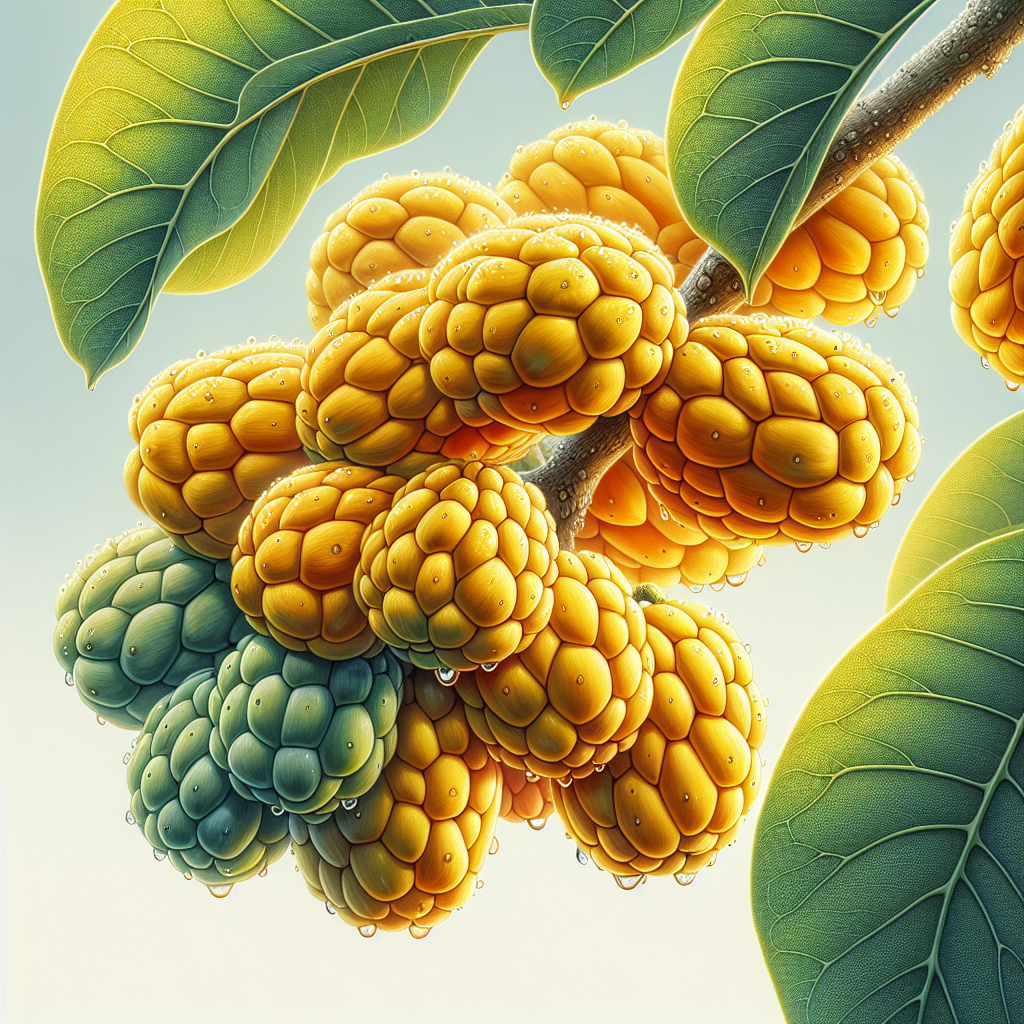
Introduction to Kwai Muk (Artocarpus hypargyreus)
Kwai Muk (Artocarpus hypargyreus), also known as the silver mulberry or wild jackfruit relative, is an underappreciated tropical fruit tree originating from the Guangdong and Guangxi provinces of southern China. This evergreen species belongs to the Moraceae family, closely related to the common mango and jackfruit, but distinguished by its smaller, clustered fruits that ripen to a vibrant yellow-orange hue. Each fruit, about the size of a golf ball, features a sweet-tart flesh with creamy texture, high moisture content, and a flavor profile evoking pineapple, mango, and citrus—making it a gourmet delight for fresh eating, juicing, or desserts.
Farmers and home growers are increasingly drawn to Kwai Muk for its ornamental value, with glossy dark green leaves featuring striking silver undersides that shimmer in the breeze, adding aesthetic appeal to tropical landscapes. The tree's rarity outside Asia positions it as a high-value niche crop, commanding premium prices in specialty markets, farmers' markets, and exotic fruit boutiques. Mature trees can produce 50-100 kg of fruit annually after 5-7 years, thriving in USDA zones 10-11 or equivalent subtropical regions with high humidity. This guide provides professional-grade, step-by-step advice for successful cultivation, from seed to harvest, emphasizing organic methods and sustainable practices to maximize yields while minimizing inputs. Whether scaling for commercial orchards or backyard groves, mastering Kwai Muk cultivation unlocks a profitable, low-maintenance tropical powerhouse.
Botanical Profile of Kwai Muk (Artocarpus hypargyreus)
Artocarpus hypargyreus is a medium-sized evergreen tree reaching 10-20 meters in height at maturity, with a straight trunk up to 50 cm in diameter and a broad, dense canopy spreading 8-12 meters. The leaves are alternate, lanceolate to obovate, 10-25 cm long, leathery, dark green above with distinctive silvery-white pubescence beneath—hence the species epithet 'hypargyreus' meaning 'silvery beneath.' This adaptation aids in heat reflection and humidity retention, ideal for tropical understories.
Dioecious (separate male and female trees), Kwai Muk produces small, greenish-white flowers in axillary clusters. Female inflorescences develop into syncarps—multiple fruits fused into irregular, oblong clusters 5-10 cm long, weighing 100-300 grams each. The rind is thin, yellowish, and bumpy, enclosing 20-50 juicy segments of aril-like flesh surrounding small, hard seeds. Fruits mature in 3-4 months, with peak seasons from June to September in native habitats. Nutritionally, Kwai Muk boasts high vitamin C (up to 50 mg/100g), antioxidants, dietary fiber, and moderate sugars (12-15 Brix), contributing to its rising popularity in health-focused markets.
Root systems are extensive and shallow, with lateral spread exceeding canopy width, making it sensitive to mechanical damage but excellent for soil stabilization on slopes. Phenologically, trees exhibit minimal deciduous behavior, with new growth flushes triggered by wet seasons. Genetic diversity is limited in cultivation, but grafting preserves elite clones for superior fruit quality and precocity. For deeper insights into related Moraceae species, see the jackfruit profile—wait, no, actually mango shares propagation similarities.
Soil, pH, and Climate Requirements for Kwai Muk (Artocarpus hypargyreus)
Kwai Muk demands well-drained, fertile loamy soils rich in organic matter, with sandy loam or clay loam ideal (sand 40-60%, silt 20-30%, clay 20%). Avoid heavy clays prone to waterlogging, as roots are susceptible to root rot. Optimal pH ranges 5.5-7.0, slightly acidic to neutral; test soil annually and amend with dolomite lime if below 5.5 or sulfur if exceeding 7.5. Incorporate 10-20 kg compost per square meter pre-planting to enhance microbial activity and cation exchange capacity.
Climatically, Kwai Muk flourishes in humid subtropical to tropical zones with average temperatures 22-32°C (72-90°F), tolerating brief dips to 10°C but suffering damage below 5°C. Annual rainfall of 1500-2500 mm is perfect, with distinct wet/dry seasons mimicking native habitats; supplemental irrigation critical during dry spells (<50 mm/month). High humidity (70-90%) promotes flowering, while full sun (6-8 hours daily) ensures vigorous growth and fruit set. Wind protection is essential for young trees, as gales can shred foliage and scar fruits. In marginal areas, use frost blankets or site in microclimates near water bodies. For heatwave strategies, check this blog post on organic resilience tactics adaptable to tropicals.
Mulch with 10-15 cm organic layers (coconut coir, rice hulls) to retain moisture, suppress weeds, and moderate soil temps. Soil salinity tolerance is low (EC <2 dS/m); flush with rainwater if irrigated with brackish sources.
Step-by-Step Planting & Propagation
Propagation Methods
Kwai Muk propagates readily via seeds, air-layering, or grafting, with air-layering preferred for uniformity.
- Seed Propagation: Extract seeds from ripe fruits, wash off pulp, and sow fresh in 50:50 sand-compost mix. Germination in 10-20 days at 25-30°C under mist. Pot seedlings at 2-3 leaves, transplant at 30-50 cm tall.
- Air-Layering: Select 2-3 year-old branches (1-2 cm diameter), girdle 5 cm wide, apply rooting hormone (IBA 5000 ppm), wrap in moist sphagnum moss and plastic. Roots form in 6-8 weeks; sever and pot.
- Grafting: Cleft or veneer graft scions onto rootstocks of Artocarpus heterophyllus (jackfruit) for vigor. Success rate 70-80% in humid conditions.
Planting Steps
- Site Prep: Dig pits 60x60x60 cm, 4-6 m apart (5x5 m for dwarfs), fill with topsoil + 20 kg FYM + 500g superphosphate + 200g muriate of potash.
- Planting Time: Early wet season; plant at same depth as nursery pot, stake if needed.
- Initial Care: Water deeply weekly first year, shade 50% for 3-6 months. Prune to single leader. Expect first fruits in 3-5 years from air-layers.
Care & Maintenance regimes for Kwai Muk (Artocarpus hypargyreus)
Irrigation: Drip irrigate to 80% field capacity; 40-60 L/tree/week mature. Deficit irrigation post-harvest enhances next bloom. Fertilization: Annual schedule: NPK 10-10-10 at 1-2 kg/tree/year split 4x, plus micronutrients (Zn, B, Mn). Foliar sprays bi-monthly. Pruning: Annual post-harvest: remove deadwood, water sprouts, open canopy for light penetration. Train to 3-4 main scaffolds. Weed Control: Mulch + manual; avoid herbicides near trunk. Pollination: Plant 1 male:10 females; hand-pollinate if low set. Monitor growth; aim 50-80 cm/year.
Pests, Diseases & Organic Management
Pests: Common foes include aphids, mealybugs, fruit borers, and bats. Neem oil (2%) weekly sprays; install copper nets. Introduce ladybugs. Diseases: Phytophthora root rot, anthracnose, powdery mildew. Use biofungicides (Trichoderma), improve drainage. Copper oxychloride for fungal spots. Integrated Approach: Scout weekly; thresholds: 5% leaf infestation triggers action. Companion herbs deter pests. For advanced tactics, explore Why 90% of Small Farms Fail at Pest Management—adaptable to tree crops. Organic certification viable with strict IPM.
Harvesting, Curing & Optimal Storage
Harvest when 80% yellow, clusters firm but yielding slightly (3-4 months post-bloom). Clip with shears, avoiding stem tears. Yield peaks years 8-15. Post-Harvest: Cool to 12-15°C, 85-90% RH; shelf life 2-4 weeks. For markets, hydrocool and pack in ventilated crates. Storage: 10-13°C, 90% RH up to 4 weeks; freeze pulp at -18°C for 12 months. Process into jams, juices for value-add. Minimal curing needed; ripen at 25°C.
Companion Planting for Kwai Muk (Artocarpus hypargyreus)
Pair with nitrogen-fixers like pigeon pea for soil enrichment, marigold against nematodes, and thyme for pest repulsion. Avoid water-hungry crops like corn. Understory: ginger, turmeric. Enhances biodiversity, yields 15-20%. See Fall Companion Planting Guide for seasonal synergies.