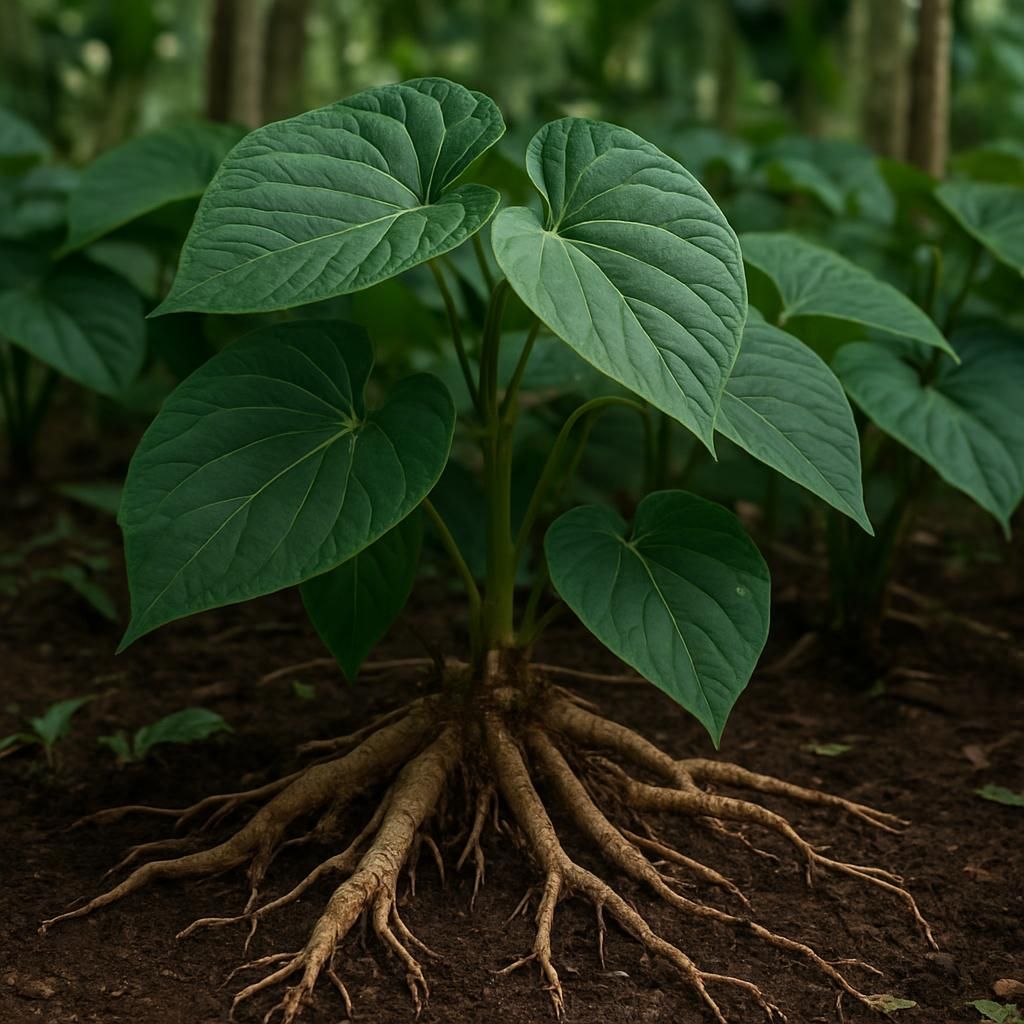
Introduction to Kava Kava (Tudei)
Kava Kava (Tudei), a high-kavalactone cultivar of Piper methysticum, has been cultivated for centuries across the Pacific Islands for its sedative, anxiolytic, and muscle-relaxant properties. The Tudei variety is prized for its robust growth habit and elevated concentrations of dihydrokavain and dihydromethysticin, delivering longer-lasting effects than noble varieties. Commercial production now extends beyond traditional regions into tropical and subtropical zones where suitable microclimates exist. This guide delivers professional-grade agronomic advice for establishing and maintaining productive Kava Kava (Tudei) plantings.
Botanical Profile of Kava Kava (Tudei)
Piper methysticum is a member of the Piperaceae family. The Tudei cultivar exhibits a bushy, multi-stemmed growth habit reaching 2–4 meters in height with heart-shaped, dark-green leaves up to 20 cm long. Stems are jointed and succulent, producing adventitious roots at nodes when in contact with moist soil. The plant rarely flowers under cultivation and is propagated vegetatively. Roots develop into a dense, fibrous mass containing up to 15% kavalactones by dry weight, concentrated primarily in the lateral and secondary root tissues.
Soil, pH, and Climate Requirements for Kava Kava (Tudei)
Kava Kava (Tudei) thrives in deep, well-drained loamy soils with high organic matter. It is sensitive to waterlogging and compacted subsoils. The following table summarizes ideal growing conditions:
| Parameter | Ideal Range | Notes |
|---|---|---|
| Soil Type | Loam to sandy loam | High humus content preferred |
| Soil pH | 5.5 – 6.8 | Slightly acidic to neutral |
| Temperature | 20 – 30 °C day / 18 – 24 °C night | Frost intolerant below 10 °C |
| Annual Rainfall | 1,800 – 3,500 mm | Even distribution; supplemental irrigation required in dry periods |
| Relative Humidity | 70 – 90 % | Supports leaf health and root development |
| Altitude | Sea level to 800 m | Higher elevations slow growth |
| Light | 30 – 50 % shade | Full sun causes leaf scorch |
Step-by-Step Planting & Propagation
Kava Kava (Tudei) is exclusively propagated from stem cuttings taken from healthy, disease-free mother plants. Select 30–40 cm cuttings with at least three nodes. Remove lower leaves and plant cuttings at a 45° angle in a well-drained propagation mix of 50 % perlite and 50 % coconut coir. Maintain 80 % humidity under 50 % shade cloth. Roots typically form within 4–6 weeks. Transplant rooted cuttings into 20 cm pots and grow on for an additional 8–12 weeks before field planting. Space plants 1.5 m × 1.5 m in prepared beds enriched with 5–8 cm of well-rotted compost. Plant at the same depth as the nursery container and water thoroughly.
Care & Maintenance regimes for Kava Kava (Tudei)
Consistent moisture and balanced nutrition are critical during the first 18 months. The following table outlines recommended schedules:
| Growth Stage | Irrigation Frequency | Fertilizer (NPK) | Pruning / Training |
|---|---|---|---|
| Establishment (0–6 mo) | 2–3 times weekly to field capacity | 10-10-10 at 150 g/plant monthly | Remove lower leaves to promote airflow |
| Vegetative (6–18 mo) | Weekly deep watering | 14-7-14 at 200 g/plant quarterly | Tip prune at 1.2 m to encourage branching |
| Mature (>18 mo) | Every 10–14 days | 8-4-12 at 250 g/plant biannually | Remove dead stems annually |
Mulch with 10 cm of organic material to conserve moisture and suppress weeds. Monitor leaf color for nitrogen deficiency and adjust fertilizer rates accordingly.
Pests, Diseases & Organic Management
Common pests include Aphids, Spider mites, and Mealybugs. Monitor weekly and apply neem oil or insecticidal soap at the first sign of infestation. Major diseases are Root rot caused by Phytophthora species and Pythium damping-off in poorly drained soils. Improve drainage, avoid overwatering, and drench with beneficial Trichoderma species as a preventative. Remove and destroy severely infected plants to limit spread.
Harvesting, Curing & Optimal Storage
Harvest Kava Kava (Tudei) roots when plants are 3–5 years old. Cut stems 10 cm above soil level, then carefully excavate the entire root mass. Separate lateral roots from the stump and wash thoroughly. Slice roots into 1–2 cm chips and sun-dry or use forced-air dryers at 35–40 °C until moisture content reaches 12 %. Store cured chips in food-grade, airtight containers in a cool, dark location. Properly cured product retains potency for up to two years.
Companion Planting for Kava Kava (Tudei)
Interplant with nitrogen-fixing legumes such as Pigeon pea or Clover to improve soil fertility. Ginger and Turmeric provide partial shade and share similar moisture requirements. Avoid planting near Tomato or Potato to reduce risk of shared soil-borne pathogens. Marigold borders help deter nematodes and enhance biodiversity.