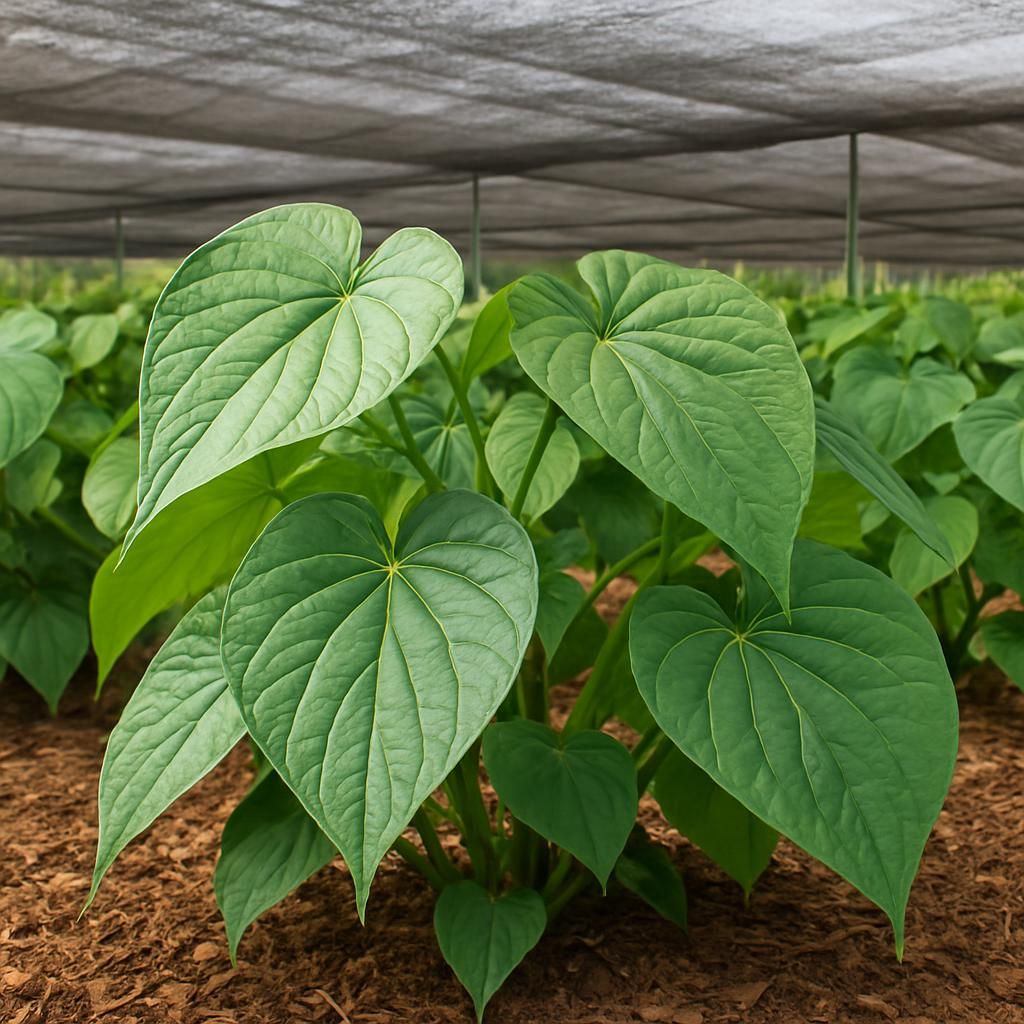
Introduction to Kava Kava (Noble)
Kava Kava (Noble) refers to select cultivars of Piper methysticum prized for their balanced kavalactone profiles and traditional ceremonial use across Polynesia, Melanesia, and Micronesia. Unlike non-noble or "tudei" types, noble varieties produce a smoother, shorter-duration effect and command premium market value. The plant is a slow-growing, shade-tolerant shrub reaching 2–4 meters in height with heart-shaped leaves and thickened rhizomes that store the active compounds. Commercial cultivation has expanded from traditional island agroforestry systems into dedicated plots in Hawaii, Vanuatu, Fiji, and parts of Australia, driven by demand for high-quality, traceable root material.
Successful production requires replicating the humid, shaded understory conditions of its native range while maintaining strict phytosanitary standards to protect against viral decline. This guide provides professional-grade, field-tested recommendations for soil preparation, propagation, irrigation, fertility, pest and disease control, harvest timing, and post-harvest handling to achieve consistent noble-grade yields.
Botanical Profile of Kava Kava (Noble)
Piper methysticum is a member of the Piperaceae family and is propagated vegetatively because it rarely sets viable seed. The plant produces erect, jointed stems with swollen nodes and large, cordate leaves that can reach 20 cm across. Roots and rhizomes are the primary economic organs; they develop a dense network of lateral roots that store kavalactones, particularly kavain, dihydrokavain, and methysticin. Noble cultivars are distinguished by leaf morphology, stem coloration, and chemotype ratios that determine beverage quality and market classification.
Growth is determinate within each annual cycle, with new shoots emerging from the crown after harvest or during favorable wet periods. The plant is perennial and can remain productive for 8–15 years under good management, although commercial rotations often replant after 5–7 years to maintain vigor and reduce disease pressure.
Soil, pH, and Climate Requirements for Kava Kava (Noble)
Kava thrives in deep, well-drained, fertile soils with high organic matter. It performs best in tropical to subtropical climates with consistent humidity and protection from strong winds and direct midday sun.
| Parameter | Ideal Range | Notes |
|---|---|---|
| Soil Type | Loamy to sandy loam with good structure | Avoid heavy clays that retain water |
| Soil pH | 5.5 – 6.8 | Slightly acidic; test and amend annually |
| Organic Matter | 4 – 8 % | Incorporate compost or aged manure |
| Temperature | 20 – 30 °C daytime; >15 °C nighttime | Frost will kill above-ground growth |
| Annual Rainfall | 1,500 – 3,000 mm, evenly distributed | Supplemental irrigation in dry periods |
| Relative Humidity | 70 – 90 % | Maintain via shade and windbreaks |
| Light | 30 – 50 % shade | Full sun reduces kavalactone concentration |
| Elevation | 0 – 600 m | Higher elevations may slow growth |
Step-by-Step Planting & Propagation
- Select disease-free noble stock plants certified free of kava dieback virus. Harvest 30–50 cm stem cuttings from healthy, one-year-old shoots with at least three nodes.
- Prepare a well-drained propagation bed or use 15 cm pots filled with a 1:1 mix of perlite and coconut coir. Maintain 70–80 % humidity and bottom heat of 24–26 °C.
- Insert cuttings at a 45° angle so two nodes are buried. Roots typically form in 4–6 weeks; transplant when new leaves appear and roots are 5–8 cm long.
- Site preparation includes clearing competing vegetation, installing shade cloth (30–50 % shade), and forming raised beds 30 cm high to improve drainage.
- Space plants 1.5 m × 1.5 m for commercial density or 2 m × 2 m in agroforestry systems. Plant at the same depth as the propagation container and water immediately.
- Apply a 5–8 cm layer of organic mulch (wood chips or coconut husk) to conserve moisture and suppress weeds.
Care & Maintenance regimes for Kava Kava (Noble)
Consistent moisture and balanced nutrition are critical during the first 18 months. After establishment, reduce irrigation frequency while maintaining soil moisture at 60–70 % field capacity.
| Growth Stage | Watering Schedule | Fertilizer Program | Pruning Schedule |
|---|---|---|---|
| Establishment (0–6 mo) | 3–4 times weekly; keep evenly moist | 10-10-10 NPK at 50 g/plant monthly | Remove lower leaves and weak shoots monthly |
| Vegetative (6–18 mo) | 1–2 times weekly; deep soak | 12-5-20 + micronutrients every 8 weeks | Tip prune at 1.2 m to encourage branching |
| Mature (>18 mo) | Every 7–10 days; reduce in rain | Organic compost tea or 8-4-12 every 10 weeks | Annual removal of dead stems post-harvest |
Monitor leaf color and soil EC monthly. Adjust fertility if interveinal chlorosis appears, indicating possible magnesium or iron deficiency.
Pests, Diseases & Organic Management
Major threats include root-knot nematodes, aphids, and spider mites. Viral diseases such as kava dieback require immediate rogueing of infected plants. Implement an integrated approach:
- Use certified clean planting material and practice 3-year rotations with non-host crops such as Ginger or Turmeric.
- Apply beneficial nematodes (Steinernema carpocapsae) at 1 billion per hectare for soil pests.
- Introduce predatory mites (Phytoseiulus persimilis) and lacewings for spider mites and aphids.
- Maintain strict sanitation: remove and burn infected material; disinfect tools between plants.
- Apply neem oil or horticultural soap at 7–10 day intervals during high-pressure periods.
- Mulch and improve drainage to reduce Pythium and Phytophthora root rots.
Regular scouting every 7–10 days allows early intervention before economic thresholds are reached.
Harvesting, Curing & Optimal Storage
Harvest when plants are 3–5 years old and stems show visible lignification. Cut stems at ground level, then carefully excavate the entire root mass. Wash roots thoroughly in running water to remove soil, then divide into lateral roots and crown.
Traditional curing involves sun-drying for 3–5 days followed by 2–4 weeks of shade drying to 12 % moisture. Commercial operations use forced-air dryers at 35–40 °C for 48–72 hours. Store dried roots in food-grade, airtight containers with oxygen absorbers at 15–20 °C and <60 % RH. Properly cured noble kava retains kavalactone potency for 18–24 months.
Companion Planting for Kava Kava (Noble)
Kava benefits from understory companions that provide shade, improve soil biology, and deter pests. Recommended pairings include Ginger, Turmeric, and Thai Basil planted in alternating rows to enhance biodiversity and reduce aphids and spider mites. Leguminous cover crops such as Clover fix nitrogen and suppress weeds between kava beds. Tall windbreak species like Gliricidia protect young plants from wind damage while contributing organic matter through periodic pruning. Avoid planting near solanaceous crops that may share viral vectors.
Learn more about sustainable Pacific Island agroforestry systems on Wikipedia.
Read practical insights on companion planting strategies here.