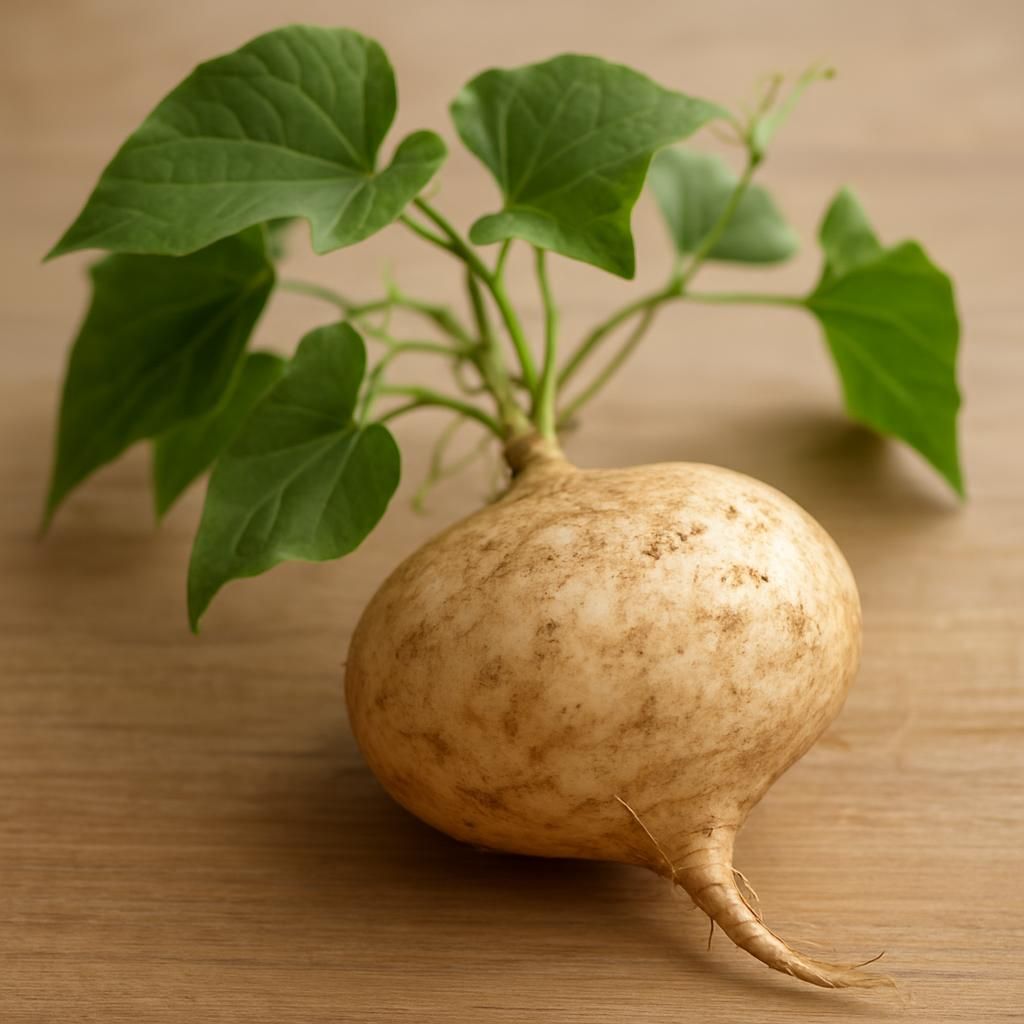
Introduction to Jicama (Pachyrhizus erosus)
Jicama (Pachyrhizus erosus) is a vigorous, warm-season legume native to Mexico and Central America. The plant produces an enlarged taproot that is harvested for its crunchy, juicy white flesh with a mild sweetness similar to apple or pear. Although the tuber is the primary crop, the plant also fixes atmospheric nitrogen, making it valuable in sustainable rotations. Commercial production is concentrated in Mexico, the Philippines, and parts of Southeast Asia, while interest is rising among North American and European specialty growers.
Botanical Profile of Jicama (Pachyrhizus erosus)
Pachyrhizus erosus belongs to the Fabaceae family. It is a perennial vine that is typically grown as an annual. The plant develops long, twining stems reaching 3–5 m with trifoliate leaves and white or pale lavender flowers. The tuber is a modified taproot that can weigh 1–5 kg under optimal conditions. Seeds are contained in flat pods but are toxic due to rotenone and should never be consumed. The crop matures in 5–9 months depending on cultivar and climate.
Soil, pH, and Climate Requirements for Jicama (Pachyrhizus erosus)
Jicama thrives in well-drained sandy loam to loam soils with high organic matter. Heavy clay soils should be amended or avoided to prevent root deformation. The plant requires a long frost-free period of at least 150 days and full sun. Ideal conditions are summarized below:
| Parameter | Ideal Range | Notes |
|---|---|---|
| Soil Type | Sandy loam to loam | Good drainage essential |
| Soil pH | 5.5–7.0 | Slightly acidic to neutral |
| Temperature (day) | 25–32 °C | Optimal tuber development |
| Temperature (night) | 18–24 °C | Avoid below 15 °C |
| Frost Tolerance | None | Killed by frost |
| Annual Rainfall | 800–1500 mm | Supplemental irrigation needed in dry spells |
| Growing Season | 150–270 days | Warm season crop |
Step-by-Step Planting & Propagation
Start seeds indoors 4–6 weeks before the last frost or direct sow when soil temperature reaches 20 °C. Soak seeds for 12–24 hours to improve germination. Plant seeds 2–3 cm deep and 15 cm apart in rows 75–90 cm apart. Thin seedlings to 30–45 cm spacing once they have two true leaves. Provide trellising or allow vines to sprawl on the ground. For commercial fields, use 60–75 cm in-row spacing to optimize tuber size.
Care & Maintenance regimes for Jicama (Pachyrhizus erosus)
Consistent moisture and fertility management are critical. Mulch heavily to conserve water and suppress weeds. The following table outlines recommended schedules:
| Growth Stage | Watering Schedule | Fertilizer Schedule | Pruning Schedule |
|---|---|---|---|
| Establishment (0–4 wks) | 2–3 times/week, keep evenly moist | 10-10-10 NPK at 200 kg/ha at planting | None |
| Vegetative (1–3 mo) | 25–40 mm/week | Side-dress with 50 kg/ha N at 6–8 weeks | Remove lower leaves if disease risk |
| Tuber Bulking (3–6 mo) | 30–50 mm/week | No additional N; apply K at 80 kg/ha | Pinch growing tips if excessive vine |
| Pre-harvest (last 4 wks) | Reduce to 15–20 mm/week | None | None |
Pests, Diseases & Organic Management
Common pests include Aphids, Spider mites, and cutworms. Use insecticidal soap or neem oil for aphids and mites; employ floating row covers for cutworms. Root-knot nematodes can be managed with crop rotation and solarization. Major diseases are Pythium and Phytophthora root rots in poorly drained soils. Improve drainage, avoid overwatering, and use resistant rootstocks where available. Powdery mildew may appear in humid conditions; sulfur-based sprays provide control.
Harvesting, Curing & Optimal Storage
Harvest when tubers reach 10–15 cm diameter, typically 150–200 days after planting. Cut vines 2–3 weeks before digging to toughen skins. Use a garden fork to lift roots carefully. Cure in a shaded, well-ventilated area at 25–30 °C for 3–5 days. Store at 12–15 °C and 85–90 % relative humidity for up to 4 months. Do not refrigerate, as temperatures below 10 °C cause chilling injury and off-flavors.
Companion Planting for Jicama (Pachyrhizus erosus)
Jicama benefits from nitrogen-fixing partnerships and pest-repelling neighbors. Compatible companions include Corn, Okra, and Marigold. Avoid planting near Potato or other root crops that compete for space. Interplanting with Cucumber can help reduce aphid pressure while maximizing bed utilization. See Summer Companion Planting: 10 Organic Pairings to Boost Small Farm Resilience for expanded strategies.