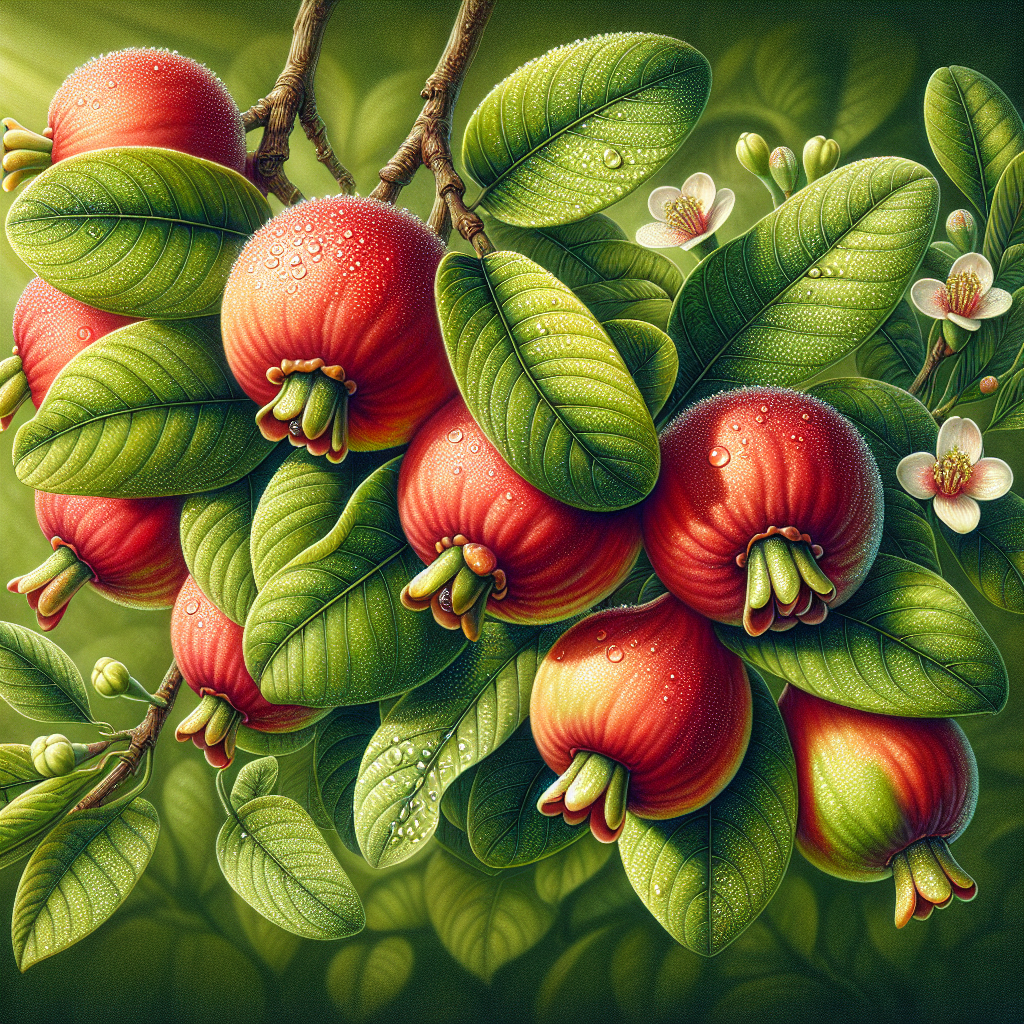
Introduction to Guava (Lemon Guava)
Lemon Guava, scientifically known as Psidium cattleianum, stands out among tropical fruits for its petite size, intense lemony aroma, and vibrant red or yellow fruits that pack a punch of citrus tang balanced with subtle strawberry notes. Native to the forests of Brazil and widely naturalized in subtropical regions worldwide, this evergreen shrub grows to 3-6 meters tall, making it ideal for smaller orchards, hedgerows, or even container cultivation in cooler climates. Unlike its larger cousin, the common Guava (crop), Lemon Guava fruits are smaller (2-4 cm diameter), seedier, and ripen to a glossy crimson or lemon yellow, exuding a fragrance reminiscent of lemon rind when mature.
What makes Lemon Guava a favorite among professional growers is its resilience: it tolerates poor soils, drought, and light frosts down to -4°C (25°F), while producing prolifically without heavy fertilization. Fruits are exceptionally high in vitamin C (over 200mg/100g), antioxidants, and fiber, positioning it as a superfood for fresh eating, juicing, jams, or desserts. For small-scale farmers, its low maintenance and ability to fruit within 2-3 years from seed or cuttings offer quick returns. This deep-dive guide draws from decades of agronomic research and field trials to deliver proven strategies for maximum productivity, from propagation to post-harvest handling. Whether you're in Florida, California, Hawaii, or pushing boundaries in USDA zones 9-11, mastering Lemon Guava unlocks a reliable, high-value crop.
Botanical Profile of Guava (Lemon Guava)
Lemon Guava belongs to the Myrtaceae family, closely related to eucalyptus and clove. It exhibits two main varieties: the red-fruited P. cattleianum var. cattleianum (most common, with sweeter, smaller berries) and yellow-fruited P. cattleianum var. lucidum (larger fruits, more acidic). Leaves are opposite, glossy, elliptical (5-10 cm long), and emit a spicy aroma when crushed. The tree's smooth, mottled bark peels in patches, revealing creamy underlayers.
Flowers emerge year-round but peak in spring, solitary or clustered at branch tips: white petals (1-2 cm), numerous stamens, and a sweet fragrance attracting bees and butterflies. Pollination is primarily entomophilous, though self-fertile cultivars exist. Fruits develop in 60-90 days, forming round berries with thin, edible skin enclosing juicy, granular flesh studded with 100-200 hard seeds. Seedlings exhibit variability, but grafted or air-layered plants ensure uniformity.
Growth habit is upright and dense, perfect for espalier or topiary. Root system is shallow and fibrous, extending 2-3 meters laterally, which demands mulching for moisture retention. In optimal conditions, trees yield 20-50 kg per mature plant annually, with dwarf selections suiting containers. For deeper insights into guava relatives, explore Strawberry Guava (crop), a close synonym often used interchangeably.
Soil, pH, and Climate Requirements for Guava (Lemon Guava)
Lemon Guava is remarkably adaptable but excels in well-drained, loamy soils rich in organic matter. Sandy loams or volcanic soils (pH 5.5-7.0) are ideal; it tolerates clay but suffers in waterlogged conditions. Test soil pH annually—acidic tolerance down to 4.5 prevents nutrient lockout, while liming heavy soils to 6.0-6.5 optimizes uptake of phosphorus and micronutrients. Incorporate 5-10 kg compost per square meter pre-planting to boost microbial activity and cation exchange capacity.
Climatically, it demands frost-free winters (USDA 9b-11) but survives brief dips to -4°C with mulch protection. Optimal temperatures range 15-30°C (59-86°F), with full sun (6-8 hours daily) for fruit coloration and sugar accumulation. High humidity (60-80%) promotes flowering, but dry spells trigger dormancy—irrigate deeply (20-30 liters/week per tree) during establishment. Windy sites require shelterbelts, as gales shred tender growth. In marginal zones, use microclimates or high tunnels. For heatwave resilience, see this blog on summer heatwave strategies.
Elevations up to 1,200 meters suit it, with rainfall needs of 1,000-2,000 mm/year evenly distributed. Drought tolerance kicks in after year 2, but deficit irrigation enhances flavor. Salinity tolerance (ECe <4 dS/m) allows coastal planting with gypsum amendments.
Step-by-Step Planting & Propagation
Propagation Methods: Seeds germinate in 2-4 weeks at 25-30°C but produce variable offspring—stratify in moist sand for 30 days to boost rates >80%. Cuttings (10-15 cm semi-hardwood, dipped in 3,000 ppm IBA) root in 4-6 weeks under mist. Air-layering yields 95% success: girdle branches in June, apply rooting hormone, wrap in sphagnum moss. Grafting (cleft or veneer onto P. guajava rootstock) confers vigor and disease resistance.
Site Preparation: Select full-sun locations with 4-6 m spacing (3 m for dwarfs). Dig 60x60x60 cm pits, fill with 40% compost, 20% sand, 5 kg manure, and 100g superphosphate. Plant in early spring post-frost, aligning graft unions 10 cm above soil. Stake young trees; apply 10 cm mulch ring.
Planting Steps: 1. Water root balls pre-planting. 2. Place at original depth. 3. Firm soil, avoiding air pockets. 4. Water deeply (50 liters/tree). 5. Prune back 30% to balance top growth. Expect first fruits in 2 years from cuttings, 3-4 from seeds.
Care & Maintenance regimes for Guava (Lemon Guava)
Irrigation: Drip systems deliver 20-40 liters/week, increasing to 60 during fruit swell. Maintain 60-70% field capacity; wilting indicates stress.
Fertilization: Annual regime: February (N-P-K 10-10-10 at 200g/tree), May (bloom boost: 0-20-20 + micronutrients), August (post-harvest: compost + potassium sulfate). Foliar sprays (2% urea + zinc sulfate) correct deficiencies—yellow leaves signal iron chlorosis.
Pruning: Annually post-harvest, remove deadwood, water sprouts, and thin canopy for light penetration. Tip-bearing cultivars need heading cuts to stimulate laterals. Dwarf forms benefit from espalier training.
Weed Control: Mulch suppresses 90% growth; hoe around bases. Cover crops like clover enhance soil.
Pollination Boost: Plant bee-attracting flowers nearby.
Pests, Diseases & Organic Management
Common pests include fruit flies (Fruit flies (pest)), piercing new growth, managed with protein baits and sanitation. Scale insects (pest) and mealybugs (pest) suck sap—treat with neem oil (2 ml/L) or insecticidal soap weekly. Aphids (pest) curl leaves; hose off or introduce ladybugs. For integrated strategies, check Why 90% of Small Farms Fail at Pest Management.
Diseases: Anthracnose (disease) causes fruit rot—ensure airflow, apply copper fungicide. Root rot (disease) from Phytophthora thrives in wet soils; use raised beds and biofungicides like Trichoderma. Powdery mildew responds to potassium bicarbonate sprays. Monitor for nematodes; solarize soil pre-planting. Organic IPM: Scout weekly, prune infected parts, rotate crops.
Harvesting, Curing & Optimal Storage
Harvest when fruits yellow/flush and detach easily (Brix 12-15%). Twist or clip with secateurs; yield peaks every 45-60 days over 6-8 months. Handle gently to avoid bruises. For market, cure at 20-25°C, 85% RH for 3-5 days to soften and aromatize.
Storage: Fresh fruits last 2-4 weeks at 8-10°C, 90% RH. Freeze pulp (blanch first), dry slices at 60°C, or process into pastes/jellies (pectin + sugar at 105°C). Post-harvest dips in 500 ppm benzoic acid extend shelf life.
Companion Planting for Guava (Lemon Guava)
Lemon Guava pairs well with nitrogen-fixers like pigeon pea for soil enrichment and Thai Basil (crop) to deter flies. Underplant with Marigold (crop) against nematodes, or Nasturtium (crop) as trap crop for aphids. Avoid legumes prone to shared pathogens. Gliricidia (crop) provides shade and mulch. Benefits include pest diversion, pollinator attraction, and microclimate moderation—boosting yields 20-30%.