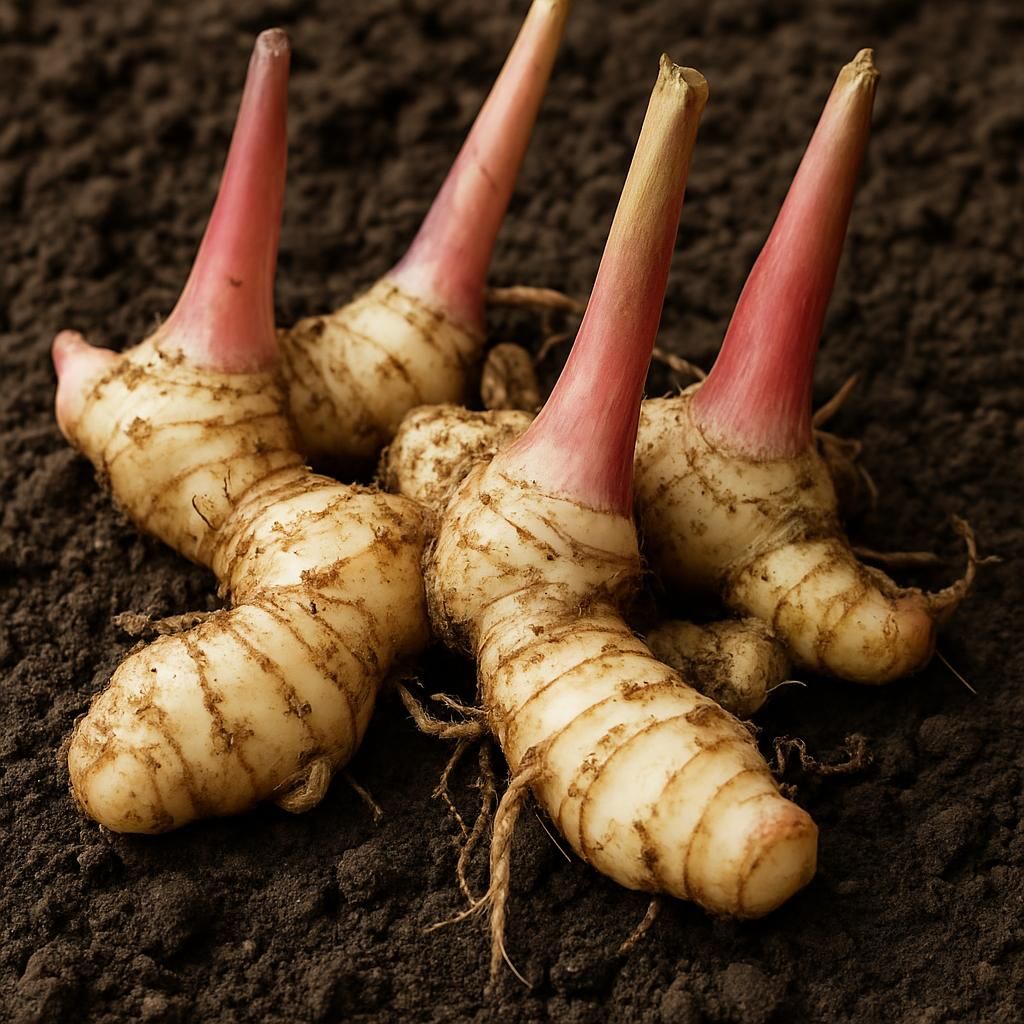
Introduction to Galangal (Greater)
Greater galangal (Alpinia galanga) is a tall, aromatic member of the ginger family (Zingiberaceae) cultivated throughout tropical Asia for its thick, fibrous rhizomes. Unlike common ginger, galangal rhizomes are ivory-white with pink shoots and deliver a sharper, more resinous flavor profile. The plant reaches 1.5–2.5 m in height, producing long, lance-shaped leaves and showy white flowers with pink veins. Its economic importance continues to rise as demand grows for authentic Thai, Indonesian, and Malaysian dishes as well as natural anti-inflammatory extracts.
Botanical Profile of Galangal (Greater)
Greater galangal is a herbaceous perennial that spreads via underground rhizomes. Each pseudostem consists of overlapping leaf sheaths emerging from the rhizome. The plant produces terminal inflorescences with fragrant white flowers that attract pollinators. Rhizomes develop in horizontal layers, with new shoots arising from lateral buds. The species is closely related to Ginger and Turmeric, sharing similar growth habits but requiring slightly higher fertility and more consistent moisture.
Soil, pH, and Climate Requirements for Galangal (Greater)
Greater galangal thrives in fertile, well-drained loamy soils rich in organic matter. It tolerates partial shade but yields best under full sun with afternoon protection in the hottest regions. The crop is strictly tropical, damaged below 10 °C.
| Parameter | Ideal Range | Notes |
|---|---|---|
| Soil Type | Sandy loam to clay loam | High organic content essential |
| Soil pH | 5.5 – 6.8 | Slightly acidic; avoid alkaline soils |
| Temperature | 22 – 32 °C (day); >18 °C (night) | Frost intolerant |
| Annual Rainfall | 1500 – 3000 mm | Even distribution preferred |
| Relative Humidity | 70 – 90 % | Maintain with misting in dry seasons |
| Elevation | 0 – 1200 m | Best below 800 m for maximum rhizome size |
| Light | Full sun to 30 % shade | Shade reduces yield but improves quality |
Step-by-Step Planting & Propagation
- Select healthy, disease-free rhizome pieces 5–8 cm long containing at least two buds.
- Pre-sprout rhizomes in moist cocopeat at 28 °C for 10–14 days until shoots emerge.
- Prepare raised beds 30 cm high and 1 m wide, incorporating 20–30 t/ha well-rotted manure.
- Plant pieces 8–10 cm deep with buds facing upward at 30 cm × 30 cm spacing (or 40 cm × 40 cm for mechanical harvest).
- Mulch immediately with 5–8 cm of rice straw or chopped leaves to conserve moisture.
- Irrigate lightly until new shoots establish, then increase to maintain field capacity.
Care & Maintenance regimes for Galangal (Greater)
Consistent moisture and balanced nutrition are critical during the 8–10 month growth cycle. The following schedule ensures optimal rhizome development.
| Growth Stage | Watering Schedule | Fertilizer Application | Pruning / Sanitation |
|---|---|---|---|
| Establishment (0–8 weeks) | Light daily irrigation or drip at 2 L/plant/day | 10 t/ha compost + 40 kg N/ha at week 4 | Remove yellow leaves weekly |
| Vegetative (2–6 months) | 25–30 mm/week; maintain 60 % field capacity | 60 kg N + 40 kg P + 80 kg K/ha split monthly | Cut flower stalks after bloom to redirect energy |
| Rhizome Bulking (6–9 months) | Reduce to 20 mm/week; avoid waterlogging | 20 kg N + 30 kg K/ha at month 7 | Remove diseased foliage; maintain mulch |
| Pre-harvest (last 4 weeks) | Withhold irrigation 10–14 days before harvest | None | Clear weeds and debris |
Pests, Diseases & Organic Management
Major pests include Rhizome scale, Root-knot nematodes, and Mealybugs. Common diseases are Rhizome rot caused by Pythium and Phytophthora species and Leaf spot from Colletotrichum. Implement crop rotation with Rice or legumes, use disease-free planting material, and apply neem oil or Trichoderma harzianum drenches at planting. Maintain field sanitation by removing crop debris after harvest.
Harvesting, Curing & Optimal Storage
Harvest 8–10 months after planting when leaves begin to yellow. Lift entire clumps carefully with a fork to avoid rhizome damage. Separate planting stock from marketable rhizomes. Wash gently, air-dry 2–3 days in shade, then cure at 25–28 °C and 70 % RH for 5–7 days to reduce moisture to 12–15 %. Store cured rhizomes in ventilated crates at 12–15 °C with 70–75 % humidity; viability remains high for 4–6 months.
Companion Planting for Galangal (Greater)
Galangal benefits from intercropping with Thai Basil, Lemongrass, and Black Pepper. These companions provide light shade, improve biodiversity, and reduce pest pressure. Avoid planting near solanaceous crops that share similar soil-borne pathogens.