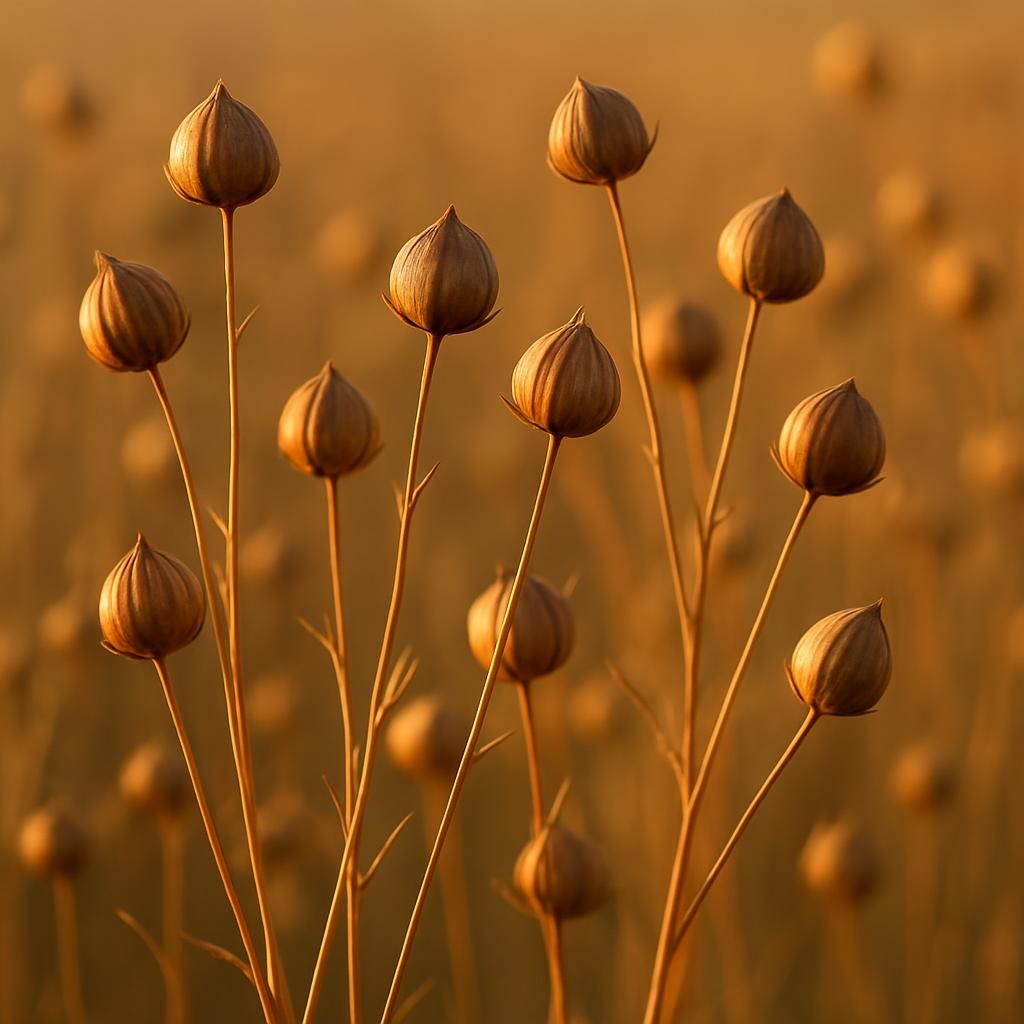
Introduction to Flax Seed (Brown)
Brown flax (Linum usitatissimum) has been cultivated for more than 10,000 years for both its edible seeds and strong stem fibers. Today, brown flax is primarily grown for its oil-rich seeds that supply omega-3 fatty acids, lignans, and dietary fiber to human and livestock diets. Commercial producers also harvest the straw for industrial fiber applications including linen textiles, insulation, and biocomposites. Because the crop matures quickly in cool climates and tolerates moderate drought once established, it fits well into diversified grain rotations on both conventional and organic farms.
Botanical Profile of Flax Seed (Brown)
Flax is an annual herbaceous plant in the Linaceae family that reaches 30–120 cm in height. The slender stems branch near the top and bear alternate, narrow lanceolate leaves 20–40 mm long. Small, five-petaled flowers appear in terminal cymes; brown-seeded cultivars produce sky-blue blooms that self-pollinate. Each spherical capsule contains up to ten flattened, glossy brown seeds rich in alpha-linolenic acid. The plant develops a shallow but dense fibrous root system that efficiently extracts moisture and nutrients from the top 30 cm of soil.
Soil, pH, and Climate Requirements for Flax Seed (Brown) (MUST INCLUDE A MARKDOWN TABLE OF IDEAL CONDITIONS)
Successful brown flax production begins with well-drained, fertile loam or clay-loam soils that retain adequate moisture without waterlogging. The crop performs best on soils with good structure and moderate organic matter; heavy clays that crust after rain should be avoided or improved with cover crops. Flax is moderately tolerant of salinity but sensitive to soil compaction and herbicide residues from previous broadleaf crops.
| Parameter | Ideal Range | Notes |
|---|---|---|
| Soil Type | Loam to clay-loam | Avoid compacted or poorly drained sites |
| Soil pH | 5.5 – 7.0 | Slightly acidic to neutral; liming may be required below 5.5 |
| Temperature (Germination) | 5 – 10 °C | Cool soil promotes uniform emergence |
| Temperature (Growth) | 15 – 24 °C daytime | Cool-season crop; heat above 30 °C reduces seed set |
| Frost Tolerance | Seedlings tolerate –2 °C | Mature plants damaged by hard frost |
| Annual Rainfall | 400 – 750 mm | Supplemental irrigation needed in drier regions |
| Day Length | Long-day (>14 h) | Critical for flowering induction |
Step-by-Step Planting & Propagation
- Site Selection: Choose fields with at least two years since the last flax or sunflower crop to reduce disease carry-over.
- Soil Testing & Amendment: Target 40–60 kg N/ha, 20–30 kg P/ha, and 30–50 kg K/ha based on soil tests; incorporate well-rotted manure or compost six weeks before planting.
- Seedbed Preparation: Till to a fine, firm seedbed 5–7 cm deep; roll to ensure good seed-to-soil contact.
- Seeding Rate & Depth: Drill 40–50 kg/ha of certified seed at 1–2 cm depth in 15–20 cm rows; increase rate by 10 % on heavy soils.
- Timing: Sow when soil temperature reaches 5 °C and risk of hard frost has passed—typically early spring in temperate zones.
- Inoculation: Although flax does not fix nitrogen, seed treatments with phosphate-solubilizing bacteria can improve early vigor on low-P soils.
Care & Maintenance regimes for Flax Seed (Brown) (MUST INCLUDE A MARKDOWN TABLE OF WATER, FERTILIZER, AND PRUNING SCHEDULES)
Flax requires minimal intervention once established. Weed competition is the greatest threat during the first 30 days; a single harrowing or use of a rotary hoe at the 4–6 leaf stage usually suffices. No pruning is performed; instead, focus on balanced nutrition and timely irrigation.
| Growth Stage | Irrigation Frequency | Fertilizer Application | Notes / Pruning |
|---|---|---|---|
| Pre-plant | None | 40–60 kg N, 20–30 kg P, 30–50 kg K/ha incorporated | Incorporate compost |
| Emergence–30 days | Light irrigation if <10 mm rain/week | None additional | Control weeds mechanically |
| Stem Elongation | 25–30 mm/week | 10–15 kg N/ha side-dress if deficiency | No pruning |
| Flowering | Maintain even moisture | Avoid excess N to prevent lodging | Scout for capsule borers |
| Seed Fill | Reduce to 15–20 mm/week | None | Monitor for lodging |
| Pre-harvest | Withhold irrigation | None | Swath or direct combine |
Pests, Diseases & Organic Management
Brown flax is relatively resistant to pests but can suffer from cutworms, grasshoppers, and capsule borers. Scout fields weekly from emergence through flowering. Organic controls include Bacillus thuringiensis for lepidopteran larvae, neem-based sprays for aphids, and encouraging beneficial insects with flowering strips. Primary diseases include Fusarium wilt, Alternaria leaf spot, and powdery mildew. Use certified seed, practice 3–4 year rotations with cereals, and remove volunteer flax plants. Copper-based fungicides or sulfur dusts provide acceptable organic suppression when applied at first sign of infection.
Harvesting, Curing & Optimal Storage
Flax is physiologically mature when 75 % of capsules have turned brown and seeds rattle inside. Swathing is preferred in regions with uneven ripening; allow windrows to cure 7–14 days before combining. Direct combining is possible when moisture content drops below 12 %. Clean seed to <1 % foreign material and dry to 8–9 % moisture for long-term storage. Store in aerated bins at 10–15 °C and <65 % relative humidity; monitor for storage beetles and maintain 0.5 % phosphine fumigation only if organic certification allows.
Companion Planting for Flax Seed (Brown)
Flax benefits from association with cereals such as wheat and oats that provide structural support and reduce lodging. Intercropping with clover or hairy vetch supplies nitrogen and suppresses weeds. Avoid planting near sunflower or canola because of shared disease susceptibility. Marigold borders deter nematodes and attract beneficial insects, while nasturtium acts as a trap crop for aphids. In small-farm systems, flax–pulse rotations improve soil structure and break pest cycles, aligning with principles discussed in Summer Companion Planting: 10 Organic Pairings to Boost Small Farm Resilience.