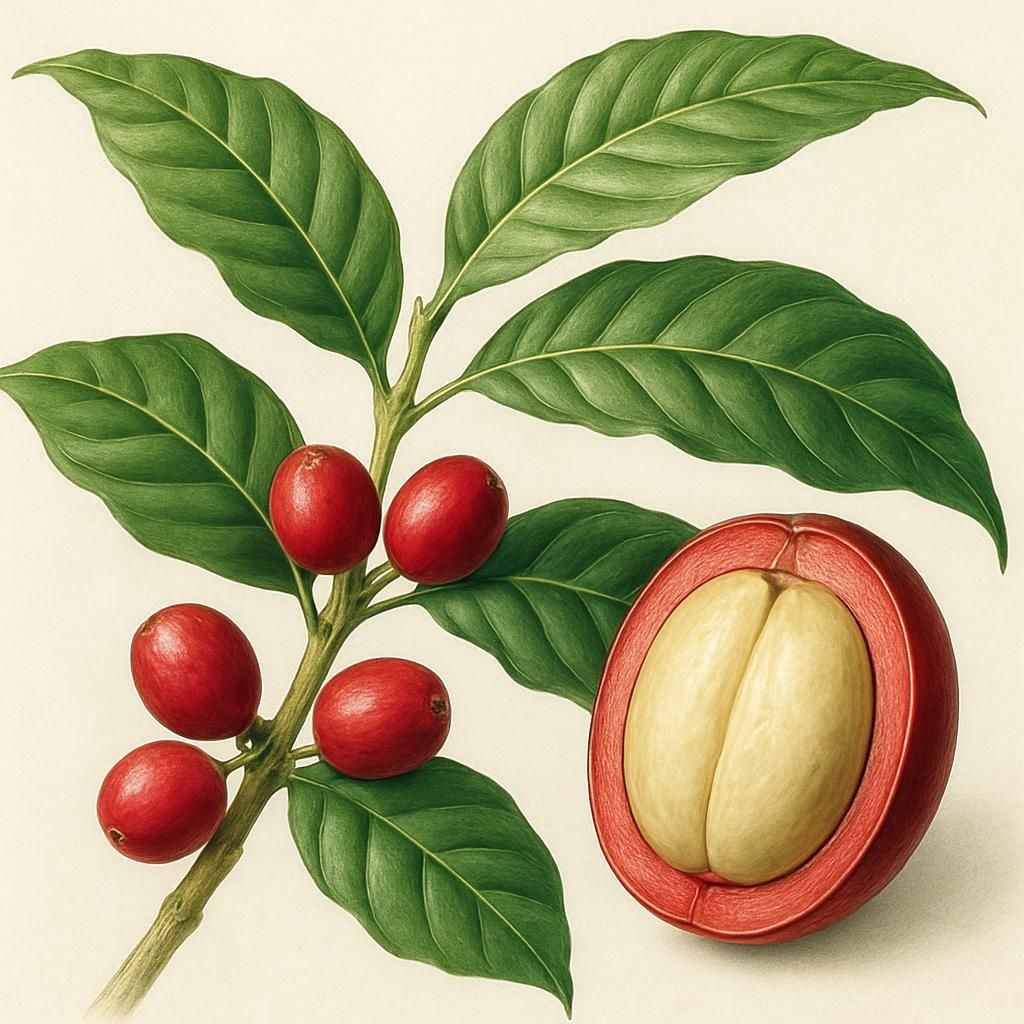
Introduction to Coffee (Arabica - Maragogype)
Maragogype, often called the "Elephant Bean," originated as a natural mutation of Coffea arabica in Brazil's Maragogipe region. The cultivar is distinguished by its oversized leaves, elongated internodes, and beans that can exceed 50% larger volume than standard Arabica varieties. Its flavor profile is typically bright, floral, and complex with pronounced acidity, making it highly sought after by specialty roasters. Commercial success demands precise microclimate control, well-drained soils, and careful post-harvest processing to preserve its distinctive cup characteristics.
Botanical Profile of Coffee (Arabica - Maragogype)
Maragogype exhibits a tall, open growth habit reaching 3–4 meters at maturity. Leaves are significantly larger (up to 30 cm) and thinner than Typica or Bourbon types, with prominent venation. Flowers are white, fragrant, and self-fertile, typically appearing after the first significant rains. The fruit (cherry) matures in 8–9 months, turning deep red when ripe. Each cherry contains two large, elongated seeds with a characteristic elongated shape and lower density, resulting in lighter roast weights but exceptional flavor extraction.
Soil, pH, and Climate Requirements for Coffee (Arabica - Maragogype)
Maragogype demands well-aerated, fertile soils with excellent drainage. Volcanic or deep loamy soils rich in organic matter produce the best results. The cultivar is sensitive to waterlogging and compacted subsoils.
| Parameter | Ideal Range | Notes |
|---|---|---|
| Soil Type | Deep sandy loam to clay loam | High organic matter content preferred |
| Soil pH | 5.8 – 6.5 | Avoid below 5.5 or above 7.0 |
| Altitude | 1,000 – 1,800 m | Higher elevations enhance acidity |
| Temperature | 15 – 24 °C (day); 10 – 18 °C (night) | Frost-free conditions essential |
| Annual Rainfall | 1,500 – 2,500 mm | Even distribution with 2–3 month dry period |
| Relative Humidity | 70 – 85 % | High humidity promotes disease |
Step-by-Step Planting & Propagation
- Seed Selection & Germination: Choose certified Maragogype seed from disease-free mother plants. Soak seeds for 24 hours, then sow in sterilized sand-peat mix at 2 cm depth. Maintain 25–28 °C and 80 % humidity; germination occurs in 4–8 weeks.
- Nursery Phase: Transplant seedlings at 4–6 true leaves into 15 cm polybags with 1:1:1 loam-compost-sand substrate. Provide 50 % shade and consistent moisture.
- Field Preparation: Clear land, incorporate 20–30 t/ha well-rotted manure, and establish contour drains. Plant shade trees (e.g., Gliricidia) 6–8 months before coffee.
- Outplanting: At 6–8 months and 30–40 cm height, transplant at 2.5 × 2.5 m spacing (1,600 plants/ha) during the onset of rains. Mulch immediately with 10 cm organic layer.
Care & Maintenance regimes for Coffee (Arabica - Maragogype)
Consistent cultural practices are critical for sustaining high yields and bean size. The following schedule outlines seasonal tasks for mature plantations.
| Season | Watering Schedule | Fertilizer Application | Pruning Schedule |
|---|---|---|---|
| Pre-flowering (Dec–Jan) | 20–25 L/plant/week if rainfall <15 mm | 150 g NPK 15-15-15 + 50 g MgSO4 per plant | Remove water shoots and basal suckers |
| Flowering & Fruit Set (Feb–Apr) | Maintain even moisture; avoid water stress | Foliar 1 % urea + micronutrients; 200 g ammonium sulfate | Light tipping of leaders at 1.8 m |
| Berry Development (May–Aug) | 30–40 L/plant/week during dry spells | 200 g NPK 20-10-20 split into two applications | Remove crossing branches; open canopy |
| Ripening & Harvest (Sep–Nov) | Reduce irrigation 2 weeks pre-harvest | 100 g potassium sulfate to improve bean quality | Sanitary prune after harvest; remove diseased wood |
Pests, Diseases & Organic Management
Major threats include Coffee Berry Borer (not listed; new entry required), Aphids, Scale insects, and Leaf miners. Fungal diseases such as Coffee Leaf Rust (new entry), Anthracnose, and Root rot are prevalent in humid conditions.
Organic strategies:
- Monitor weekly using yellow sticky traps and pheromone lures for borers.
- Apply neem oil (0.5 %) or Beauveria bassiana for sucking insects.
- Use copper-based fungicides only during high-risk periods; rotate with potassium bicarbonate.
- Maintain strict sanitation: remove fallen cherries and prune infected branches.
- Encourage natural enemies by planting Marigold and Nasturtium borders.
Harvesting, Curing & Optimal Storage
Harvest only fully ripe cherries by selective hand-picking every 7–10 days. Process within 6 hours using the washed method: depulp, ferment 24–36 hours at 20–24 °C, wash thoroughly, and dry on raised African beds to 10–12 % moisture. Store parchment coffee in jute bags inside cool (15–18 °C), dry warehouses with 60 % RH. Avoid direct sunlight and strong odors. Green beans maintain quality for 12–18 months under proper conditions.
Companion Planting for Coffee (Arabica - Maragogype)
Strategic companions improve soil fertility, suppress weeds, and attract beneficial insects. Recommended pairings include Gliricidia and Pigeon pea for nitrogen fixation and light shade, Banana for wind protection, and Marigold or Nasturtium for pest deterrence. Interplant rows of Clover or Hairy vetch as living mulch to reduce erosion and improve soil structure between coffee rows.