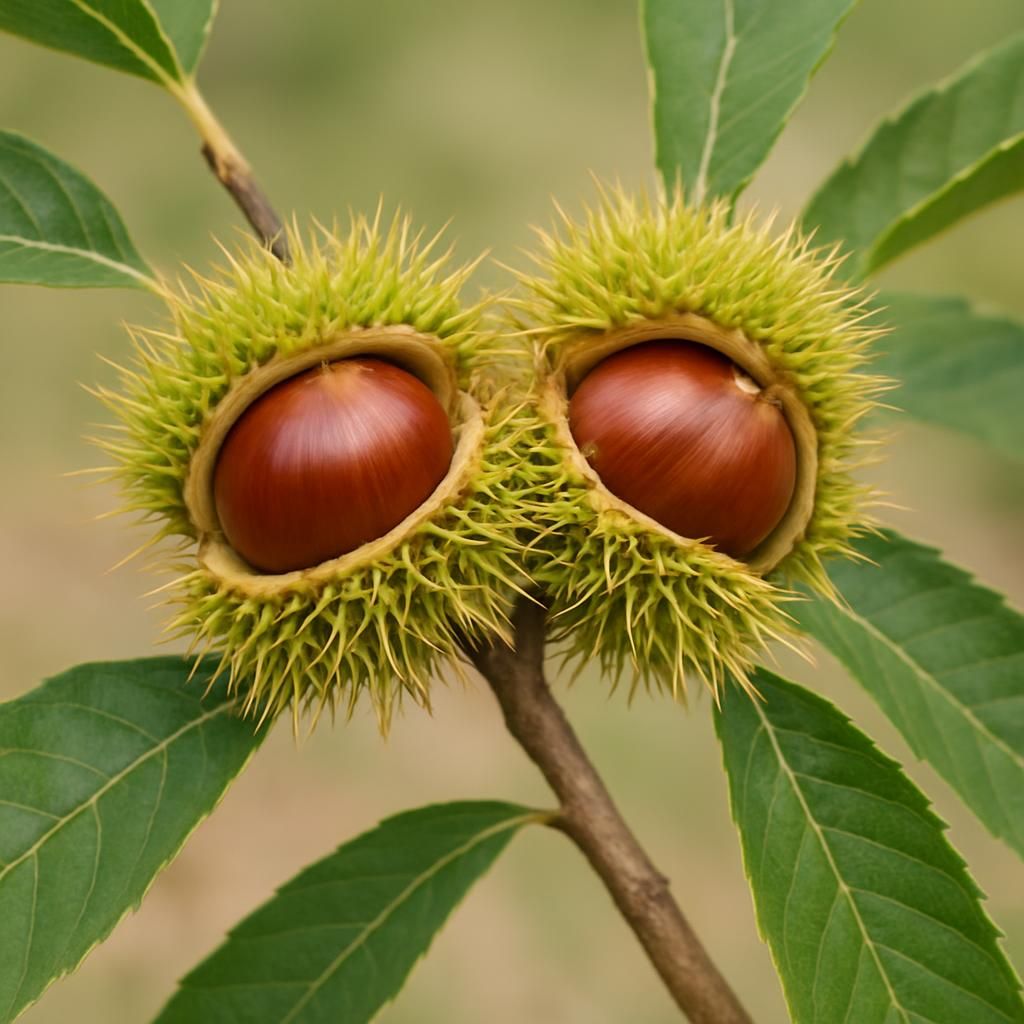
Introduction to Chinquapin (Castanea pumila)
Chinquapin (Castanea pumila) is a compact, multi-stemmed deciduous tree or large shrub native to the southeastern United States. It produces small, sweet chestnuts encased in spiny burs and is prized by foragers and small-scale growers for its flavor and adaptability. Unlike the larger Chestnut species, Chinquapin trees rarely exceed 20 feet in height, making them suitable for home orchards, agroforestry systems, and wildlife plantings. The nuts ripen earlier than most chestnuts and have a higher sugar content, delivering a rich, nutty taste that rivals commercial varieties.
Historically, Chinquapin played an important ecological role in eastern forests before the introduction of chestnut blight. Today, renewed interest in native nut crops has positioned Chinquapin as a climate-resilient option for growers seeking low-input, high-value perennial crops. Its tolerance of poor soils, drought, and occasional flooding makes it an excellent candidate for regenerative agriculture and edible landscaping.
This definitive growing guide covers every stage of Chinquapin production from site selection and propagation through harvest and storage. Professional growers will find detailed recommendations for soil management, organic pest control, and companion planting strategies that maximize both yield and ecosystem services.
Botanical Profile of Chinquapin (Castanea pumila)
Chinquapin belongs to the beech family (Fagaceae) and is closely related to American chestnut. The plant typically grows as a multi-stemmed shrub or small tree with smooth gray bark that becomes furrowed with age. Leaves are alternate, oblong to lanceolate, 3–6 inches long, with coarsely toothed margins and a glossy upper surface.
Male catkins appear in late spring, while female flowers develop into spiny burs containing one to three nuts. Each nut measures ½ to ¾ inch in diameter with a thin, light-brown shell. The kernel is sweet and starchy with minimal tannin bitterness. Chinquapin is monoecious and wind-pollinated, though insect activity can improve nut set.
The species is highly variable across its range, with several recognized varieties including the Allegheny chinquapin (C. pumila var. pumila) and the Ozark chinquapin (C. pumila var. ozarkensis). All share similar cultural requirements and nut quality characteristics.
Soil, pH, and Climate Requirements for Chinquapin (Castanea pumila) (MUST INCLUDE A MARKDOWN TABLE OF IDEAL CONDITIONS)
Chinquapin thrives in well-drained, acidic soils typical of its native upland habitats. It performs best on sandy loam or gravelly soils with good aeration but can tolerate heavier clays if drainage is adequate. Avoid sites with prolonged winter waterlogging.
The species prefers full sun to partial shade. In hotter southern climates, afternoon shade can reduce heat stress on young trees. Chinquapin is hardy in USDA zones 5–9 and tolerates winter temperatures to –20 °F once established.
| Parameter | Ideal Range | Notes |
|---|---|---|
| Soil Type | Sandy loam to loam | Well-drained; avoid heavy compacted clays |
| Soil pH | 5.0–6.5 | Strongly to moderately acidic |
| Organic Matter | 3–6% | Incorporate compost at planting |
| Drainage | Excellent | Raised beds or berms on marginal sites |
| Annual Rainfall | 30–60 inches | Supplemental irrigation first 2–3 years |
| Temperature Range | –20 °F to 95 °F | Protect young trees from late spring frost |
| USDA Hardiness Zones | 5–9 | Full sun to light afternoon shade |
| Elevation | Sea level to 3,000 ft | Higher elevations in southern range |
Step-by-Step Planting & Propagation
Chinquapin can be propagated from seed or grafted onto rootstock. Seed-grown plants are genetically variable but produce true-to-type nuts in most populations. Collect ripe burs in autumn, remove the nuts, and stratify immediately.
- Harvest sound nuts in September–October when burs begin to split.
- Soak nuts in water for 24 hours; discard floaters.
- Mix viable nuts with moist sand or peat and cold-stratify at 34–40 °F for 60–90 days.
- Sow stratified nuts 1 inch deep in well-drained nursery beds or containers in early spring.
- Provide 50% shade cloth for the first summer and keep evenly moist.
- Transplant seedlings to permanent sites after one or two growing seasons when they reach 12–18 inches tall.
For faster production of known cultivars, graft scions of superior selections onto seedling rootstock using whip-and-tongue or cleft grafts in late winter. Plant trees 15–20 feet apart in rows 20–25 feet apart. Amend planting holes with aged compost and a handful of rock phosphate. Water deeply at planting and apply 2–3 inches of organic mulch, keeping mulch 3 inches away from the trunk.
Care & Maintenance regimes for Chinquapin (Castanea pumila) (MUST INCLUDE A MARKDOWN TABLE OF WATER, FERTILIZER, AND PRUNING SCHEDULES)
Young Chinquapin trees require consistent moisture during the first three summers. Once established, they are moderately drought tolerant. Fertilizer needs are modest; excessive nitrogen promotes vegetative growth at the expense of nut production.
| Season | Watering Schedule | Fertilizer Application | Pruning Schedule |
|---|---|---|---|
| Spring | 1 inch per week if rainfall insufficient | Apply ½ lb 10-10-10 per tree at bud break | Remove dead/diseased wood; shape framework |
| Summer | Deep soak every 10–14 days in drought | Side-dress ¼ lb nitrogen if growth weak | Light tipping of vigorous shoots |
| Fall | Reduce watering after leaf drop | Top-dress 2–3 inches compost | Remove crossing branches |
| Winter | None required once dormant | None | Major structural pruning on dormant trees |
Maintain a 3–4 foot weed-free zone around each tree using organic mulch or shallow cultivation. Avoid deep tillage that damages shallow feeder roots. Monitor leaf color; pale foliage indicates possible nitrogen or micronutrient deficiency.
Pests, Diseases & Organic Management
Chinquapin shares many pests and diseases with other Castanea species. The most significant threat is chestnut blight caused by Cryphonectria parasitica, though many Chinquapin populations show partial resistance. Other concerns include Chestnut weevils, nut weevils, and occasional aphids.
Organic management begins with cultural practices: remove and destroy fallen burs to break the life cycle of weevils. Encourage beneficial insects by planting flowering understory species. For weevil control, apply beneficial nematodes to the soil in late summer. Copper-based fungicides applied at bud break can suppress foliar diseases in wet seasons.
Regular scouting and prompt removal of infected plant material remain the most effective strategies. Resistant selections and diverse plantings further reduce disease pressure.
Harvesting, Curing & Optimal Storage
Chinquapin nuts ripen from late August through October depending on latitude. Burs turn from green to brown and begin to split naturally. Shake or hand-pick burs onto tarps, then remove nuts promptly to prevent mold.
Cure nuts by spreading in a single layer in a cool, dry, well-ventilated area for 7–10 days. Moisture content should drop to approximately 10% before storage. Store cured nuts in breathable containers at 32–40 °F with 60–70% relative humidity. Properly cured nuts maintain quality for 4–6 months. For longer storage, freeze at 0 °F in airtight containers.
Companion Planting for Chinquapin (Castanea pumila)
Chinquapin integrates well into multi-species systems. Understory plantings of Clover, Thyme, and Yarrow improve soil fertility, attract pollinators, and suppress weeds. Tall companions such as Pecan or Walnut provide partial shade in hotter climates while creating a savanna-like structure.
Avoid planting Chinquapin near black walnut due to juglone sensitivity. Instead, pair with nitrogen-fixing shrubs and insectary plants that support beneficial predators. Diverse ground covers also moderate soil temperature and moisture, enhancing overall system resilience.
For more information on perennial nut crop systems, see the Summer Companion Planting: 10 Organic Pairings to Boost Small Farm Resilience article.