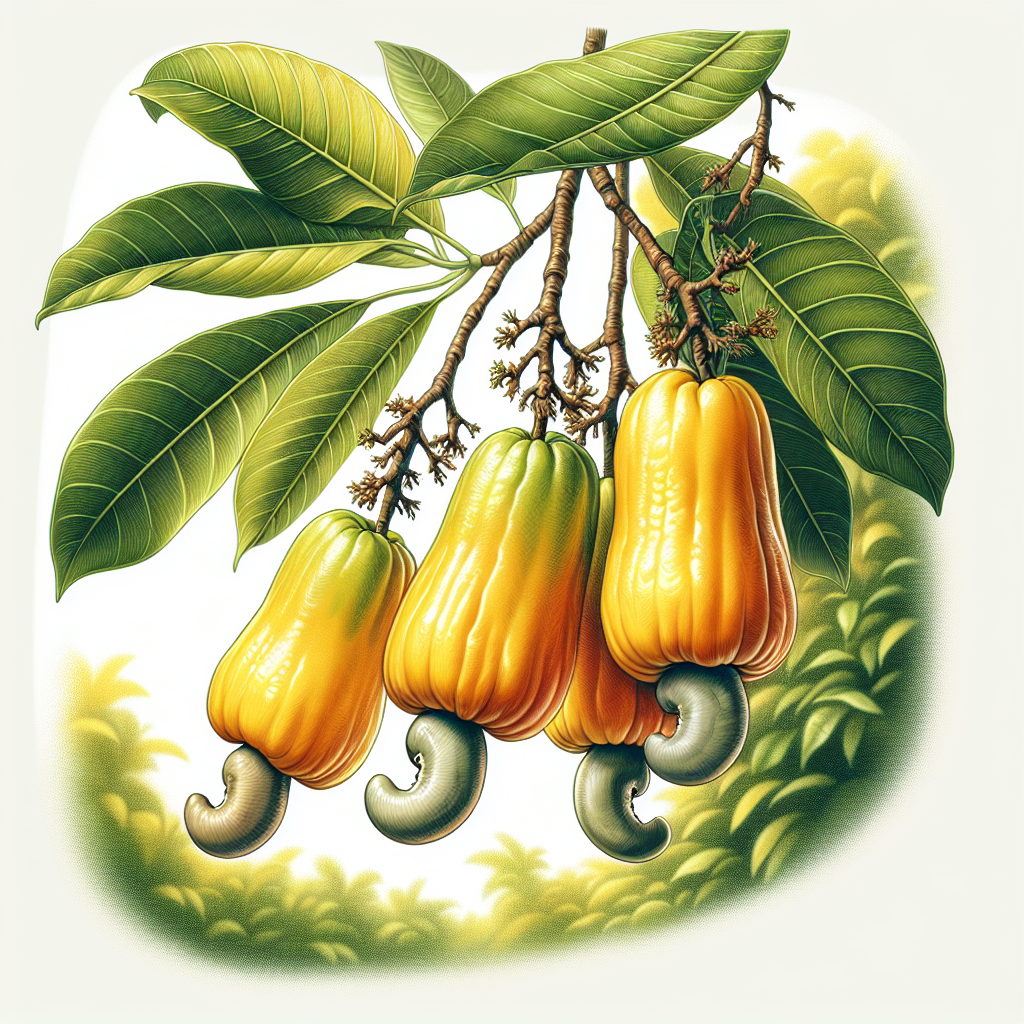
Introduction to Cashew Apple (Yellow)
The yellow cashew apple, derived from the cashew tree (Anacardium occidentale), represents one of tropical agriculture's most intriguing dual-purpose crops. Unlike typical fruits, the 'apple' is not a true fruit but a swollen peduncle—a fleshy, yellow-orange pseudocarp that develops below the hard-shelled true fruit, or cashew nut. Native to Brazil, this variety is distinguished by its bright yellow hue when ripe, milder astringency compared to red types, and exceptional juiciness, boasting vitamin C levels up to five times that of oranges.
Yellow cashew apples are harvested primarily for fresh consumption, juices, jams, and fermented beverages like feni in Goa, India. Their thin skin and sweet-tart profile make them ideal for small-scale farmers seeking high-value niche markets. Globally, cashew cultivation spans 4.6 million hectares, but apple utilization remains low at under 5% in major producers like Vietnam and India, presenting untapped revenue streams. For growers, success hinges on understanding the tree's unique inverted fruiting mechanism and tropical demands. This comprehensive guide equips you with professional-grade strategies to cultivate thriving yellow cashew apple orchards, from propagation to post-harvest handling. Expect first yields in 3-5 years, with mature trees producing 20-50 kg of apples per tree annually under optimal conditions.
Botanical Profile of Cashew Apple (Yellow)
Cashew trees belong to the Anacardiaceae family, sharing kinship with mango (Mango (crop)), pistachio, and sumac. The yellow cashew apple variety features a pear-shaped peduncle measuring 5-11 cm long and 4-6 cm wide, ripening to a vivid yellow with minimal red blush. Its skin is glossy and thin, enclosing a spongy, fiberless pulp rich in sugars (up to 25% brix) and organic acids. The attached kidney-shaped nut hangs below, encased in a caustic resinous shell containing anacardic acid—handle with gloves to avoid dermatitis.
Trees are evergreen, drought-tolerant perennials reaching 6-12 meters tall, with a spreading canopy of glossy, obovate leaves (15-22 cm). They produce small, pinkish-white flowers in panicles, with a 1:1 male-to-female ratio, though only 1 in 4,000 typically sets fruit due to pollinator dependency. Flowering occurs in dry seasons (November-February in tropics), with fruit maturation in 6-8 weeks. Root systems are deep-taprooted with extensive laterals, conferring resilience to sandy soils. Yellow varieties like 'Yellow Occidental' excel in uniformity and shelf-life, making them preferable for commercial orchards over red types. Genetic diversity from Brazilian ecotypes enhances disease resistance, vital for sustainable cultivation.
Soil, pH, and Climate Requirements for Cashew Apple (Yellow)
Cashew apples demand well-drained, sandy loam soils with pH 5.5-7.0; avoid heavy clays prone to waterlogging, which induces root rot. Optimal texture is 80% sand, 10% silt, 10% clay, with organic matter at 1-2%. Conduct soil tests pre-planting—amend acidic soils with lime (1-2 tons/ha) and incorporate 10-15 tons/ha farmyard manure for micronutrients like zinc and boron, often deficient in tropics.
Climatically, yellow cashew thrives in USDA zones 10b-12, requiring 1,200-3,000 annual chill hours below 22°C for flowering induction, followed by 2,000-3,500 mm rainfall or equivalent irrigation. Daytime temperatures of 25-35°C and nighttime lows above 15°C prevent chilling injury. It's highly drought-tolerant once established, surviving 6-8 months dry spells via CAM photosynthesis, but young trees need consistent moisture. Windbreaks are essential in exposed sites, as gales damage brittle branches. Elevations up to 1,200 m suit yellow varieties, outperforming reds in cooler highlands. For small farms, integrate with coconut intercropping to optimize microclimates. Refer to Soil Health Mastery: 5 Proven Strategies for Small Farms to Build Fertile Ground Without Breaking the Bank for advanced amendments.
Step-by-Step Planting & Propagation
Propagation: Prioritize grafted saplings of yellow varieties ('Pra 23', 'BRS 226') for dwarfing and precocity over seeds, which yield variable offspring. Use veneer or softwood grafting on wild rootstocks—success rates exceed 85%. Collect nuts from high-yielding mother trees, float-test for viability, and sow in polybags with 3:1:1 sand-soil-FYM. Germination takes 4-8 days at 30°C; transplant at 30-40 cm height after 6 months.
Site Preparation: Clear land, plow to 30 cm, and form raised beds (1x1 m, 0.5 m high) spaced 7x7 m (204 trees/ha) or 8x8 m for vigorous types. Dig 50x50x50 cm pits, fill with 20 kg FYM, 500g SSP, 200g neem cake. Plant during monsoon onset, aligning graft union 10 cm above soil.
Planting Steps: 1. Water pits 2 days prior. 2. Place sapling centrally, spread roots. 3. Backfill, stake firmly. 4. Basin-mulch with 10 cm dry leaves. Irrigate immediately. Initial spacing allows pigeon pea intercrop for nitrogen fixation. Survival rates hit 95% with shade nets for first 2 years.
Care & Maintenance regimes for Cashew Apple (Yellow)
Irrigation: Drip systems deliver 500-700 mm/year equivalents; deficit irrigation boosts nut quality but reduces apple size. Mulch conserves 30% water.
Fertilization: Year 1: 100g NPK 10-26-26/tree. Mature: Split 500g N, 300g P, 300g K annually, plus 100g MgSO4. Foliar ZnSO4 (0.5%) corrects deficiencies evident as 'little leaf'.
Pruning: Annually post-harvest, remove deadwood, water sprouts; train to open center for light penetration. Tipping boosts branching by 40%.
Weed Control: Slash mulch; pre-emergent glyphosate selectively. Intercultivate 3x/year.
Pollination Enhancement: Introduce honeybees; avoid pesticides during bloom. Yields double with managed hives.
Monitor via regular scouting—vigorous trees yield 8-10 kg nuts + 40-50 kg apples/tree by year 5.
Pests, Diseases & Organic Management
Key Pests: Tea Mosquito Bug damages florets (20-30% loss); deploy yellow sticky traps, neem oil (3%). Stem and Root Borers tunnel trunks—probe and inject carbaryl paste. Helicoverpa species attack young apples; BT sprays effective. Thrips and leaf miners controlled by spinosad.
Diseases: Anthracnose (Anthracnose) causes dieback; copper oxychloride sprays preventively. Phytophthora gummosis at collars—drainage + Bordeaux paste. Powdery Mildew managed with sulfur dust. For organic protocols, see Why 90% of Small Farms Fail at Pest Management - And 8 Organic Fixes That Actually Work.
IPM: Pheromone traps, bioagents like Trichoderma, resistant rootstocks. Scouting grids every 7 days catch infestations early.
Harvesting, Curing & Optimal Storage
Harvest when apples turn full yellow, nuts drop-prone (45-50 days post-set). Hand-pick or shake onto sheets to avoid nut shell rupture. Yield ratios: 1:4-8 nut:apple by weight. Separate immediately; steam nuts to detoxify.
Apple Processing: Wash, sort blemish-free. Juice via hydraulic press (yield 60-70%); pasteurize at 85°C/30s. Fresh store at 8-10°C, 85-90% RH for 3-4 weeks. Dried chips: 60°C/8hrs, vacuum-pack.
Nut Curing: Dry to 7% moisture in solar tunnel dryers (3 days), shell mechanically post-roasting. Store nuts at <7% MC, 10°C.
Post-harvest losses minimized to <5% with ventilated crates.
Companion Planting for Cashew Apple (Yellow)
Cashew's open canopy suits understory crops. Pair with black pepper vines on trunks for shade tolerance and extra income. Nitrogen-fixers like cowpea or Gliricidia suppress weeds, add 20-30 kg N/ha. Marigold deters nematodes; pineapple groundcover retains moisture. Avoid water-hungry crops like banana initially. Multi-tier systems boost land efficiency 2-3x. Detailed synergies in Why Companion Planting Feels Like Guesswork for Small Farms - And How AI Makes It Foolproof.