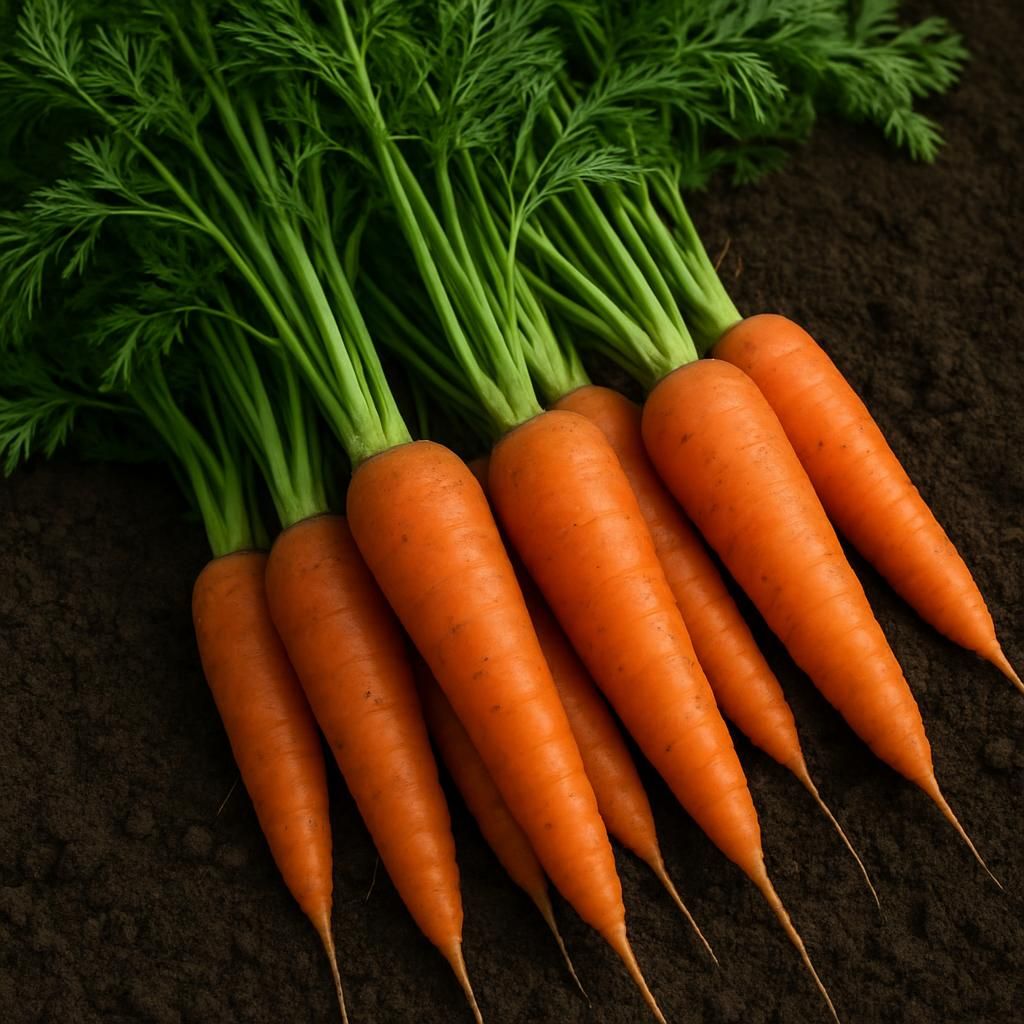
Introduction to Carrot (Danvers Half Long)
Danvers Half Long carrots have been a staple in North American gardens since the late 1800s. Developed in Danvers, Massachusetts, this variety offers a balance of flavor, productivity, and adaptability that makes it a favorite among home gardeners and small-scale commercial growers. Its shorter, thicker roots perform well in clay-heavy or rocky soils where longer types struggle.
The variety produces roots typically 6–8 inches long with broad shoulders tapering to a blunt tip. The deep orange flesh is rich in beta-carotene and sugars, delivering excellent flavor whether eaten raw, roasted, or juiced. Danvers Half Long stores exceptionally well, retaining crispness and sweetness for months in proper conditions.
Botanical Profile of Carrot (Danvers Half Long)
Carrots belong to the Apiaceae family and are biennial plants grown as annuals for their edible taproots. The Danvers Half Long cultivar features a strong central taproot with secondary feeder roots that efficiently absorb water and nutrients. Foliage consists of finely divided, feathery leaves arranged in a basal rosette.
The plant produces an umbel of small white flowers in its second year if allowed to bolt. Seeds are small, ribbed, and light brown. The root develops its characteristic color and sweetness as sugars accumulate during cooler fall temperatures.
Soil, pH, and Climate Requirements for Carrot (Danvers Half Long)
Carrots demand loose, well-drained soil free of rocks and clods that cause forking. Heavy clay soils should be amended with coarse sand and aged compost to improve structure.
| Parameter | Ideal Range/Value | Notes |
|---|---|---|
| Soil Type | Sandy loam to loam | Avoid compacted or stony ground |
| Soil pH | 6.0–6.8 | Slightly acidic to neutral |
| Soil Temperature | 45–85 °F (7–29 °C) | Optimal germination 55–75 °F |
| Air Temperature | 60–75 °F (16–24 °C) day / 50–60 °F night | Cool-season crop; tolerates light frost |
| Spacing | 2–3 inches between plants; 12–18 inches between rows | Thin seedlings early |
| Depth | Seeds ¼–½ inch deep | Keep consistently moist until germination |
| Sunlight | Full sun (6–8 hours) | Tolerates partial shade in hot climates |
Step-by-Step Planting & Propagation
- Prepare beds by removing rocks and breaking up compacted soil to at least 12 inches deep. Incorporate 2–3 inches of well-rotted compost.
- Sow seeds directly outdoors 2–3 weeks before the last spring frost when soil reaches 45 °F. For fall harvest, sow 10–12 weeks before first frost.
- Plant seeds ¼–½ inch deep in rows 12–18 inches apart. Cover lightly and firm soil gently.
- Keep seedbed evenly moist; germination takes 7–21 days. Use row covers to retain moisture and deter pests.
- Thin seedlings to 2–3 inches apart once they reach 2 inches tall to prevent crowding and forking.
- Successive sowings every 3 weeks extend the harvest window.
Care & Maintenance regimes for Carrot (Danvers Half Long)
Consistent moisture prevents cracking and bitterness. Apply 1–1.5 inches of water per week, increasing during dry spells. Mulch helps retain soil moisture and suppress weeds.
| Growth Stage | Water Schedule | Fertilizer Schedule | Pruning/Thinning Schedule |
|---|---|---|---|
| Germination (0–3 weeks) | Light daily misting to keep top ½ inch moist | None; avoid high-nitrogen amendments | None |
| Seedling (3–6 weeks) | ½–¾ inch every 2–3 days | Side-dress with low-nitrogen organic fertilizer at 4 weeks | Thin to 2–3 inches |
| Vegetative (6–10 weeks) | 1 inch per week | Light compost tea every 4 weeks | Remove yellowing leaves |
| Root Bulking (10+ weeks) | 1–1.5 inches per week | No additional nitrogen; potassium-rich amendments optional | None |
Pests, Diseases & Organic Management
Common pests include carrot rust fly, aphids, and cutworms. Floating row covers effectively exclude carrot rust flies. Handpick cutworms and apply beneficial nematodes for soil-dwelling larvae.
Diseases such as Alternaria leaf spot and powdery mildew can be managed with crop rotation, adequate spacing for airflow, and neem oil sprays. Avoid overhead watering to reduce foliar disease pressure.
Harvesting, Curing & Optimal Storage
Harvest Danvers Half Long carrots when roots reach ¾–1 inch in diameter at the shoulder, typically 65–75 days after sowing. Loosen soil with a fork before pulling to avoid breakage.
Cure by removing tops to ½ inch and allowing roots to air-dry in a shaded area for 1–2 hours. Store in perforated plastic bags or damp sand at 32–38 °F with 90–95% humidity. Properly stored roots remain crisp for 4–6 months.
Companion Planting for Carrot (Danvers Half Long)
Carrots pair well with onion, leek, and radish. Alliums help repel carrot rust flies while radishes loosen soil and mark rows for early harvest. Avoid planting near dill as it can cross-pollinate and reduce seed quality in subsequent seasons. Lettuce provides light shade during hot weather and benefits from the same moisture regime.