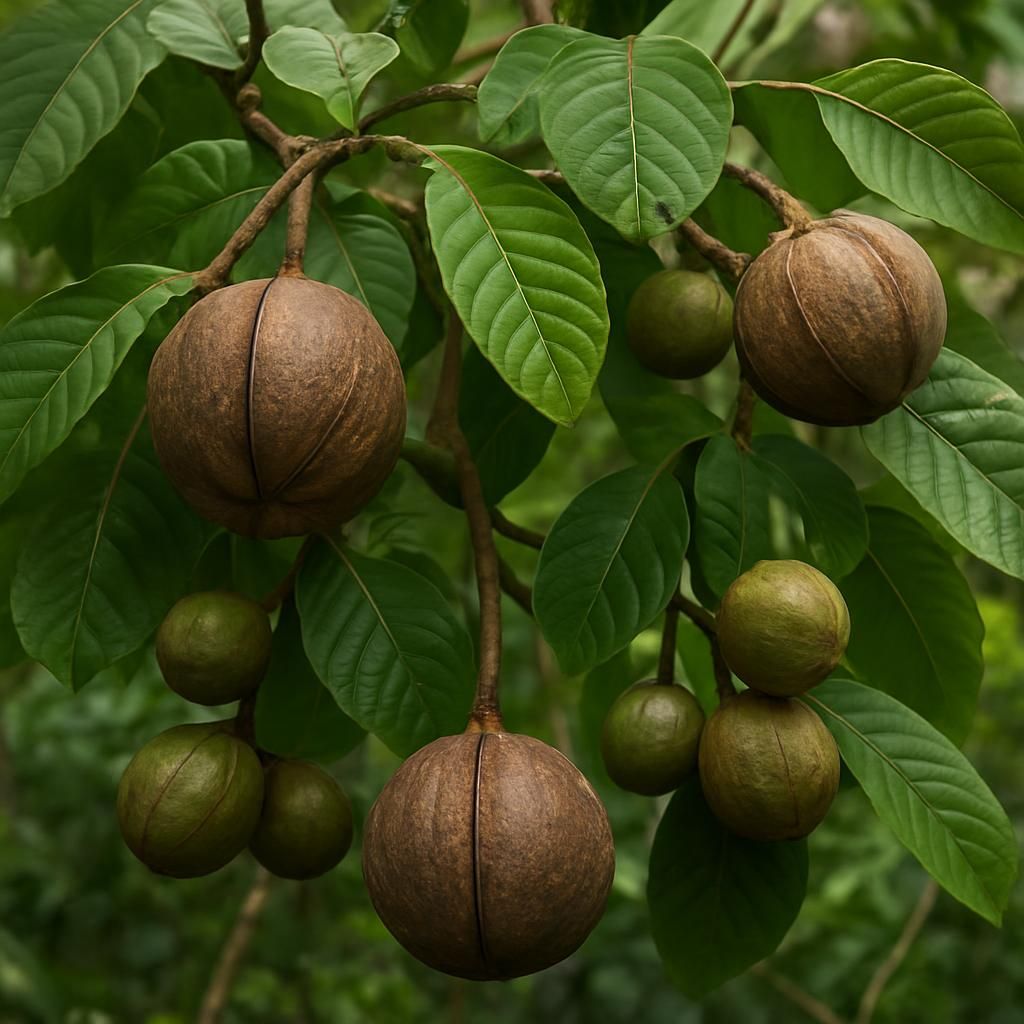
Introduction to Brazil Nut (Bertholletia excelsa)
The Brazil nut tree (Bertholletia excelsa) is one of the most iconic species of the Amazon rainforest and the sole commercial source of Brazil nuts. These massive, slow-growing trees can reach 50 meters in height and live for over 500 years. Brazil nuts are prized worldwide for their rich, creamy flavor and high selenium content, making them a staple in both culinary and nutritional applications. The tree plays a critical ecological role, supporting diverse wildlife and indigenous livelihoods through sustainable harvesting practices.
Commercial production remains concentrated in the Amazon basin of Brazil, Bolivia, and Peru, where wild stands are still the primary source. Attempts at large-scale plantation cultivation have met significant challenges due to the species' complex reproductive biology and specific habitat requirements. Understanding these factors is essential for anyone considering Brazil nut cultivation.
Botanical Profile of Brazil Nut (Bertholletia excelsa)
Bertholletia excelsa belongs to the Lecythidaceae family and is the only species in its genus. The tree features a straight, cylindrical trunk with smooth gray bark that becomes fissured with age. Its large, leathery leaves are simple, alternate, and oblong, measuring up to 45 cm long. The tree produces large, fragrant white or pale yellow flowers that develop into woody, spherical capsules known as "ouricos" containing 12–24 triangular nuts arranged like orange segments.
The reproductive system is highly specialized. Brazil nut trees are primarily pollinated by large-bodied orchid bees (Euglossini), particularly the species Euglossa and Eulaema. Without these specific pollinators, fruit set is minimal. The tree exhibits mast seeding behavior, producing heavy crops every 2–3 years. Seed dispersal relies almost exclusively on agoutis, which gnaw open the hard capsules and bury individual nuts, some of which remain uneaten and germinate.
Soil, pH, and Climate Requirements for Brazil Nut (Bertholletia excelsa)
Brazil nut trees thrive in the humid, equatorial climate of the Amazon basin. They require deep, well-drained, nutrient-poor but structurally rich soils typical of terra firme forests. The species is intolerant of waterlogging and compacted soils.
| Parameter | Ideal Range | Notes |
|---|---|---|
| Soil Type | Deep, well-drained sandy loam to clay loam | Avoid heavy clay or waterlogged soils |
| Soil pH | 4.5 – 6.5 | Prefers acidic conditions typical of Amazonian oxisols |
| Annual Rainfall | 1,400 – 2,800 mm, evenly distributed | Supplemental irrigation needed in drier periods |
| Temperature Range | 24 – 32 °C (day); minimum 18 °C | Sensitive to frost and prolonged cool spells |
| Relative Humidity | 70 – 90 % | High humidity essential for flowering and fruit set |
| Altitude | 0 – 800 m | Best growth below 500 m elevation |
| Sunlight | Full sun after establishment | Seedlings tolerate partial shade |
Step-by-Step Planting & Propagation
Propagation of Brazil nut is almost exclusively achieved through seeds, as vegetative methods have proven unreliable. Fresh seeds must be collected from recently fallen capsules and soaked in water for 24–48 hours to soften the hard seed coat. Germination rates improve significantly when seeds are planted in deep nursery beds with high organic matter content.
Select a planting site with deep, fertile soil and protection from strong winds. Space trees 12–15 meters apart in a grid or triangular pattern to allow full canopy development. Plant seeds 5–8 cm deep during the onset of the rainy season. Germination typically occurs within 30–90 days. Seedlings should remain in the nursery for 12–18 months before field transplanting. Grafting and air-layering techniques have been attempted with limited success; most commercial orchards rely on direct seeding or transplanting nursery-grown seedlings.
Care & Maintenance regimes for Brazil Nut (Bertholletia excelsa)
Young trees require regular weeding, mulching, and protection from herbivores during the first 3–5 years. Once established, maintenance focuses on soil fertility management and canopy health. Because Brazil nut trees are canopy emergents, they need ample vertical space and minimal competition from neighboring vegetation.
| Task | Frequency | Details |
|---|---|---|
| Watering | Weekly during dry season | Deep irrigation to maintain soil moisture without waterlogging |
| Fertilizer | Every 4–6 months (years 1–5) | Balanced NPK (10-10-10) plus micronutrients; reduce after year 5 |
| Mulching | Annually, 10–15 cm depth | Use leaf litter or wood chips to conserve moisture and suppress weeds |
| Pruning | Year 3 onward, as needed | Remove dead or crossing branches; minimal structural pruning required |
| Pest Scouting | Monthly during growing season | Monitor for Aphids, Mealybugs, and Scale insects |
Pests, Diseases & Organic Management
The most significant threats to Brazil nut cultivation are fungal pathogens and insect pests that attack both seedlings and mature trees. Common issues include Phytophthora root rot, Anthracnose, and various leaf spot diseases. Insect pests such as Aphids, Mealybugs, and Scale insects can weaken trees and reduce nut production.
Organic management begins with maintaining soil health through regular mulching and compost applications. Introduce beneficial insects such as lady beetles and lacewings to control aphid populations. For fungal diseases, apply copper-based fungicides or neem oil during periods of high humidity. Remove and destroy infected plant material promptly. In plantation settings, intercropping with leguminous cover crops improves biodiversity and reduces pest pressure.
Harvesting, Curing & Optimal Storage
Brazil nuts are harvested when mature capsules fall naturally to the forest floor, typically between December and March in the Amazon. Collect capsules promptly to prevent mold development and animal predation. Use long-handled tools or trained climbing crews to gather nuts safely.
After collection, crack open the woody capsules using machetes or mechanical shellers. Spread the nuts in a single layer on shaded drying racks for 7–10 days until moisture content reaches 6–8 %. Store cured nuts in cool, dry conditions (below 15 °C and 60 % RH) in breathable sacks or vacuum-sealed containers. Properly cured and stored Brazil nuts remain viable for 6–12 months. For longer storage, refrigeration or freezing is recommended.
Companion Planting for Brazil Nut (Bertholletia excelsa)
Because of the tree's immense size and canopy dominance, traditional companion planting is limited. However, agroforestry systems have successfully integrated Brazil nut with shade-tolerant understory crops such as Cacao, Vanilla, and Black Pepper. Leguminous cover crops like Pigeon pea and Gliricidia improve soil nitrogen levels and support pollinator habitats.
Avoid planting competitive species that cast dense shade or compete for water during establishment. In mature orchards, interplanting with Banana or Papaya can provide temporary income while Brazil nut trees reach bearing age. Maintaining diverse understory vegetation supports the orchid bee populations essential for pollination.