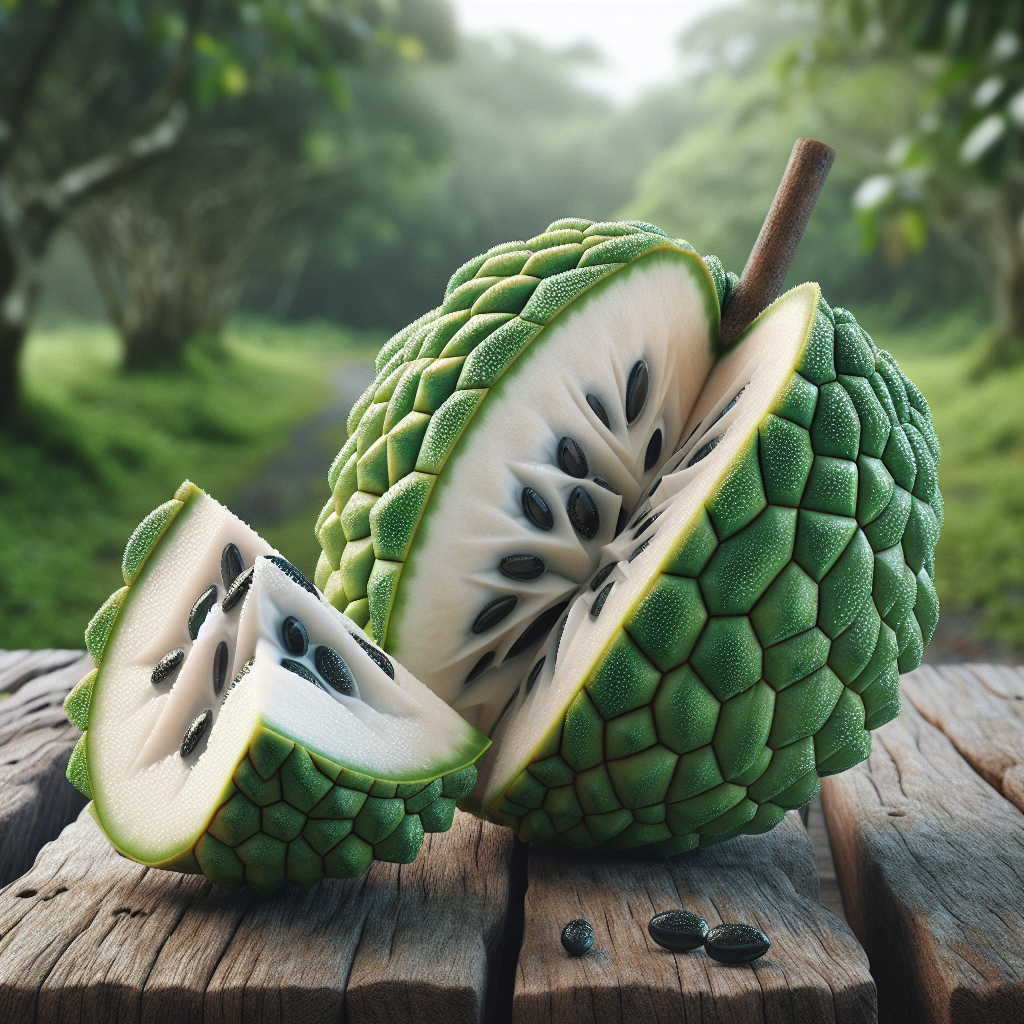
Introduction to Atemoya (African Pride)
Atemoya 'African Pride' represents the pinnacle of custard apple hybridization, combining the best traits of cherimoya (Annona cherimola) and sugar apple (Annona squamosa). Developed in South Africa, this cultivar has gained international acclaim for producing some of the largest and most flavorful fruits in the Annonaceae family. Each fruit can weigh 1-3 kg (2-6.6 lbs), featuring a segmented green skin that ripens to subtle yellow, encasing luscious white flesh studded with glossy black seeds.
The flavor profile is unmatched—think pineapple, banana, and strawberry dancing on the palate with creamy custard undertones and minimal fiber. 'African Pride' trees grow vigorously to 6-10 meters (20-33 feet) tall, bearing heavy crops annually when properly managed. Commercial growers achieve yields of 50-100 kg (110-220 lbs) per mature tree, while home orchards enjoy abundant harvests from year three onward.
This guide provides professional-grade cultivation protocols optimized for maximum productivity and fruit quality. Whether establishing a commercial plantation or backyard grove, mastering 'African Pride' cultivation unlocks a high-value tropical crop with strong market demand and premium pricing potential.
Botanical Profile of Atemoya (African Pride)
Family: Annonaceae Hybrid Parentage: Annona cherimola × Annona squamosa Growth Habit: Evergreen tree, upright-spreading canopy Mature Height: 6-10 m (20-33 ft) Canopy Width: 4-7 m (13-23 ft) Leaves: Oblong-lanceolate, 10-20 cm long, glossy dark green above, felted rusty-brown beneath Flowers: Cream-white, 3-petaled, 2.5-3.5 cm diameter, protogynous (female phase first) Fruit: Heart-shaped to round, 10-20 cm diameter, green skin with pentagonal segments, white creamy flesh (25-35% edible), 1-3 kg weight Seeds: Black, glossy, 1-2 cm, 20-50 per fruit Pollination: Self-incompatible; requires cross-pollination between compatible cultivars or hand-pollination
'African Pride' exhibits superior vigor compared to standard atemoyas, with thicker trunks, denser foliage, and enhanced wind resistance. Root system is shallow but extensive, demanding wide spacing and mulching. Trees enter bearing at 3-4 years from graft, peaking at 8-12 years with annual crops during late fall to winter.
Soil, pH, and Climate Requirements for Atemoya (African Pride)
Optimal Soil: Deep, well-drained loams or sandy loams with 2-3% organic matter. Avoid heavy clays prone to waterlogging. Hass Avocado (crop) shares similar well-drained soil preferences, making mixed plantings viable in suitable sites.
pH Range: 5.5-7.0 (slightly acidic to neutral). Test soil annually; amend with dolomite lime for pH below 5.5 or elemental sulfur for pH above 7.5.
Climate: Subtropical to tropical, USDA zones 10-11. Thrives at 24-30°C (75-86°F) daytime, 15-20°C (59-68°F) nights. Tolerates brief dips to 5°C (41°F) but suffers damage below 0°C (32°F). Requires 1,200-2,000 chill hours (above freezing) for optimal flowering, though less demanding than cherimoya parent.
Rainfall: 1,000-1,500 mm (40-60 inches) annually, well-distributed. Supplemental irrigation critical during dry spells and fruit swell (3-6 months post-bloom). High humidity (60-80%) essential during flowering; drought stress reduces fruit set by 70%.
Wind Protection: Plant in sheltered locations or install windbreaks. 'African Pride' withstands moderate winds but sustained gusts >40 km/h (25 mph) cause flower drop and scarring.
Site selection determines 80% of success—prioritize elevation (100-600 m / 330-2,000 ft) for frost avoidance and superior fruit quality.
Step-by-Step Planting & Propagation
Propagation Methods:
- Grafted Saplings (preferred): Use 1-2 year-old rootstocks of sugar apple or pond apple, cleft-grafted with 'African Pride' scion. Success rate: 85-95%. Nurse in shade house 4-6 weeks before field planting.
- Air Layering: Select 2-3 cm diameter branches, girdle, apply rooting hormone, wrap in moist sphagnum. Roots form in 8-12 weeks. Ideal for rapid orchard establishment.
- Seedlings: Viable only for rootstock; fruiting trees highly variable and true-to-type rare.
Planting Steps:
- Site Prep: Deep rip to 1 m (3 ft), incorporate 20-30 kg (44-66 lbs) compost + 0.5 kg (1 lb) superphosphate per hole.
- Spacing: 6-8 m (20-26 ft) between trees, 8-10 m (26-33 ft) between rows (100-160 trees/ha or 40-65/acre).
- Planting Hole: 60x60x60 cm (24x24x24 in), backfill with native soil + 30% compost.
- Planting Season: Early spring or post-rainy season when soil warms to 18°C (64°F).
- Planting Technique: Position graft union 10-15 cm (4-6 in) above soil. Stake immediately, water deeply.
- Initial Care: Mulch 10-15 cm (4-6 in) thick with organic material, irrigate weekly to establish roots.
Expect 50-70% survival with proper technique; monitor for transplant shock (wilting, leaf drop) and prune lightly first year.
Care & Maintenance regimes for Atemoya (African Pride)
Irrigation: Drip system delivering 40-60 L/tree/week during dry periods. Reduce to 20 L/week in rainy season. Critical periods: flowering (flower drop prevention), fruit set (70% of final size), pre-harvest (sugar accumulation).
Fertilization Schedule:
- Year 1-2: 100-200 g NPK 10-10-10 per tree, split 4x/year.
- Year 3+: 1-2 kg N, 0.5-1 kg P, 1.5-2 kg K annually, plus 200 g Mg and micronutrients (Zn, Fe, B). Apply 60% during vegetative flush, 40% post-harvest. Foliar sprays: 2% urea + 0.5% micronutrient mix monthly during growth.
Pruning: Annual post-harvest. Remove dead/diseased wood, water sprouts, inward-growing branches. Maintain open center for light penetration. Tip prune terminals to promote fruiting wood.
Training: First 3 years: Select 4-6 scaffold branches, space evenly. Head back to 60-80 cm (24-32 in) at planting.
Weed Control: Mulch + pre-emergent herbicides first 3 years. Mature orchards: mow between rows, spot-spray.
Pollination Management: Hand-pollinate evenings using pollen from compatible cultivars ('Pink's Mammoth', 'Page') transferred via brush. Commercial: hire pollinators or use mechanical shakers. Boosts set 3-5x.
Read our comprehensive guide on Why Companion Planting Feels Like Guesswork for Small Farms - And How AI Makes It Foolproof for advanced integration strategies.
Pests, Diseases & Organic Management
Major Pests:
- Mealybugs (pest): Colonies on tender shoots/fruits. Organic: Neem oil 2% weekly, introduce Cryptolaemus montrouzieri lady beetles.
- Scale insects (pest): Armored scales on branches. Horticultural oil + insecticidal soap rotations.
- Fruit borers: Larvae tunnel fruits. Btk (Bacillus thuringiensis) sprays at petal fall.
- Anthracnose (disease): Brown lesions on flowers/fruits. Copper fungicide pre-bloom, sanitation.
- Phytophthora root rot (disease): Wilting, collar lesions. Improve drainage, phosphonate drenches.
Integrated Program:
- Monitor weekly with sticky traps.
- Cultural: Prune for airflow, mulch suppresses soil pests.
- Biological: Release predatory mites, parasitoids.
- Organic sprays: Alternate neem, spinosad, pyrethrin.
Learn proven organic fixes in Why 90% of Small Farms Fail at Pest Management - And 8 Organic Fixes That Actually Work.
Disease Prevention: Avoid overhead irrigation, apply 3-4 copper sprays/season. Resistant rootstocks reduce root rot (disease) incidence by 60%.
Harvesting, Curing & Optimal Storage
Maturity Indices:
- Color change: Green to yellowish-green
- Slight give under finger pressure
- 24-28° Brix sugar content (refractometer)
- Specific gravity >1.00
Harvest Windows: 150-180 days post-pollination, late fall/winter. Clip fruits with 2-3 cm (1 in) stem using secateurs. Yield: 50-100 fruits/tree.
Harvesting Technique: Harvest every 7-10 days during peak. Handle gently—skin bruises easily. Field sort: discard split/insect-damaged.
Curing: Store at 20-25°C (68-77°F), 85-90% RH for 3-5 days. Ethylene exposure (banana room) hastens ripening.
Storage:
- Short-term: 15°C (59°F), 85-90% RH, 2-3 weeks (10-15°C optimal flavor).
- Controlled Atmosphere: 12% O2, 3-5% CO2, 12-15°C (59-68°F), 4-6 weeks.
- Market Life: 7-10 days at 20°C (68°F).
Postharvest dips: 500 ppm Strobon + 1% calcium chloride reduce rot 50%. Package in ventilated cartons, 4-6 fruits/box.
Companion Planting for Atemoya (African Pride)
Strategic companions enhance biodiversity, pest control, and resource efficiency:
Beneficials:
- Marigold (crop): Repels root-knot nematodes (pest), attracts pollinators.
- Thai Basil (crop): Deters aphids (pest), improves flavor via volatile compounds.
- Legumes (Pigeon pea (crop)): Nitrogen fixation, shade tolerance.
Support Species:
- Gliricidia (Gliricidia (crop)): Windbreak, green manure, chopped mulch.
- Nasturtium (crop): Trap crop for aphids (pest), groundcover.
Avoid: Banana (crop) (water/nutrient competition), nightshades (disease reservoirs).
Layout: Interplant herbs at 2 m (6.5 ft) from trunks, windbreaks 10 m (33 ft) apart. Rotate annuals yearly.
This system cuts fertilizer needs 30%, boosts beneficial insects 40%.