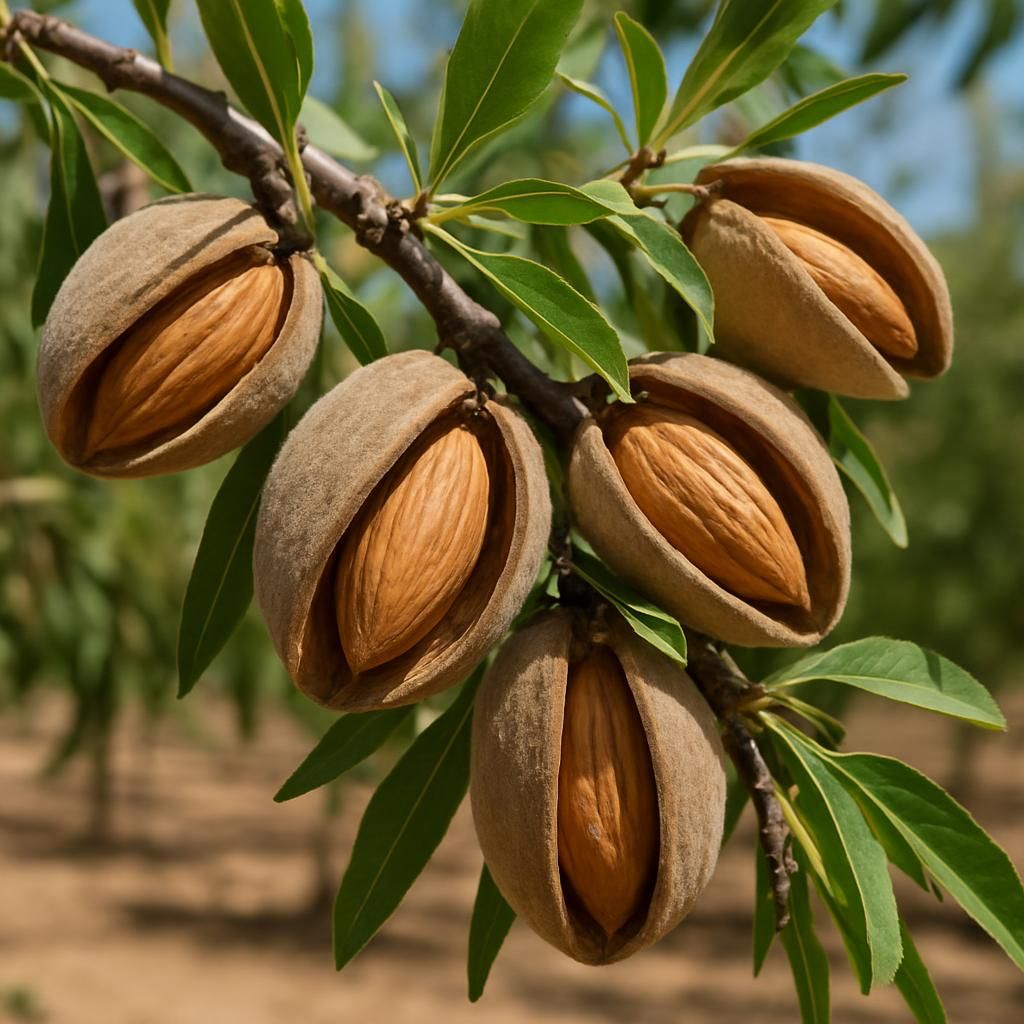
Introduction to Almond (Carmel)
The Carmel almond cultivar (Prunus dulcis 'Carmel') is a late-blooming, high-yielding variety developed in California that produces large, uniform kernels with excellent blanching characteristics. Growers favor Carmel for its consistent nut set, moderate tree vigor, and adaptability to mechanical harvesting. With proper site selection and integrated management, Carmel orchards can deliver commercial-grade yields of 1.8–2.5 tons of kernels per acre under optimal conditions.
This definitive guide covers every stage of production from soil preparation through post-harvest storage, providing practical, research-backed recommendations for both new and established almond operations.
Botanical Profile of Almond (Carmel)
Carmel is a deciduous tree in the Rosaceae family that reaches 15–25 feet at maturity with an upright, moderately spreading canopy. It produces showy white to pale-pink flowers in early spring before leaf-out. The fruit is a drupe whose hull splits at maturity to release the hard-shelled nut containing a single edible kernel. Carmel is partially self-fertile but benefits from cross-pollination with compatible varieties such as Nonpareil Almond or Mission Almond.
Soil, pH, and Climate Requirements for Almond (Carmel)
Carmel almonds perform best on deep, well-drained sandy loam to loam soils with good water-holding capacity. Avoid heavy clay or poorly drained sites that promote root diseases.
| Parameter | Ideal Range | Notes |
|---|---|---|
| Soil Type | Sandy loam to loam | Minimum 4–6 ft rooting depth |
| Soil pH | 6.0–7.5 | Slightly acidic to neutral |
| Soil Salinity (EC) | < 2.0 dS/m | Sensitive to chloride and boron |
| Annual Chill Hours | 250–500 | Ensures uniform bloom and nut set |
| USDA Hardiness Zones | 7–9 | Protect young trees from late frosts |
| Summer Temperature | 75–95 °F (24–35 °C) | Optimal photosynthesis and kernel fill |
| Winter Temperature | 35–55 °F (2–13 °C) | Dormancy requirement |
| Annual Rainfall | 10–20 inches (supplemental irrigation) | Most production occurs in Mediterranean climates |
Step-by-Step Planting & Propagation
- Site Preparation: Conduct soil tests and amend with lime or sulfur to reach target pH. Rip soil to 3–4 ft depth and incorporate 10–15 tons/acre of well-aged compost.
- Rootstock Selection: Use vigorous, nematode-resistant rootstocks such as Nemaguard or Hansen 536.
- Planting Window: Plant bare-root or potted trees in late fall through early winter when soils are moist but not saturated.
- Spacing: Standard density is 20 × 20 ft (109 trees/acre); high-density hedgerow systems use 16 × 10 ft.
- Planting Technique: Dig holes twice the width of the root ball. Set trees so the graft union is 2–3 inches above final soil grade. Backfill and water thoroughly.
- Irrigation at Planting: Apply 5–10 gallons per tree immediately after planting and maintain consistent moisture for the first 6–8 weeks.
Care & Maintenance regimes for Almond (Carmel)
Consistent water, balanced nutrition, and annual pruning are essential for sustained productivity.
| Season | Water Schedule | Fertilizer Application | Pruning Schedule |
|---|---|---|---|
| Dormancy (Dec–Jan) | None (or light frost protection) | Apply 40–60 lbs N/acre as compost or organic blend | Dormant pruning: remove dead, crossing wood |
| Bloom–Nut Set (Feb–Apr) | 0.8–1.2 in/week via micro-sprinklers | Split N applications; 15–20 lbs N/acre at petal fall | Minimal; tip-prune new growth if needed |
| Kernel Fill (May–Jul) | 1.5–2.0 in/week peak demand | 30–40 lbs N/acre; boron foliar at 0.5 lb/acre if deficient | Summer pruning for light penetration |
| Post-Harvest (Aug–Oct) | Reduce to 0.5 in/week | 20 lbs N/acre post-harvest to rebuild reserves | Structural pruning after leaf drop |
Pests, Diseases & Organic Management
Carmel almonds face pressure from Navel orangeworm, peach twig borer, and mites. Monitor with pheromone traps and degree-day models. Sanitation (mummy nut removal) is the foundation of navel orangeworm control.
Organic options include:
- Bacillus thuringiensis (Bt) for twig borer larvae
- Horticultural oils and predatory mites for spider mites
- Kaolin clay particle films during hull-split
- Cover crops that support beneficial insects
Harvesting, Curing & Optimal Storage
Carmel almonds are typically harvested in late August to mid-September when hulls split and kernels reach 5–6% moisture. Shake trees mechanically, sweep windrows, and pick up within 24–48 hours. Field-dry nuts to 8% moisture, then cure in forced-air dryers at 110–115 °F until kernel moisture reaches 5–6%. Store at 35–40 °F and 65–70% RH in sealed bins or totes to maintain quality for 12–18 months.
Companion Planting for Almond (Carmel)
Interplant low-growing legumes such as clover or hairy vetch in orchard rows to fix nitrogen and improve soil structure. Flowering strips of thyme, rosemary, and yarrow attract pollinators and predatory insects. Avoid tall companions that compete for light or harbor rodents.
For more on building resilient small-farm systems, see The Hidden Power of Mulching: 8 Organic Strategies to Transform Small Farm Soil.