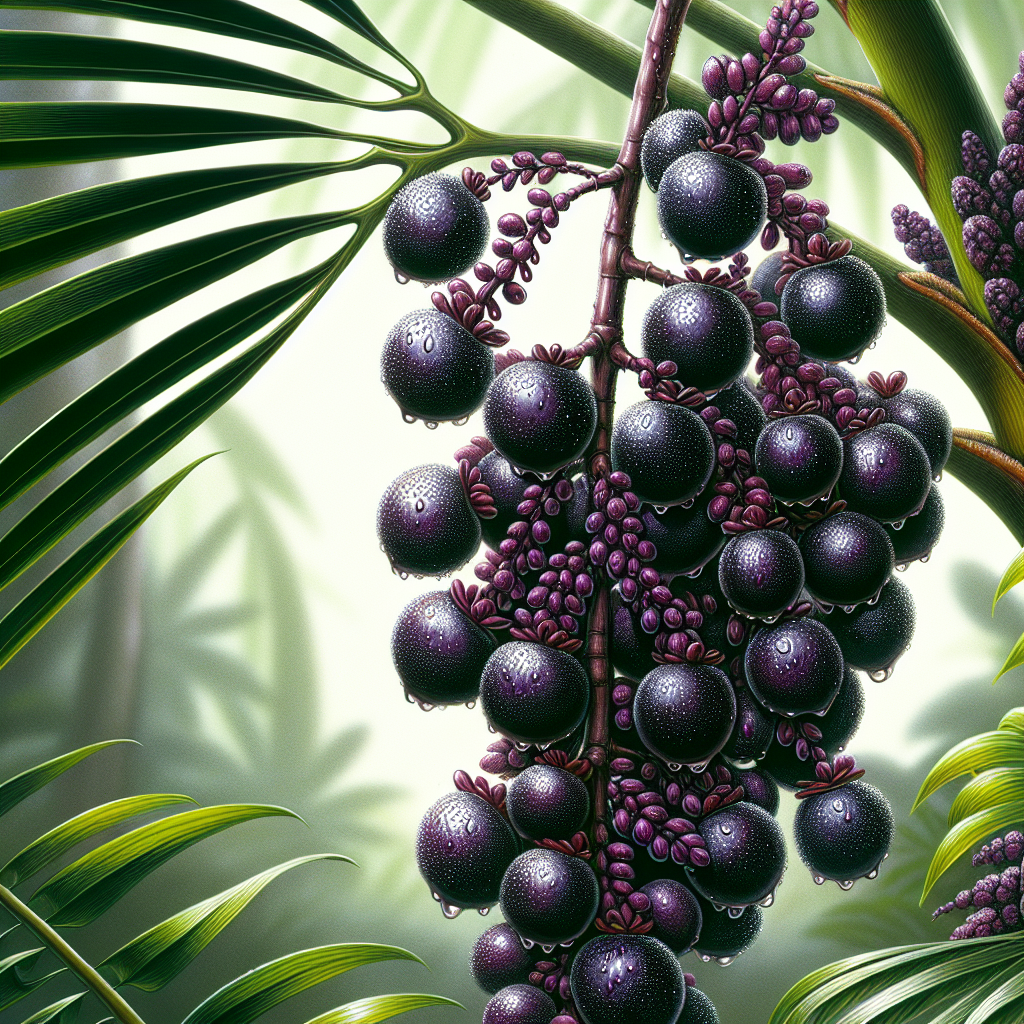
Introduction to Acai (Euterpe oleracea)
Acai (Euterpe oleracea), often called the 'Amazon superfood,' is a multi-stemmed palm that thrives in flooded floodplains of the Amazon basin. Native to South America, particularly Brazil, Venezuela, and Peru, this crop has exploded in global popularity due to its berries' exceptional nutritional profile—packed with anthocyanins, healthy fats, fiber, and vitamins. Each mature palm can produce 20-40 kg of fruit annually after 4-5 years, making it a lucrative perennial for tropical agriculture.
Commercially, acai berries are harvested fresh, frozen, or processed into pulp for smoothies, supplements, and foods. Yields peak in clusters of 3-5 kg per stalk, with the dark purple drupes averaging 1 cm in diameter. Sustainable cultivation mimics natural wetland conditions, supporting biodiversity while generating income. For small-scale farmers, acai offers resilience in humid tropics, with low maintenance once established. This guide provides professional-grade techniques for propagation, care, and organic pest control to maximize your harvest. Why Companion Planting Feels Like Guesswork for Small Farms - And How AI Makes It Foolproof.
Botanical Profile of Acai (Euterpe oleracea)
Euterpe oleracea belongs to the Arecaceae family, characterized by its clustering growth habit with 4-8 slender stems per plant, each reaching 15-25 meters tall and 8-12 cm in diameter. The pinnate leaves form a crown of 12-20 fronds, up to 3 meters long, with a prominent central axis. Inflorescences emerge from the base, producing thousands of tiny flowers that develop into fruit clusters (panicles) weighing 3-8 kg.
The fruit is a small, round drupe with a thin exocarp (skin), juicy mesocarp (pulp, 10-15% of fruit weight), and hard endocarp encasing a single seed. Pulp yield is low (5-15%), necessitating mechanical processing. Acai palms are dioecious or monoecious, with male and female flowers on the same or separate plants—plant at least 1 male per 10 females for pollination. Root systems are fibrous and adventitious, adapted to waterlogged soils. Growth is slow initially but accelerates in humid, shaded conditions. Phenology includes vegetative growth year-round, flowering 2-3 times annually, and fruit maturation in 4-6 months. For detailed palm cultivation insights, see the Banana (crop) wiki.
Soil, pH, and Climate Requirements for Acai (Euterpe oleracea)
Acai demands fertile, acidic soils with pH 4.5-6.0, thriving in clay-loam or sandy-loam with high organic matter (5-10%). It excels in 'varzea' floodplains—seasonally inundated soils rich in silt from river deposits. Drainage is critical during dry periods to prevent stagnation; raised beds or terraces work in non-flooded sites. Test soil for aluminum toxicity (common in Amazon soils) and amend with lime if pH <4.5.
Optimal climate: 25-30°C daytime, 20-25°C nights, with 2,000-3,000 mm annual rainfall distributed evenly. Tolerates brief dry spells but requires irrigation in <1,500 mm zones. Humidity >80% prevents flower abortion; altitudes <500 m ASL. Frost-sensitive (dies below 0°C), so USDA zones 10b-12 only. Wind protection is essential for young plants. Mulch heavily with organic matter to retain moisture and suppress weeds. In marginal areas, interplant with nitrogen-fixers like Gliricidia (crop).
Step-by-Step Planting & Propagation
Propagation
Acai is primarily propagated by seeds, as cuttings rarely root. Collect ripe berries, depulp by maceration, wash seeds, and sow immediately (viability drops 50% in 1 week). Germination: 30-60 days at 30-35°C in shaded beds with 100% humidity. Scarify seeds in 10% H2SO4 for 10 min to boost rates to 70%. Seedlings ready for transplant at 20-30 cm (6-12 months).
Site Preparation
Clear land selectively to retain canopy shade (50-70% light interception). Dig pits 50x50x50 cm, 8-10 m apart (100-150 plants/ha), filled with topsoil + 10 kg compost + 200g superphosphate + 100g KCl. In flood-prone areas, plant on mounds 50 cm high.
Planting
Transplant in rainy season. Place seedling at original depth, tamp soil, and stake if windy. Irrigate immediately. Initial spacing: 5x5 m, thin to 8x8 m at year 5. Survival rate: 85-95% with proper care. For small farms, start with 0.5 ha nursery.
Care & Maintenance regimes for Acai (Euterpe oleracea)
Water Management: Maintain soil moisture at 60-80%; irrigate 20-30 L/plant weekly in dry seasons via drip systems. Flooding 20-30 cm deep for 3-6 months mimics natural habitat.
Fertilization: Year 1: 100g N, 50g P2O5, 150g K2O/plant split 4x. Mature: 1-2 kg NPK 10-20-20 + 5 kg manure annually. Foliar Mg/Zn if deficient (yellowing leaves).
Pruning: Remove dead fronds and old fruit stalks post-harvest. Thin clusters to 4-6 stems/plant at year 10 for airflow.
Weeding: Mulch 10 cm deep; manual control first 2 years.
Monitoring: Scout monthly for nutrient deficiencies (chlorosis = N/Mg lack).
Pests, Diseases & Organic Management
Pests: Aphids (pest) and Mealybugs (pest) on young shoots—blast with water or neem oil (2% weekly). Red palm weevil (pest) bores trunks; trap with pheromone lures and destroy infested stems. Leafhoppers controlled by Thrips (pest)-resistant varieties and insecticidal soap.
Diseases: Root rot (disease) from Phytophthora—improve drainage, apply Trichoderma biofungicide. Leaf spot diseases (disease) (Cercospora)—copper sprays + prune wet fronds. Avoid overhead irrigation. For more, check Why 90% of Small Farms Fail at Pest Management - And 8 Organic Fixes That Actually Work.
Organic IPM: Introduce predatory beetles, plant Marigold (crop) borders.
Harvesting, Curing & Optimal Storage
Harvest when 80% berries black-purple (July-Oct in Brazil). Cut entire panicle with pole-saw at 1.5-2 m height. Yield: 10-20 tons/ha at maturity. Process within 24h: depulp mechanically, pasteurize at 75°C/30s, freeze at -18°C. Pulp stores 12-24 months frozen; shelf-stable puree 6 months.
Post-harvest: Soak clusters 1h to loosen pulp, avoid bruising. Dry seeds for replanting.
Companion Planting for Acai (Euterpe oleracea)
Acai benefits from agroforestry: underplant with Clover (crop) or Pigeon pea (crop) for N-fixation and soil cover. Shade-loving Ginger (crop) or Turmeric (crop) in interrows boost biodiversity. Avoid legumes prone to nematodes. Yarrow (crop) repels aphids; Nasturtium (crop) traps pests. Multi-tier systems yield 2x revenue.