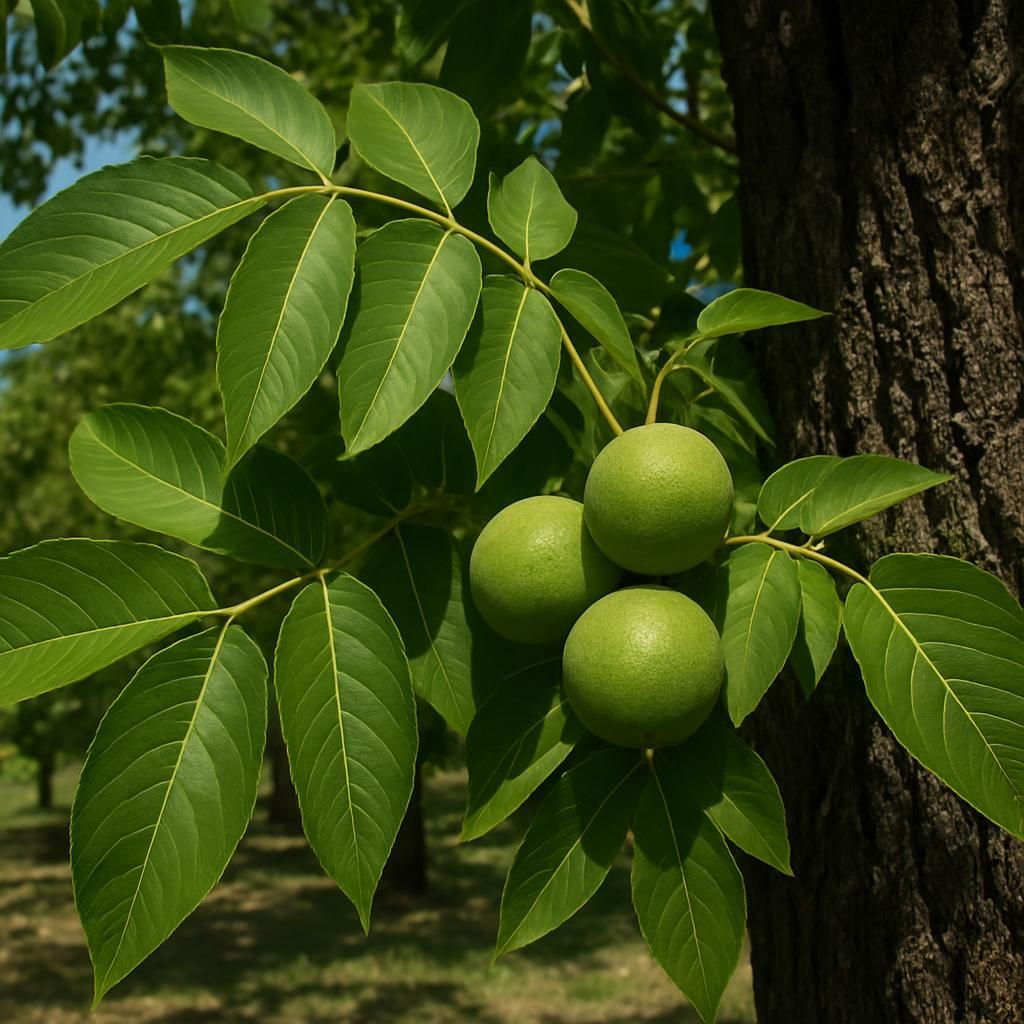
Introduction to Walnut (Black - Thomas)
Black walnut (Juglans nigra) is one of North America’s most valuable native nut trees. The ‘Thomas’ cultivar stands out for its exceptionally large nuts, thinner shells, and reliable bearing habit. Growers choose ‘Thomas’ for both commercial orchards and home landscapes because it combines strong timber value with consistent nut production. This definitive guide covers every stage from site selection through harvest and storage, giving professional growers and serious hobbyists the information needed for long-term success.
Botanical Profile of Walnut (Black - Thomas)
‘Thomas’ black walnut is a deciduous member of the Juglandaceae family. Trees reach 60–80 feet at maturity with a broad, spreading canopy. The compound leaves consist of 15–23 lanceolate leaflets that turn bright yellow in autumn. Male catkins appear in spring before the leaves, while female flowers develop into the characteristic round, thick-husked fruit. Inside the husk is a hard, dark shell containing the rich, flavorful kernel. The cultivar is self-fertile but benefits from a second compatible pollinizer such as English Walnut or another black walnut selection.
Soil, pH, and Climate Requirements for Walnut (Black - Thomas)
Black walnuts demand deep, fertile, well-drained soils. They perform best on loamy or sandy loam textures with good moisture-holding capacity yet excellent drainage. Avoid heavy clay or sites with a high water table. The species is hardy in USDA zones 4–9 and requires 140–160 frost-free days.
| Parameter | Ideal Range | Notes |
|---|---|---|
| Soil Texture | Loam to sandy loam | Avoid compacted or heavy clay |
| Soil Depth | ≥ 4 ft (1.2 m) | Allows deep taproot development |
| Soil pH | 6.0–7.2 | Slightly acidic to neutral |
| Organic Matter | 3–5 % | Improves moisture retention and fertility |
| Annual Rainfall | 30–50 in (760–1270 mm) | Supplemental irrigation in dry periods |
| Temperature Range | −25 °F to 95 °F (−32 °C to 35 °C) | Cold hardy; heat tolerant once established |
| Frost-Free Days | 140–160 | Required for nut maturation |
Step-by-Step Planting & Propagation
- Site Preparation: Clear competing vegetation and rip the soil to 18–24 inches. Incorporate aged compost and correct pH if needed.
- Planting Window: Plant bare-root trees in early spring while dormant or in late fall after leaf drop. Container-grown trees can be planted any time soil is workable.
- Spacing: Standard orchard spacing is 30–40 ft between trees and 30 ft between rows. High-density plantings use 20 ft × 20 ft with eventual thinning.
- Hole Dimensions: Dig holes twice as wide and as deep as the root ball. Position the graft union 2–3 inches above soil level.
- Backfill & Water: Replace soil, tamp gently, and water thoroughly. Apply 3–4 inches of organic mulch, keeping it 6 inches from the trunk.
- Staking: Stake young trees only if wind exposure is severe; remove stakes after the first season.
Care & Maintenance regimes for Walnut (Black - Thomas)
Consistent care during the first five years establishes a strong framework and accelerates nut production.
| Season | Watering Schedule | Fertilizer Application | Pruning Schedule |
|---|---|---|---|
| Spring | 1–2 in per week if rainfall is insufficient | 1 lb of 10-10-10 per year of tree age | Remove dead or crossing branches; train central leader |
| Summer | Deep soak every 10–14 days during drought | Side-dress with compost tea mid-June | Minimal; pinch vigorous suckers |
| Fall | Reduce watering as trees enter dormancy | Apply 2–3 in aged manure or compost | Light structural pruning after leaf drop |
| Winter | None required | None | Dormant pruning to shape scaffold branches |
Pests, Diseases & Organic Management
Common pests include Walnut husk fly, Codling moth, and Walnut aphid. Diseases of concern are Walnut blight caused by Xanthomonas arboricola pv. juglandis and Anthracnose. Implement integrated management:
- Monitor with pheromone traps for husk fly starting in July.
- Apply dormant oil plus copper in late winter to suppress overwintering pathogens.
- Encourage beneficial insects with flowering understory plants.
- Remove and destroy fallen husks promptly to break pest cycles.
- Use kaolin clay sprays during peak flight periods for organic suppression.
Harvesting, Curing & Optimal Storage
Nuts are mature when the husk begins to split and the kernel reaches 15–18 % moisture. Shake or hand-pick in September–October. Remove husks within 24 hours using a corn sheller or pressure washer. Cure nuts on screens in a shaded, well-ventilated area at 60–70 °F for 2–3 weeks until kernels rattle inside shells. Store cured nuts in mesh bags or sealed containers at 32–40 °F with 60–70 % relative humidity. Properly cured nuts maintain quality for 12–18 months.
Companion Planting for Walnut (Black - Thomas)
Black walnuts produce juglone, a natural allelochemical that inhibits many plants. Compatible companions include Clover, Garlic, and Onion which tolerate juglone. Avoid planting tomatoes, peppers, or apples within the root zone. Use deep-rooted cover crops such as Winter Rye in alleyways to improve soil structure without competing with the trees.