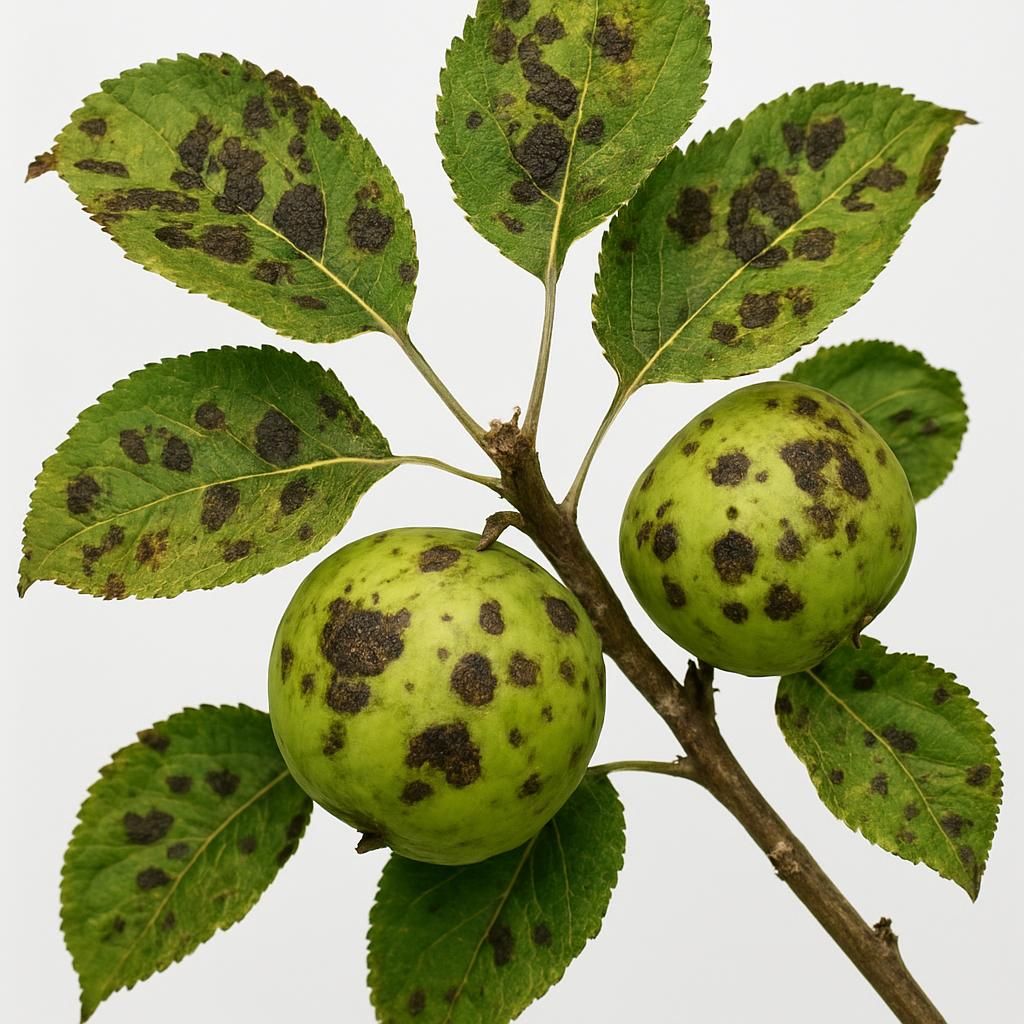
Introduction to Venturia inaequalis
Venturia inaequalis is an ascomycete fungus that causes apple scab, one of the most economically important diseases of apples globally. The pathogen also affects pears and certain ornamental species in the Rosaceae family. It produces characteristic olive-green to black lesions that reduce both the aesthetic and market value of fruit while weakening trees through repeated defoliation. Understanding its biology is essential for developing sustainable control programs that minimize chemical inputs while protecting yields.
Identifying Symptoms & Damage
Early infections appear as small, velvety olive-green spots on the upper surface of young leaves. These spots enlarge into circular lesions with distinct margins and may develop a fuzzy appearance from conidial production. On fruit, lesions start as small raised spots that become corky, cracked, and discolored, often leading to deformation and premature drop. Severe infections cause yellowing and premature leaf drop, reducing tree vigor and next season’s fruit bud formation. Twigs may also show scab lesions that serve as overwintering sites.
Lifecycle and Progression of Venturia inaequalis
The disease cycle begins with overwintering pseudothecia on fallen leaves. Ascospores are released in spring during wetting events and infect emerging tissues. Secondary infections are driven by conidia produced on primary lesions. The table below summarizes the key stages.
| Stage | Description | Timing | Key Conditions |
|---|---|---|---|
| Overwintering | Pseudothecia form on fallen leaves | Late autumn to early spring | Cool, moist leaf litter |
| Primary Infection | Ascospores ejected during rain | Bud break to petal fall | 6–24 °C with leaf wetness >9 h |
| Secondary Infection | Conidia spread by rain splash | Throughout growing season | Repeated wetting periods |
| Fruit Infection | Conidia infect developing fruit | Fruit set to harvest | Warm, humid weather |
| Leaf Drop & Survival | Infected leaves fall and harbor pseudothecia | Autumn | Mild, wet conditions |
Environmental Triggers & Risk Factors
Infection risk rises sharply when temperatures range between 15–20 °C combined with at least 9–18 hours of continuous leaf wetness. High relative humidity (>85 %) and frequent rainfall events prolong wetness duration. Orchards with poor air circulation, dense canopies, or low-lying areas experience prolonged leaf wetness and higher disease pressure. Susceptible cultivars such as Gala Apple and McIntosh Apple are especially vulnerable when grown in regions with frequent spring rains.
Organic Control & Treatment Plans
Organic management integrates cultural sanitation, resistant varieties, and approved biological or mineral-based products. Timely removal of leaf litter and pruning for better airflow are foundational practices. The table below outlines common organic treatments and application frequencies.
| Treatment Option | Active Ingredient / Product | Application Frequency | Notes |
|---|---|---|---|
| Sulfur | Micronized sulfur | Every 7–10 days during primary infection period | Avoid >30 °C to prevent phytotoxicity |
| Potassium bicarbonate | 1–2 % solution | Every 7–14 days | Good contact fungicide; reapply after heavy rain |
| Bacillus subtilis | Commercial biofungicide | Every 7–10 days | Preventive; tank-mix with sticker for better coverage |
| Neem oil | Cold-pressed neem | Every 10–14 days | Also suppresses some insect pests |
| Compost tea | Aerated compost extract | Every 14 days | Boosts microbial competition on leaf surface |
Preventing Venturia inaequalis in the Future
Long-term prevention centers on planting scab-resistant cultivars such as Liberty Apple or Redhaven Peach where appropriate, combined with rigorous sanitation. Remove and destroy fallen leaves in autumn to reduce overwintering inoculum. Prune trees to an open vase or central-leader structure that promotes rapid drying after rain. Implement a The Overlooked Art of Crop Rotation for Small Farm Resilience strategy by rotating cover crops that enhance soil biology and suppress leaf litter pathogens. Regular monitoring with a simple leaf-wetness recorder allows growers to time interventions precisely and avoid unnecessary sprays.
Crops Most Affected by Venturia inaequalis
While primarily known as a disease of apples, Venturia inaequalis also infects pears, crabapples, and certain hawthorns. Among commercial varieties, early-season apples like Gala Apple and Fuji Apple show high susceptibility. Late-season or resistant cultivars such as Granny Smith Apple and Braeburn Apple experience significantly lower infection rates when integrated management is followed. Pears can suffer similar scab symptoms, although the economic impact is generally lower than in apple production.